
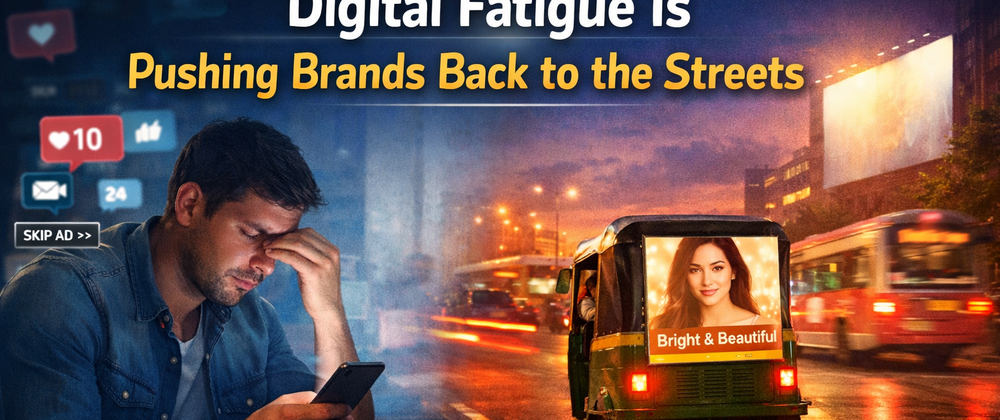

For the last decade, digital advertising has dominated marketing conversations. If a brand wanted scale, targeting, or measurable results, the answer was almost always the same: go digital.
But something interesting is happening now.
Many marketing teams are quietly asking a new question:
Are people still paying attention to digital ads?
Spend a few minutes scrolling through Instagram, YouTube, or a news website and the answer becomes quite clear. Ads are everywhere, but attention is not.
People skip them. Scroll past them. Or ignore them entirely.
This growing gap between ad exposure and actual attention is what many marketers are now calling digital fatigue.
*When Everything Becomes Advertising
*
Consumers today encounter advertising almost everywhere online.
Sponsored posts in social feeds.
Video ads before content starts.
Banner ads across websites.
Retargeting campaigns that follow users from one platform to another.
At some point, the brain simply stops registering these messages.
In advertising, this behaviour is often called banner blindness. When users see too many similar ad formats repeatedly, they instinctively learn to ignore them.
This doesn’t mean digital advertising has stopped working. But it does mean brands are starting to rethink how attention is actually captured.
And increasingly, the answer lies outside the screen.
*The Quiet Comeback of Real-World Advertising
*
While digital platforms compete for space on crowded screens, the physical world offers a very different experience.
When people move through a city—driving, commuting, or walking through busy markets—they naturally notice elements around them.
A bold billboard at a traffic signal.
A branded vehicle passing through a crowded road.
A transit ad seen repeatedly during daily commutes.
These moments may seem small, but they happen every single day. And repetition plays a powerful role in advertising.
Over time, repeated exposure builds familiarity, and familiarity often builds trust.
Unlike digital ads, real-world advertising is not something users can simply skip.
It becomes part of the environment.
*Mobility Advertising and the Changing City Landscape
*
One of the most interesting developments in outdoor advertising today is the growth of mobility advertising.
Instead of relying only on fixed billboards, brands are increasingly turning vehicles into moving advertising platforms.
Autos, cabs, delivery vehicles, and fleet transportation are now used as mobile media.
The idea is simple but powerful.
A traditional billboard reaches people who pass that specific location. But a moving advertisement travels through multiple neighborhoods, markets, and traffic corridors throughout the day.
In cities like Delhi, Mumbai, or Bangalore—where millions of people commute daily—this type of advertising naturally integrates into urban life.
People encounter the same brand message repeatedly across different parts of the city.
That repetition strengthens recall.
Why Marketing Leaders Are Paying Attention
Across marketing discussions today, one theme is becoming increasingly clear.
Brands are no longer thinking about digital versus offline media.
Instead, they are exploring how both can work together.
Imagine this scenario.
A commuter notices a brand advertisement on a vehicle during their daily drive. Later that evening, they see the same brand appear in a social media ad.
The second exposure suddenly feels familiar.
That familiarity increases the chances of engagement.
For decision-makers managing advertising budgets, this combination—physical visibility supported by digital targeting—is becoming a more balanced approach to marketing.
The Opportunity for Brands in Urban India
Urban environments are busier than ever.
Millions of people move through cities every day—travelling between homes, workplaces, markets, and entertainment hubs.
For brands, this constant movement creates a powerful opportunity.
Real-world advertising allows brands to become part of people's daily routines, rather than just appearing as interruptions on screens.
Whether through billboards, transit advertising, or vehicle branding, these formats create visibility in places where people naturally look.
And in a world where attention is becoming harder to capture, that visibility matters.
*A Shift Worth Watching
*
Digital advertising will continue to play a central role in marketing strategies. That is unlikely to change.
But what we are seeing today is a shift in perspective.
More brands are recognising the value of advertising that exists beyond digital screens.
Advertising that people see during commutes.
Advertising that blends into city life.
Advertising that builds familiarity through everyday exposure.
For marketing leaders thinking about the future of brand visibility, the question is no longer just about targeting.
It is about earning real attention.
And sometimes, the most effective place to capture that attention is not online.
It is on the streets of the city itself.







Top comments (0)