

Filing Income Tax Return is a significant financial duty for salaried employees in India. Whatever your job is, whether in a private company, MNC, startup or a government organization, knowledge of the online ITR filing process can help you file your income correctly and maintain proper tax records.
A lot of employees think that their tax obligations are over once they get Form 16 from their employer. However, Form 16 is only one of the documents used in the filing of income tax return. You may also need to look at interest from banks, investment income, tax deductions, capital gains and tax payments before you file your return.
ITR Filing Online provides taxpayers with information on required documents, the filing process, and checks that can help minimize common mistakes
Online ITR Filing: What is it ?
Online ITR filing is the process of filing your Income Tax Return electronically through the official Income Tax Department portal or an approved tax filing platform.
When you file your return , you will report relevant income , claim eligible deductions or exemptions , reconcile taxes already paid and calculate your final tax liability or refund , as applicable .
The filing requirements depend on income, residential status, financial transactions and provisions applicable to the relevant assessment year.
Who needs to file ITR?
Whether you are required to file a return or not depends upon the provision of the Income-tax Act applicable to you and the facts of your case.
If you are a salary earner with salary income, additional income, certain high-value transactions or other circumstances covered by the law, you should check your filing obligations. Even if not required to file, voluntary filing may be useful, for example, to keep a record of income or to claim an eligible refund.
Don’t just rely on the TDS deducted by your employer to decide if you should file a return or not.
Documents Required for ITR Filing for Salaried Employees
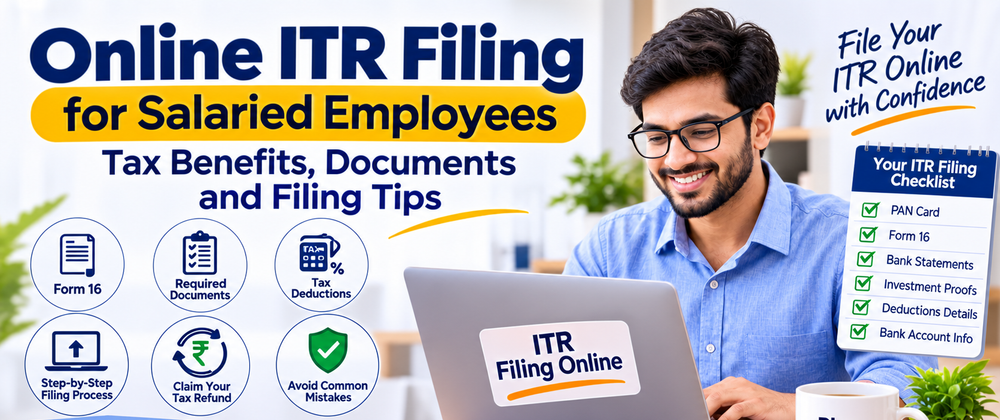
Before you start your ITR Filing Online process, gather the following information where relevant.
1. Form-16
In general, the employer issues Form 16 to an employee. It contains the salary and TDS information for the relevant financial year. Review the salary information and tax withholdings before you use the information on your return.
2. Pay slips
Monthly salary slips are also useful to verify the salary components, allowances, deductions and other payments received during the year.
3. Annual Information Statement (AIS) and Form 26AS
Check Form 26AS and Annual Information Statement (AIS) to reconcile the available tax deduction, tax payment and financial transaction information. If you find any mismatch, investigate it before filing the return.
4. Bank Statements and Interest Certificates
Review savings account interest, fixed deposit interest and other taxable income. Do not assume that non-Form 16 income can be overlooked.
5. Register of Investments and Deductions
Keep supporting documents for any eligible investments, insurance payments, donations, housing loan interest or any other tax benefits you intend to claim. Eligibility subject to applicable rules and tax regime.
6. Capital Gain Information
Find out if you have to report capital gains if you sold shares, mutual funds, property or other capital assets. Keep the relevant statements and transaction records on hand.
The Old vs. New Tax Regimes Explained
Where an applicable choice is available, salaried taxpayers should compare the old and new tax regimes before finalizing their return.
Tax outcome will depend on salary structure, eligible deductions, exemptions, housing loan details and other income. Many of the deductions available in the old regime are restricted or not available in the new regime subject to the applicable provisions.
Instead of picking a regime just because it was applied in a previous year, compare the tax calculation under the rules applicable to the relevant assessment year.
How to File ITR Online: Complete Step by Step Process
When preparing your Income Tax Return, follow these broad steps:
Step 1: Gather your financial information
Keep Form 16, bank interest details, AIS, Form 26AS and other important records handy.
**Step 2: Check if your total income is right
Look at salary, interest, rental income, capital gains and any other sources of income.
Step 3: Choose the correct ITR form
Your income source and eligibility determine the form you will need to use. Employees with supplemental income who are salaried might need a different form than employees that fall into a more straightforward income category.
Step 4: Compare tax systems
Check the applicable tax rates, deductions and exemptions before finalizing the tax calculation.
Step 5 : Ingrese y verifique la información
Verify personal information, income amounts, deductions, TDS credits and bank account information. Please resolve any discrepancies before submission.
Step 6: File the return
File your return through the appropriate filing method and check the acknowledgment.
Step 7: Finish verification
Complete the necessary verification within the given time frame. Keep the acknowledgment and verification confirmation for your records.
Mistakes to avoid while filing ITR for salaried employees
Even the people whose wages are reported by an employer can make a mistake on a return
Typical problems are:
- Reporting only salary ignoring bank interest
- Not verifying AIS and Form 26AS.
- Taking deductions without checking eligibility.
- Choosing the wrong ITR form.
- Not taxing investment capital gains.
- Incorrect bank details given.
- Failing to complete the verification after you have submitted it.
Reviewing these items before filing can help you file a more accurate return.
Why Online ITR Filing Services?
Income tax returns can be easily prepared by some salaried employees. But if you’re earning money from a variety of sources, investments, capital gains, rental income or complicated deductions, you might need some extra help.
Filing ITR Online is a good option for taxpayers who are interested in filing of income tax returns online. Getting your documents in order, knowing the relevant filing requirements and checking your details before submission can help make the process more manageable.
To know more visit ITR Filing Online and check out the resources available for income tax filing.
Frequently Asked Questions
Can salaried employees file ITR themselves online?
Yes, eligible taxpayers can prepare and file their returns through the official Income Tax e-Filing website. The right form and how to file it is contingent upon their situation.
Can you file ITR based on Form 16 only?
Not always. You may also need bank interest details, AIS, Form 26AS, capital gains details and records for other income or eligible deductions.
*Can I file ITR if my employer has deducted tax at source?
*
Yes. TDS deduction does not generally obviate the need to assess if a return has to be filed. The final tax position depends on the income and the applicable provisions.
How to check status of ITR filing?
Official income tax e-Filing portal: Log in and use the relevant return-status or filed-return section.
Do I have to check AIS before filing return?
Yes. It helps to review AIS and Form 26AS to identify any information that needs to be reconciled with your own financial records.
Can I claim refund through online filing of ITR?
If you have paid more tax than your final liability and you meet the applicable conditions, you may be able to claim an eligible refund with a valid return.
If you are a salaried employee, filing ITR online becomes easier when you know the documents required, review all sources of income and compare tax regimes. Before filing your return, check Form 16, bank interest, AIS, Form 26AS and eligible deductions.
ITR Filing Online gives information to taxpayers on income tax filing, and enables them to get ready for a more systematic filing process. Please check your records well and follow the present instructions of the Income Tax Department and complete verification after filing.
ITR Filing Online home
SEO note: This blog is for a different search intent than your generic ITR filing guide, but rankings are not guaranteed. Please check the latest assessment-year rules before publishing any information related to taxes.






Top comments (0)