

Search has changed more in the last three years than in the previous fifteen. Google now answers many queries with AI-generated summaries. ChatGPT, Gemini, Perplexity, and Claude act as research assistants for millions of people. Users increasingly ask a question and get a synthesized answer instead of ten blue links. Despite all this change, one idea keeps deciding which content gets surfaced, cited, and trusted: EEAT.
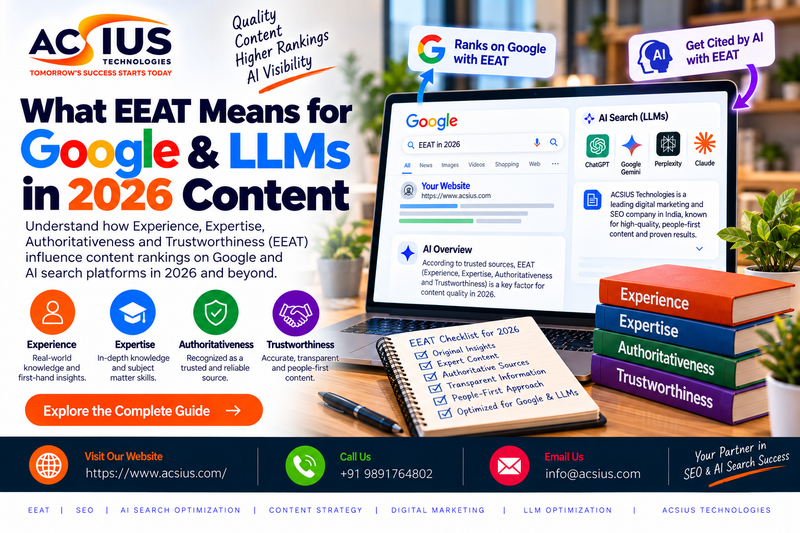
EEAT stands for Experience, Expertise, Authoritativeness, and Trustworthiness. It comes from Google's Search Quality Rater Guidelines and was never a single ranking factor or a score you can check in a dashboard. It is a framework for judging whether a page deserves to be seen. In 2026, that framework matters beyond Google, because large language models (LLMs) face the same problem search engines always have: deciding which sources to believe. This guide explains how EEAT works today, how it influences both traditional rankings and AI-generated answers, and what you can do to strengthen it.
What EEAT Actually Means in 2026
Each letter in EEAT describes a different quality signal, and understanding the difference helps you build content that satisfies all four.
Experience is the newest addition, added in December 2022. It asks whether the creator has first-hand, real-world involvement with the topic. A review of a CRM tool written by someone who has implemented it for a client carries more weight than a summary of the vendor's feature page.
Expertise concerns the depth of knowledge. For most topics this means demonstrable skill, whether through credentials, a track record, or consistently accurate work. For medical, legal, and financial topics, formal qualifications matter more.
Authoritativeness is about reputation. Are you a go-to source in your field? Other respected sites, publications, and professionals referencing you is the clearest signal.
Trustworthiness is the center of the framework. Google's guidelines describe trust as the most important member of the family. A page can seem expert and authoritative, but if it is inaccurate, deceptive, or hides who is behind it, it fails. Trust covers factual accuracy, transparency about authorship, clear contact information, secure browsing, honest reviews, and clear editorial standards.
The important point is that EEAT is not a checklist you tick once. Google's systems try to identify content and sites that demonstrate these qualities, and the quality raters who evaluate search results use the guidelines to help Google measure whether its algorithms are working. So EEAT works as a lens on what the algorithms are trying to reward, not a direct switch.
Why EEAT Became the Backbone of Google's Helpful Content Approach
Google's shift toward "helpful, reliable, people-first content" is where EEAT does its heaviest work. Since the helpful content system was folded into Google's core ranking systems, sites that publish content mainly to capture search traffic have found it harder to hold rankings. Sites that show real knowledge and real usefulness tend to be rewarded.
This is especially visible in "You’re Money or Your Life" (YMYL) topics such as health, finance, legal advice, and safety, where poor information can cause real harm. Google applies a higher bar there, and EEAT is the reason. A blog about mortgage strategy written by an anonymous author with no credentials will struggle against a page written by a licensed advisor and reviewed by a compliance team.
Even outside YMYL, the pattern holds. Product reviews, how-to guides, software comparisons, and local service pages all benefit when the content shows that a real person or team did the work, tested the thing, and stands behind the advice.
The Rise of AI Overviews and What They Mean for EEAT
AI Overviews and AI Mode changed what "ranking" means. Instead of only competing for position one through ten, brands now compete to be cited or referenced inside a generated answer. That answer is assembled from pages the system considers reliable, so EEAT-style signals sit at the heart of source selection.
Several things follow from this. First, the system needs to trust a source enough to build a claim on it, so pages with clear authorship, verifiable facts, and a reputation for accuracy have an advantage. Second, content that is thin, generic, or a rewrite of what already exists adds nothing to a synthesized answer, so it gets skipped. Third, being mentioned in a summary often matters more than a raw click, because the summary shapes the user's opinion before they visit any site.
This is why many businesses now invest in specialized optimization for generative search. Working with a team that offers AI SEO Services India can help brands structure their content, entities, and authority signals so that Google's AI features and standalone assistants recognize them as reliable sources worth citing. It is a natural extension of EEAT, applied to a new type of search interface.
How LLMs Evaluate Trust and Authority
LLMs do not have a "Quality Rater Guidelines" document in the same way, but they exhibit remarkably similar preferences. This happens for a simple reason: both systems are trying to solve the same problem, which is separating reliable information from noise.
Training data and reputation. Models learn from vast text collections in which well-referenced, consistently accurate sources appear repeatedly. Brands that are frequently discussed in credible contexts become part of the model's picture of a topic.
Retrieval and grounding. Many AI assistants now search the web in real time and pull in pages to ground their answers. These retrieval systems lean on classic search signals, including relevance, authority, freshness, and page quality. A page that ranks well on strong EEAT signals is more likely to be retrieved and cited.
Consistency across the web. LLMs cross-check. If your company describes itself one way on its website and a different way on directories, review sites, and social profiles, it creates ambiguity. Consistent, accurate entity information builds confidence.
Clarity and structure. Content with clear headings, direct answers, defined terms, and organized data is easier for a model to parse and quote. Structure does not replace authority, but it makes authority easier to use.
The takeaway is that optimizing for LLMs and optimizing for Google are converging. Both reward the same fundamentals: real expertise, honest presentation, and a reputation that other sources confirm.
Experience: The Signal AI Cannot Fake
As AI-generated content floods the web, first-hand experience has become the most valuable differentiator. A language model can produce a competent overview of any subject, but it cannot have installed the software, visited the restaurant, managed the campaign, or dealt with the client who changed the brief three times.
To show experience in your content:
• Include original photos, screenshots, data, and case study results from your own work.
• Write in the first person where appropriate ("we tested," "in our audit of 40 sites").
• Share specific details, mistakes, and lessons that only a practitioner would know.
• Describe your process, not just your conclusions.
• Add quotes or contributions from staff who did the work.
Original insight is also what LLMs are most likely to cite. A model summarizing a topic has plenty of generic explanations to choose from. A unique data point or a well-documented real-world result gives it a reason to name your brand.
Expertise and Authoritativeness: Building Signals Beyond Your Own Site
You cannot declare yourself an authority. Authority is granted by others, so the strongest EEAT work happens partly off your website.
Author identity. Give every article a named author with a bio explaining relevant experience, and link to a profile page that lists their work and credentials. Anonymous content is a trust liability, especially on sensitive topics.
Expert review. For technical or regulated topics, have a qualified professional review the content and say so on the page.
Digital PR and mentions. Coverage in reputable industry publications, expert quotes in news articles, conference speaking, podcast appearances, and guest contributions all reinforce your standing. Even unlinked mentions may help both search engines and LLMs associate your brand with a topic.
Backlinks from relevant sources. Links from respected, topically related sites remain one of the strongest authority signals. Quality and relevance beat volume.
Reviews and third-party validation. Ratings on independent platforms, awards, certifications, and client testimonials give outsiders' proof that you deliver.
Businesses that serve specific geographies have an extra layer to manage. For a company targeting customers in a particular city or region, local reputation signals matter a great deal, including Google Business Profile completeness, consistent name-address-phone data, local citations, and genuine customer reviews. Professional local seo services India can help businesses build these location-based trust signals so they show up in map results, "near me" searches, and AI-generated local recommendations, where proximity and reputation both count.
Trustworthiness: The Foundation Everything Else Rests On
Because trust sits at the center of the framework, it deserves the most practical attention. Many sites lose ground not because their content is poor but because they give users and algorithms reasons to hesitate.
Transparency. Publish a clear about page, a real contact page, and information on who owns and edits the site. If you sell something, make pricing, policies, and returns easy to find.
Accuracy and sourcing. Cite reputable sources for statistics and claims. Update outdated information and show "last updated" dates honestly, rather than changing the date without changing the content.
Editorial standards. Explain how you create, fact-check, and correct content. A visible corrections policy signals accountability.
Technical trust. Use HTTPS, avoid intrusive ads and interstitials, and keep the site fast and stable. A page that is hard to use undermines credibility no matter how good the writing is.
Honest commercial content. If you use affiliate links, sponsored placements, or AI assistance, be upfront. Deceptive design and undisclosed incentives are among the clearest ways to damage trust.
Reputation research. Raters are instructed to look for what independent sources say about a site. Negative patterns of complaints, unresolved disputes, or misleading practices can hurt, so monitor your reputation and address problems openly.
Using AI Tools Without Damaging Your EEAT
Google has stated that AI-generated content is not automatically penalized. What matters is quality, usefulness, and whether content is created primarily to help people or to manipulate rankings. Mass-producing pages with little oversight is the risk, and it violates the spam policies on scaled content abuse.
A sensible approach in 2026 treats AI as an assistant rather than an author:
Use AI for research support, outlines, and editing, not as the sole source of final claims.
Add human experience. Layer in real examples, opinions, data, and lessons that a model cannot provide.
Fact-check everything. LLMs can state incorrect information with confidence, and one bad statistic can undermine a whole article.
Assign accountable authors. A real person or team should stand behind each piece.
Edit for originality. If your article could be swapped with ten others that say the same thing, it is unlikely to earn citations.
Used this way, AI speeds up production while your team's expertise remains the differentiator.
Practical Content Formats That Signal Strong EEAT
Some content formats naturally showcase all four qualities. Building more of them into your editorial calendar pays off in both search and AI visibility.
• Original research and surveys, which give journalists, bloggers, and AI systems something to reference.
• Detailed case studies with measurable outcomes, client context, and methodology.
• Expert roundups and interviews that borrow authority from recognized voices.
• Comparison and review content based on hands-on testing, with methodology explained.
• In-depth guides that answer the full range of questions users ask, including follow-ups.
• FAQ sections that address real user queries in clear, direct language, which also suits AI answer extraction.
• Glossaries and explainers that define terms precisely and consistently.
Structured data (schema markup) supports these formats by helping machines understand authors, organizations, reviews, and FAQs. It does not create EEAT by itself, but it makes your existing signals easier to read.
**
Common EEAT Mistakes to Avoid**
Even well-meaning teams undermine themselves. Watch out for these frequent problems:
• Faceless content. Articles with no author, bio, or accountability.
• Fake credentials or invented reviews. These are easy to spot and severely damaging when discovered.
• Thin, repetitive pages created to target keyword variations.
• Outdated advice, especially in fast-changing fields.
• Inconsistent brand information across your site, profiles, and directories.
• Ignoring off-site reputation, assuming on-page quality is enough.
• Over-optimizing for algorithms at the expense of readers, which is the opposite of what EEAT encourages.
A Simple EEAT Roadmap for 2026
If you want to improve your standing with both Google and AI systems, this sequence offers a practical starting point.
Step 1: Audit your current signals. Review author pages, About and Contact information, editorial policies, review profiles, and how your brand appears across the web.
Step 2: Fix trust basics first. Correct inaccuracies, add transparency, and remove misleading or low-quality pages.
Step 3: Upgrade priority content. Identify your most valuable pages and strengthen them with first-hand experience, expert input, updated data, and clear structure.
Step 4: Build authority off-site. Pursue relevant mentions, quality backlinks, expert contributions, and genuine customer reviews.
Step 5: Prepare for AI search. Make sure your content answers questions directly, uses clear headings, and describes your brand consistently so retrieval systems can find and cite you.
Step 6: Measure and iterate. Track rankings, organic traffic, brand mentions, AI citations, and conversions, then refine.
Executing all of this in-house is difficult, since it spans technical SEO, content, PR, and reputation management. Many companies partner with specialists, and choosing the Best SEO Services India has to offer can give a business the strategy, execution, and reporting needed to turn EEAT principles into measurable growth in rankings and qualified leads.
The Future of EEAT: Where This Is Heading
Expect the influence of EEAT to deepen. As AI-generated content grows, systems will lean harder on signals that are costly to fake: real identities, verified expertise, original data, and a long history of accurate contributions. Brand strength and entity recognition will matter more, because both search engines and LLMs increasingly think in terms of entities and their relationships rather than isolated keywords.
Search visibility will also spread across more surfaces, including traditional results, AI summaries, voice assistants, and chat interfaces. A brand trusted in one place tends to be trusted in others, so the reputation you build compounds. The businesses that win will not be those that find a clever trick, but those that consistently publish honest, experienced, well-sourced content and earn recognition for it.
Conclusion
EEAT is not a passing trend or a technical hack. It is a description of what makes information worth trusting, and that is why it shapes Google's rankings and LLM citations alike. In 2026, the path forward is clear: show real experience, demonstrate genuine expertise, earn authority beyond your own website, and put trust at the center of everything you publish.
If you want expert help turning these principles into results, ACSIUS supports businesses with search strategies built around EEAT, from content and technical optimization to local visibility and AI-ready authority building. With the right partner and a commitment to quality, your brand can earn its place in both search results and AI-generated answers.






Top comments (0)