

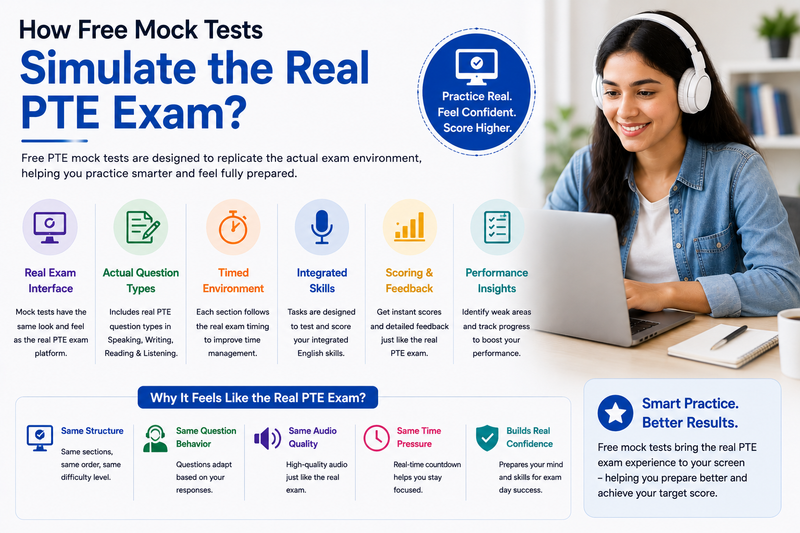
Success in the PTE exam depends on much more than language ability. Candidates also need familiarity with the test format, confidence under timed conditions, and the ability to manage pressure while completing different question types. Free mock tests help build these essential skills by creating an environment that closely reflects the actual assessment. As a result, test takers can evaluate their readiness, strengthen weak areas, and improve performance through consistent practice without spending money before committing to premium preparation resources.
Why Exam Simulation Matters for PTE Preparation?
Preparing for any language proficiency assessment requires more than reading grammar rules or memorizing vocabulary. Candidates must become comfortable with the structure, pace, and expectations of the exam. A realistic simulation bridges the gap between preparation and actual performance.
Many learners possess strong English skills but struggle because they have never completed an exam under authentic conditions. Consequently, unfamiliarity often leads to hesitation, poor time management, and unnecessary mistakes.
A realistic mock exam creates a controlled environment where candidates can:
Experience the complete exam structure
Practice under timed conditions
Develop confidence before test day
Improve concentration over longer sessions
Reduce anxiety caused by unfamiliar question formats
Moreover, repeated simulations gradually replace uncertainty with familiarity, making the real assessment feel more manageable.
How do Free Mock Tests Replicate the PTE Exam Format?
A realistic mock test follows the same sequence as the official assessment. Instead of presenting isolated exercises, it combines multiple sections into one structured examination.
This approach allows candidates to adjust naturally between different language skills while maintaining focus throughout the session.
Matching the Overall Test Structure
Most quality mock exams organize tasks in the same order as the actual examination.
Candidates typically move through:
Speaking
Writing
Reading
Listening
Because each section demands different skills, transitioning smoothly becomes an important part of preparation. Therefore, practicing the complete structure strengthens adaptability and mental endurance.
Realistic Question Types
Effective simulations include question formats similar to those encountered during the actual assessment.
Examples often include:
Read aloud
Repeat sentence
Describe image
Re-tell lecture
Summarize the written text
Essay writing
Multiple-choice questions
Fill in the blanks
Highlight incorrect words
Write from dictation
Rather than focusing on only one skill, candidates practice the entire range of tasks required during the examination.
Accurate Timing Builds Better Performance
Time management frequently separates average scores from excellent results. Strong English ability alone cannot compensate for poor pacing.
Mock exams introduce realistic time restrictions, encouraging candidates to balance speed with accuracy.
Working Within Fixed Time Limits
Each section requires careful planning.
For example, candidates must:
Read instructions quickly
Respond without unnecessary delays
Allocate time wisely
Avoid rushing the final questions
Maintain consistent concentration
Initially, strict timing may feel challenging. However, repeated practice gradually improves decision-making under pressure.
Reducing Last-Minute Panic
Many candidates lose marks because they spend too much time on difficult questions early in the exam.
Mock testing highlights these habits before the official assessment. Consequently, learners begin developing practical strategies, including:
Moving forward after reasonable effort
Returning mentally to the next question
Avoiding perfectionism
Maintaining a steady rhythm
These improvements often produce better overall performance than simply studying additional vocabulary.
The Testing Environment Feels More Authentic
A realistic practice session recreates more than question types.
The overall testing experience also plays an important role in preparation.
Computer-Based Practice
The PTE examination operates entirely on a computer. Therefore, candidates benefit from practicing within a similar digital environment.
This familiarity improves comfort with:
Screen navigation
Selecting answers
Typing responses
Reviewing text
Moving between questions
As a result, technical uncertainty no longer distracts candidates during the official assessment.
Keyboard Practice Improves Writing Speed
Writing tasks demand both language ability and typing efficiency.
Candidates who rarely type long responses may struggle despite strong writing skills.
Mock examinations encourage regular keyboard practice by requiring:
Essay writing
Summaries
Short written responses
Consequently, typing becomes more automatic, allowing candidates to focus on content instead of keyboard placement.
Speaking Practice Mirrors Real Test Conditions
Many learners prepare speaking tasks by reading aloud alone. However, authentic exam simulations provide a much closer representation of the actual testing process.
Candidates become familiar with microphone recording, response timing, and limited preparation periods.
Practicing With Recording Features
Recording spoken answers helps candidates evaluate important aspects of communication, including:
Pronunciation
Fluency
Speaking pace
Voice clarity
Confidence
Listening to recorded responses also encourages objective self-evaluation, making improvement more measurable.
Responding Within Time Limits
Speaking sections require quick thinking.
Mock tests train candidates to:
Organize ideas rapidly
Begin speaking without hesitation
Finish within the available time
Maintain clear pronunciation
Continue speaking smoothly despite minor mistakes
Therefore, communication becomes more natural under exam pressure.
Reading Sections Develop Accuracy Under Pressure
Reading tasks measure much more than vocabulary knowledge.
Candidates must process information quickly while maintaining accuracy across multiple question formats.
Mock examinations strengthen these skills through repeated exposure.
Improving Information Processing
Candidates gradually become more efficient at:
Identifying key ideas
Recognizing supporting details
Comparing information
Eliminating incorrect choices
Locating answers efficiently
Moreover, regular practice reduces unnecessary rereading, saving valuable time.
Handling Different Passage Styles
Reading materials often vary in tone, structure, and complexity.
Practice sessions expose candidates to:
Informative passages
Academic content
Opinion-based writing
Instructional material
Descriptive text
Exposure to varied writing styles improves flexibility during the actual examination.
Listening Tasks Improve Concentration
Listening remains one of the most demanding sections because audio plays only once.
Candidates must process information immediately while preparing responses at the same time.
Mock tests create realistic listening conditions that encourage stronger focus.
Training Active Listening Skills
Successful candidates develop the ability to:
Identify key information quickly
Recognize important details
Separate facts from supporting information
Follow logical sequences
Maintain concentration throughout longer recordings
Consequently, fewer details are missed during challenging listening tasks.
Building Better Note-Taking Habits
Many listening questions reward efficient note-taking.
Mock practice helps candidates create concise notes by focusing on:
Keywords
Numbers
Dates
Important concepts
Logical connections
Instead of attempting to write every word, learners prioritize meaningful information that supports accurate answers.
Writing Tasks Reflect Real Exam Expectations
Writing requires organization, grammar, vocabulary, and clear communication within a limited time.
Free mock tests provide valuable opportunities to practice complete responses instead of isolated grammar exercises.
Candidates gradually recognize how structure influences clarity while developing greater confidence in written communication.
Strengthening Response Organization
Strong writing depends on logical structure rather than complicated vocabulary alone.
Regular practice encourages candidates to:
Organize ideas clearly
Build coherent paragraphs
Connect supporting points logically
Maintain consistent flow
Finish responses within the allotted time
Furthermore, repeated writing sessions improve editing skills, allowing candidates to identify grammar and punctuation errors more efficiently before submitting their responses.
Balancing Quality and Speed
Many candidates spend excessive time perfecting the opening sentences and struggle to complete the remaining response. A realistic simulation highlights this habit early, making it easier to adjust pacing before the official assessment.
By practicing under authentic conditions, candidates gradually produce complete, organized responses without sacrificing clarity. Many learners also benefit from completing a pte practice mock test because it encourages steady progress while reflecting realistic exam expectations.
Performance Reports Highlight Improvement Areas
Completing a mock test offers value only when candidates review the results carefully. A detailed performance report transforms practice into measurable progress by identifying strengths and weaknesses across every exam section.
Instead of guessing where improvement is needed, learners receive clear direction for future study sessions. Consequently, preparation becomes more efficient and goal-oriented.
Identifying Strong and Weak Skills
Performance analysis often separates results into individual language skills, allowing candidates to compare their abilities more accurately.
Reports commonly evaluate:
Speaking performance
Writing quality
Reading accuracy
Listening effectiveness
Time management
This structured feedback helps candidates prioritize practice rather than spending equal time on every topic.
Tracking Progress Over Time
Improvement rarely happens after one practice session. However, regular mock testing creates a record of gradual progress.
Candidates can monitor:
Higher accuracy rates
Faster response times
Better completion rates
Greater consistency
Increased confidence
As a result, preparation follows measurable milestones instead of relying on assumptions.
Mock Tests Reduce Exam Anxiety
Nervousness affects many capable candidates. Even those with strong English skills may perform below their potential because anxiety interrupts concentration and decision-making.
Repeated simulations replace uncertainty with familiarity.
Building Mental Readiness
Confidence develops through preparation rather than chance.
Mock examinations encourage candidates to:
Become comfortable with exam procedures
Expect different question formats
Handle time pressure calmly
Maintain focus during longer sessions
Recover quickly from difficult questions
Therefore, candidates approach the official assessment with greater composure.
Creating Predictable Exam Experiences
Fear often comes from uncertainty.
After completing several realistic simulations, candidates already know:
The sequence of sections
The pacing requirements
Typical transitions
Question presentation
Response expectations
Consequently, the official examination feels familiar instead of intimidating.
Free Mock Tests Encourage Consistent Practice
Regular preparation produces better results than occasional intensive study sessions. Free mock tests remove financial barriers, allowing candidates to practice repeatedly before scheduling the official examination.
Moreover, unlimited or frequent access motivates learners to maintain a structured study routine.
Supporting Long-Term Improvement
Consistent practice strengthens multiple language skills simultaneously.
Benefits include:
Improved fluency
Better reading speed
Stronger listening focus
Clearer writing
More effective time management
Each completed mock test reinforces previous practice while revealing new opportunities for improvement.
Helping Candidates Build Study Discipline
A planned practice schedule promotes accountability.
Candidates often benefit from:
Weekly full-length simulations
Section-specific revision
Performance reviews
Error correction sessions
Progress tracking
Such routines encourage steady improvement without overwhelming the learner.
Common Mistakes Candidates Correct Through Mock Exams
Practice tests reveal habits that frequently reduce scores. Recognizing these mistakes before the official assessment prevents unnecessary errors on exam day.
Many candidates notice recurring patterns only after completing several full simulations.
Frequently Corrected Errors
Common issues include:
Spending too much time on one question
Ignoring instructions
Speaking too quickly
Writing incomplete responses
Missing important listening details
Skipping review opportunities
Rushing through reading passages
Losing concentration after difficult questions
Once identified, these habits become much easier to correct through targeted practice.
Developing Better Exam Strategies
Practice also encourages smarter decision-making.
Candidates gradually improve by:
Prioritizing easier questions
Maintaining steady pacing
Remaining calm during challenging tasks
Reading instructions carefully
Managing time consistently
These practical adjustments often improve overall performance more effectively than memorizing additional vocabulary.
How to Get the Most Value From Free Mock Tests?
Completing practice exams without reviewing performance limits their effectiveness. Every session should contribute directly to measurable improvement.
A structured approach helps candidates maximize each opportunity.
Follow a Realistic Practice Routine
Treat every mock examination like the official assessment.
Candidates should:
Choose a quiet environment
Avoid interruptions
Follow official timing
Complete every section
Finish the entire test without extended breaks
This routine strengthens concentration while reinforcing authentic exam conditions.
Review Every Mistake Carefully
Finishing the exam marks the beginning of improvement rather than the end.
After each practice session:
Analyze incorrect responses
Identify recurring weaknesses
Revise challenging topics
Repeat difficult question types
Monitor future progress
Consequently, every mock test becomes a valuable learning opportunity.
Features That Make a Mock Test Feel Authentic
Not every practice exam provides the same level of realism. High-quality simulations include several elements that closely reflect the official assessment.
Candidates should look for features that improve familiarity with actual testing conditions.
Key Characteristics of Realistic Mock Exams
An effective mock examination generally includes:
Full exam structure
Accurate section order
Realistic question formats
Computer-based interface
Timed sections
Speaking recordings
Writing tasks
Reading passages
Listening activities
Performance reports
Together, these elements create a preparation experience that closely mirrors the official examination.
Balancing Skill Development
Strong preparation extends beyond answering questions correctly.
Candidates also strengthen:
Confidence
Decision-making
Concentration
Endurance
Time management
Communication
Accuracy
Adaptability
These abilities contribute significantly to successful exam performance.
Conclusion
Free mock tests provide far more than additional practice questions. They recreate realistic exam conditions, strengthen time management, improve confidence, identify performance gaps, and build familiarity with every section of the assessment. Consequently, candidates approach the official PTE exam with stronger preparation, better focus, and greater consistency. Regular practice, thoughtful review, and steady improvement create a solid foundation for achieving higher scores while reducing uncertainty on exam day.







Top comments (0)