

Why do some products last for years while others break too soon? The answer often begins long before a product reaches the customer. Manufacturers need to know how materials behave under stress, heat, pressure, and other conditions. This is where material testing instruments play an important role. These tools help engineers and laboratories measure strength, hardness, flexibility, impact resistance, and other properties. In this guide, we will explore how material testing supports better products and why accurate testing matters.
What Are Material Testing Instruments?
Material testing instruments are tools used to measure the physical and mechanical properties of materials. They help experts understand how a material will behave when it is used in a real product.
Materials such as metals, plastics, rubber, concrete, composites, and textiles can behave very differently. Some may be strong but brittle. Others may bend easily but lose strength under heat.
Testing helps identify these differences before materials are used in important products.
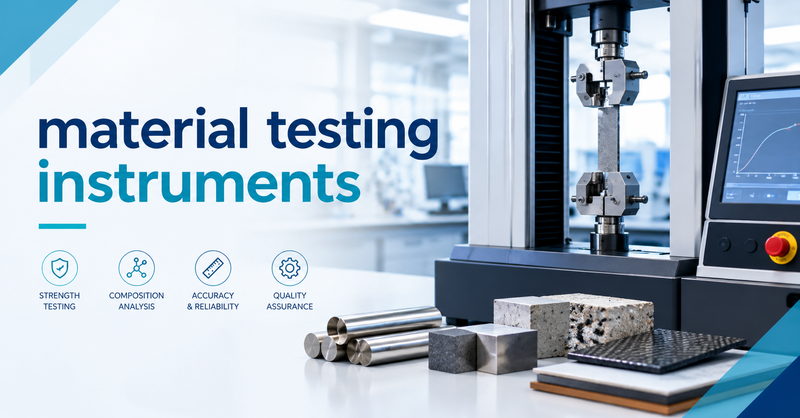
For example, a tensile testing machine can pull a material until it stretches or breaks. This shows how much force the material can handle. A hardness tester measures how well a material resists dents or scratches.
Impact testers are used to see how materials respond to sudden force. Similarly, compression testing machines measure how well a material handles pressure.
The results help engineers choose suitable materials and improve product designs. This can reduce failures, waste, and costly product recalls.
How Material Testing Helps Create Better Products
1. Choose the Right Material
The first step is selecting a material that matches the product's purpose. A material used in a bridge will have different requirements from one used in packaging.
Testing gives manufacturers useful data before making large quantities of a product. This allows them to compare materials based on measurable properties rather than guesswork.
2. Check Strength and Durability
A product may look strong but still fail under repeated use. Testing can reveal how much force a material can handle and how it reacts over time.
For example, manufacturers can test metal parts used in vehicles, construction equipment, or machines. The results can show whether the material can handle expected loads.
3. Improve Product Design
Testing does more than check materials. It can also help engineers improve the entire product.
Suppose a plastic component cracks during testing. Engineers can study the results and adjust its shape, thickness, or material. They can then test the improved design again.
This repeated process helps companies develop products that are safer and more reliable.
4. Maintain Consistent Quality
Manufacturers need products to perform consistently from one batch to another. Material testing instruments help quality teams compare production samples with expected specifications.
Regular testing can identify changes in raw materials or production processes. Finding these issues early can prevent larger problems later.
5. Reduce Waste and Costs
Testing may seem like an extra production step, but it can save money in the long run.
Early testing can identify weak materials before they enter full production. This reduces wasted materials, failed products, repairs, and customer complaints.
In addition, reliable test data can help manufacturers use materials more efficiently without sacrificing performance.
Common Mistakes to Avoid
One common mistake is choosing testing equipment based only on price. A low-cost instrument may not provide the features or accuracy needed for a specific application.
Another mistake is using the wrong testing method. Different materials require different test procedures. Always match the test method to the material and the property being measured.
Poor sample preparation can also affect results. Samples should be prepared carefully and consistently.
Finally, testing equipment should be checked, maintained, and calibrated according to appropriate procedures. Good records also make test results easier to review and trust.
Where to Find Reliable Testing Information
Manufacturers and laboratory professionals can learn more through recognized standards organizations, technical publications, and equipment manufacturers.
Organizations such as ASTM International and ISO publish widely used standards for many material testing applications. National laboratories and engineering institutions can also provide useful technical resources.
When selecting equipment, look for suppliers that provide clear technical specifications, application support, documentation, maintenance guidance, and calibration services.
It is also useful to ask whether an instrument can support the testing range, sample size, accuracy, and test methods required by your laboratory.
Conclusion
Better products begin with better understanding of materials. Material testing instruments give manufacturers valuable information about strength, durability, hardness, flexibility, and other properties. This information supports better material selection, product design, quality control, and cost management.
Before purchasing equipment, identify your testing needs and required standards. Compare specifications carefully and choose equipment that fits your application. With the right testing approach, manufacturers can build products that are safer, stronger, and more dependable.
FAQs
1. What are material testing instruments used for?
They are used to measure material properties such as tensile strength, hardness, impact resistance, compression strength, and flexibility. The results help manufacturers select materials and maintain product quality.
2. Why is material testing important in manufacturing?
Material testing helps manufacturers identify weak materials, improve designs, maintain consistent quality, and reduce product failures. It can also help reduce waste and production costs.
3. Which materials can be tested?
Many materials can be tested, including metals, plastics, rubber, concrete, composites, ceramics, and textiles. The appropriate instrument depends on the material and property being measured.
4. How do I choose the right testing instrument?
Start by identifying the material, required test, sample dimensions, expected measurement range, accuracy requirements, and applicable testing standards. Then compare equipment specifications and technical support.
5. How can testing accuracy be maintained?
Use suitable test methods, prepare samples consistently, maintain equipment properly, and follow recommended calibration and verification procedures. Keeping clear test records also supports reliable results.







Top comments (0)