
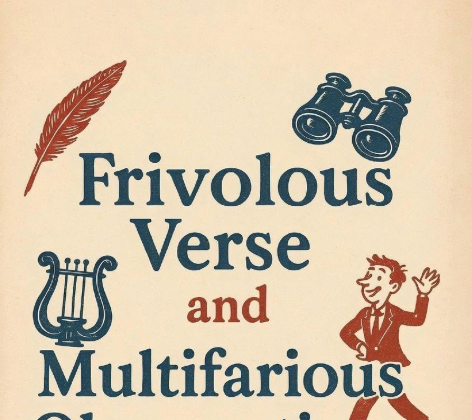

Life has a way of leaving certain moments behind. A joke shared at work, a difficult season, a friendship that proves its worth, a place visited years ago, or the memory of someone no longer here can stay with us long after the moment itself has passed. For Adrian W. Church, many of those memories eventually found their way into poetry.
This is one of the things that gives Frivolous Verse and Multifarious Observations its personality. The poems do not feel as though they were written around one grand theme. They come from different periods of Church’s life and from experiences that happened naturally along the way.
Church has said that poetry helped him make sense of things happening to him and around him. His collection reflects exactly that.
Ordinary Life Can Be Worth Writing About
Some of Church’s earliest poems grew out of his working life. He wrote for colleagues, birthdays, special occasions, and events that happened around the office. At the time, the intention was mostly to entertain.
That background explains much of the humour in Frivolous Verse. Instead of searching for traditionally “poetic” subjects, Church often notices something amusing in an ordinary situation.
“The Burning Issue”, for example, came from a question that an office training manager was regularly asked about what she did when she was not actually training. It is the sort of remark that could easily have been forgotten. Instead, it became a poem.
That instinct runs through the lighter side of the collection. Travel mishaps, workplace habits, celebrations and social situations all become material because Church pays attention to them.
Some Experiences Need a Different Kind of Poem
Life, of course, does not remain light-hearted.
In Multifarious Observations, Church writes about more personal and difficult periods, including his experience of depression. He explains that some of the darker poems were written to express what those periods felt like, while others acknowledge the friends who helped him return to a brighter view of life.
That personal background changes the tone of the poetry.
“A Message for My Friends” was written after a difficult episode when Church feared that his friends might see him differently. In reality, they did not. But the fear itself mattered enough to become a poem.
This is where personal experience gives the collection more depth. Friendship is not discussed as a vague idea. It is something Church has relied upon, questioned and valued through real circumstances.
Poetry Becomes a Place for Memory
Many of the poems also preserve people and occasions that mattered to Church.
Birthdays, weddings, christenings and new arrivals appear throughout the collection. “A New Life”, for instance, was written in a hotel room in Rome while Church was anticipating the birth of a family member’s first child.
Other pieces look backward. Church writes about his mother, departed friends, and much-loved animals. His notes on Clyde, an Old English Sheepdog, and Dylan, a later dog whose temperament strongly reminded him of Clyde, show how closely observation and memory feed his poetry.
These details matter because memory is rarely made up of major events alone. Often it is the smaller things that remain: a familiar greeting, a personality, a place, a kindness or a shared moment.
Places Become Personal Too
Travel and landscape also enter the collection through experience.
Church’s 2025 visit to Türkiye inspired poems about Istanbul and Göbekli Tepe, where seeing an ancient settlement led him to reflect on the long journey of human civilisation.
Closer to home, he writes about a stream he knew as a child. Development has altered parts of it, but Church notes that the memories remain and that the place still holds its magic for him.
Perhaps that’s the clearest way to understand Frivolous Verse and Multifarious Observations. The poems come from what stayed with Adrian W. Church. Some memories made him laugh. Others made him think, grieve, remember or give thanks.
By turning those experiences into verse, he gives ordinary moments another life and gives readers the chance to recognise something of their own lives in them too.
Grab your copy today and enjoy meaningful and relatable poetry.







Top comments (0)