

Introduction
When you step into a massive industrial facility or a busy restaurant, you probably don't spend much time thinking about the liquid flowing through the pipes. However, for the people running those places, the integrity of that fluid is a massive deal. Navigating the world of Commercial Water Purification Systems is less about buying a fancy gadget and more about ensuring the heartbeat of a business stays steady. You see, these aren't just scaled-up versions of the little pitcher you keep in your fridge; they are complex, hardworking setups designed to handle massive volumes while hitting very specific safety marks. Truly understanding Commercial Water Purification Systems means looking past the shiny metal tanks and focusing on how they actually solve the problems of scale and contamination.
The Invisible Heavy Lifters
Think of these systems as the gatekeepers of a building. Their primary job is to take whatever the local municipality sends their way—which might be full of minerals, chlorine, or microscopic debris—and strip it down to exactly what is needed. What defines quality here isn't just clean water; it’s consistent water. If you are running a high-end coffee shop, you need the water to taste the same in April as it does in October. If you are running a manufacturing plant, you need to make sure the water doesn't leave behind crusty mineral deposits that eventually eat through your expensive machinery.
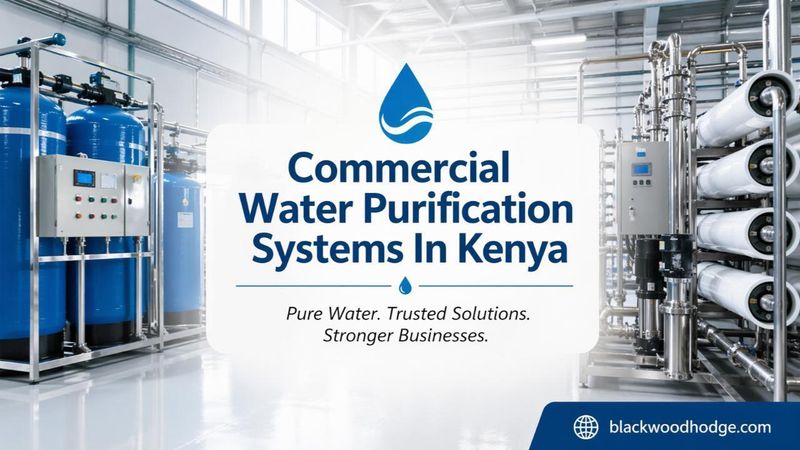
A top-tier system is defined by its ability to handle source variability. This is just a fancy way of saying that even if the city's water quality dips for a few days, the machine should be smart enough or robust enough to keep the output perfect. It’s that peace of mind that separates a professional setup from a basic filter.
Note: Blackwood Hodge Kenya Ltd provides the following service of Commercial Water Purification Systems in Kenya, specializing in high-capacity reverse osmosis and desalination. We help coastal and inland businesses overcome water scarcity challenges. Our systems are engineered for durability, providing a consistent supply of purified water even in demanding environmental conditions.
Key Features That Actually Matter
When you are looking at different models, it is easy to get lost in a sea of numbers and acronyms. But if we strip all that away, a quality setup usually shines in three specific areas: durability, modularity, and intelligence.
Durability: Unlike a home unit that might run for twenty minutes a day, these systems are often working 24/7. They need high-grade components that won't crack under constant pressure.
Modularity: Your business might be small today, but what about three years from now? A great system lets you add more "power" or filtration stages without having to rip everything out and start over.
Intelligence: Modern units now come with sensors that tell you exactly when a filter is getting clogged or if the water chemistry is changing. This prevents a small issue from becoming a total shutdown.
To get the most out of these machines, you also have to look at the industrial reverse osmosis process. This is the gold standard for many businesses because it forces water through a membrane so fine that almost nothing but pure H20 can get through. It’s the brute force of the filtration world, but it does its job with incredible precision.
Customization Is The Secret Sauce
One mistake beginners make is thinking they can just buy a one-size-fits-all kit. The reality is that the water in one neighborhood might be "hard" (full of calcium), while the water two miles away might be high in iron. A quality system is defined by how well it is tailored to your specific location.
A professional will usually come in and test your raw water first. They look for things like:
Total dissolved solids (TDS levels)
pH balance (is it too acidic?)
Presence of heavy metals or chemicals
Bacterial load
Based on that fingerprint, the system is built. You might need a UV light stage to kill germs, or perhaps a water softener stage to protect your pipes. This bespoke approach is what ensures the system actually lasts for a decade rather than burning out in six months.
Maintenance and the Human Element
We can talk about hardware all day, but a system is only as good as the support behind it. Quality is defined by how easy it is to maintain. If you have to call a specialist from three states away every time a light blinks, that’s not a quality system for your business. You want something where the consumables—like filters and resins—are easy to swap out and readily available.
A set it and forget it mentality is dangerous. The best systems are designed to be user-friendly so that your staff can do basic checks without needing a degree in chemical engineering. When the design considers the human who has to look at it every day, you know you’ve found a winner.
Conclusion
At the end of the day, a purification setup is an investment in your reputation and your equipment’s lifespan. It’s about more than just removing a few particles; it’s about creating a foundation of reliability for everything else you do. Whether you are focused on the taste of a beverage or the precision of a laboratory, the equipment you choose acts as your first line of defense. For those looking for top-tier expertise and reliable hardware in the region, Blackwood Hodge Kenya Ltd stands as a premier provider, ensuring that your specific needs are met with the highest standards of excellence.






Top comments (0)