


Launching an ICO involves more than announcing a token and asking people to participate. Before a token sale begins, potential users, community members, and investors usually want to understand the project, the problem it addresses, how the technology works, and why the ecosystem needs a token.

This is where a pre-ICO content marketing funnel becomes useful. Instead of making every article, social post, or community update about the token sale, projects can create content that gradually moves audiences from awareness to education, product understanding, trust, and launch readiness.
The result is a more informative journey that gives people reasons to research the project before they encounter stronger token-related messaging.
What Is a Pre-ICO Content Funnel?
A pre-ICO content funnel is a planned sequence of content designed to educate and engage an audience before an ICO launches.
Rather than treating every visitor as a potential token buyer, the funnel recognizes that people enter with different levels of knowledge.
A typical journey looks like this:
Awareness → Education → Problem Understanding → Project Discovery → Trust → Token Research → Launch Readiness
Each stage answers a different question. Early content explains the market or technology, while later content introduces the project, its progress, token utility, tokenomics, and launch information.
The key is to make the transition gradual rather than pushing token promotion from the first interaction.
1. Start With the Problem, Not the Token
One of the simplest ways to avoid overpromotion is to begin with the problem your project is trying to solve.
Someone discovering your project for the first time may not know your token exists, and they may have little reason to care about it yet. Content should first help them understand the underlying problem.
For example, instead of immediately publishing:
“Why You Should Join Our Upcoming Token Sale”
a project could publish:
“Why Cross-Border Payments Still Face Liquidity and Settlement Challenges”
Other useful topics could cover:
- Existing industry limitations
- Inefficient processes
- Infrastructure problems
- Emerging technology
- Market trends
- User pain points
- Regulatory or operational challenges
Once readers understand the problem, introducing a solution becomes more meaningful.
2. Build an Educational Content Layer
After creating awareness around the problem, help readers understand the technology involved.
Educational content can target people with different levels of technical knowledge. A beginner may need a simple explanation, while a developer or experienced Web3 user may want technical documentation.
For example, a content sequence could look like:
Beginner:
“What Is Tokenized Asset Management?”
Intermediate:
“How Does Tokenization Work on a Blockchain?”
Advanced:
“What Technical Infrastructure Is Required for On-Chain Asset Management?”
Project-specific:
“How Our Platform Approaches Tokenized Asset Management”
This approach creates a natural path from general education to project-specific information without making the token the focus of every article.
3. Introduce the Project as the Solution
Once an audience understands the problem and the technology, introduce the project itself.
This is where content can explain:
- What the project does
- Who it is designed for
- How its platform works
- Its primary use cases
- Key features
- Technical architecture
- Development roadmap
- Ecosystem components
Instead of simply saying that the project is innovative, explain what has actually been built.
For example:
“Inside [Project]: How the Platform Works”
or
“How [Project] Addresses the Infrastructure Gap in [Industry]”
Project-focused content helps readers evaluate the product independently before they begin researching the token.
4. Use Proof-Based Content to Build Credibility
Before asking an audience to pay attention to tokenomics or an upcoming sale, demonstrate that there is substance behind the project.
Proof-based content can include:
- Product demonstrations
- MVP releases
- Development updates
- Technical documentation
- Security assessments
- Partnerships
- Case studies
- Developer activity
- Team expertise
- Platform milestones
This type of content gives audiences something concrete to evaluate.
There is a significant difference between repeatedly claiming that a project has strong technology and actually showing how that technology works.
For example, a development update explaining a newly released feature can be more useful than another promotional post describing the project as “revolutionary.”
5. Introduce Token Content Gradually
Once the audience understands the project, introduce the token and explain its role within the ecosystem.
This is the stage where content can address questions such as:
W
- hat is the token used for?
- Why does the ecosystem require it?
- How is it distributed?
- What is the total supply?
- What are the vesting arrangements?
- Does it have a governance function?
- How does it interact with the platform?
- What are the conditions of the token sale?
- Useful content might include:
- “How the [Project] Token Fits Into the Ecosystem”
- “Understanding [Project] Tokenomics and Distribution”
- “What Is Token Utility and Why Does It Matter?”
The objective is to provide clear information rather than relying on hype, price predictions, or unrealistic expectations.
6. Build a Community and Launch-Readiness Layer
As the ICO approaches, content can become more focused on helping interested users prepare for the launch.
This could include:
- Founder interviews
- Developer updates
- AMAs
- Community Q&As
- Product demonstrations
- Documentation updates
- Launch announcements
- Eligibility information
- Frequently asked questions
- Roadmap updates
- The call to action can also evolve.
Early content might encourage users to read a guide.
Later content might encourage them to join the community, attend an AMA, explore the documentation, or subscribe to launch updates.
This creates a progression instead of repeatedly asking users to participate in the token sale.
7. Map Content to Each Funnel Stage
A simple content map can help teams identify gaps in their pre-ICO strategy.
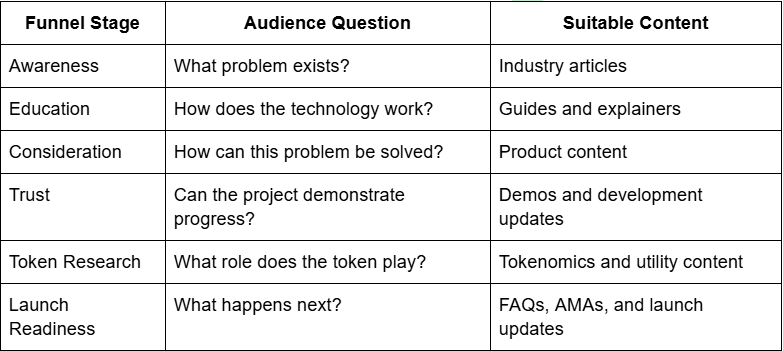
This structure also makes it easier to identify whether a content strategy is overly focused on one stage.
8. How to Avoid Overpromoting the Token
Overpromotion usually happens when every communication has the same objective.
A healthier approach is to give each piece of content a clear purpose.
Avoid mentioning the token unnecessarily in every headline. Don't use exaggerated claims simply to generate clicks, and avoid making price predictions or implying guaranteed outcomes.
Instead, focus on useful information.
A technical article should solve a technical question. An industry article should explain an industry problem. A tokenomics article should explain token-related mechanics.
The token can remain part of the broader story without becoming the entire story.
9. Measure the Entire Content Funnel
Page views alone won't tell you whether your pre-ICO content is working.
Track how users move through different stages of the funnel.
Useful metrics include:
O
- rganic traffic
- Engaged sessions
- Returning visitors
- Documentation visits
- Community registrations
- Email subscriptions
- AMA registrations
- Whitepaper engagement
- Qualified leads
- Content-to-community conversions
For example, if an educational article attracts significant traffic but almost nobody explores the project's documentation, the content journey may need improvement.
The objective is to understand which content helps audiences move from initial awareness toward meaningful project engagement.
Conclusion
A pre-ICO content funnel shouldn't feel like a continuous sales campaign. Its purpose is to help audiences understand the problem, learn about the technology, discover the project, evaluate its progress, and eventually understand the role of the token.
The strongest approach is to make each stage answer the audience's next question.
Educate first. Explain the project clearly. Demonstrate progress. Introduce the token with context. Then provide relevant launch information.
By building that progression, an ICO project can create a more informative content experience without relying on constant token promotion.





Top comments (0)