
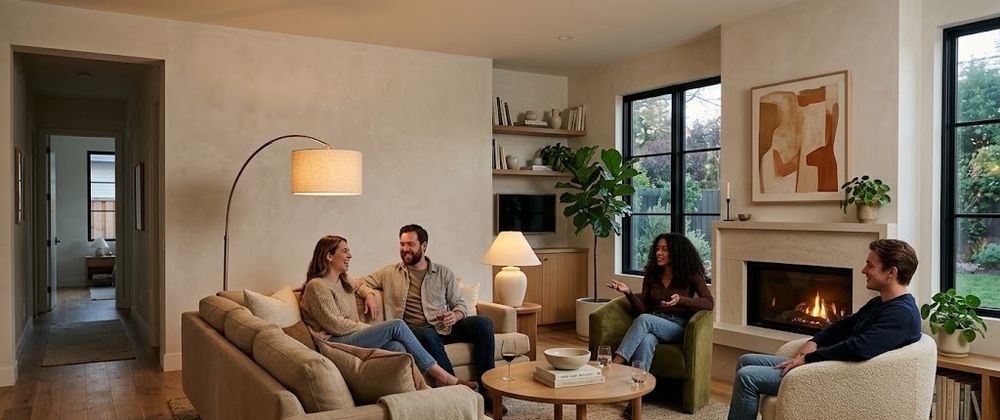

Human beings are spatial creatures. We respond to distances, angles, and sightlines without any conscious awareness that we are doing so. A gap of three feet between two people creates one kind of interaction. A gap of ten feet creates an entirely different one. Neither person needs to acknowledge the distance for it to shape their behavior.
Your living room is a laboratory for this kind of unconscious spatial negotiation. The furniture you place, the distances you set, and the directions you face all influence whether people in that room lean toward each other or drift apart. Here is what to look for — and what to change.
The Setups That Create Emotional Distance
The Empty Battlefield
Walk into many living rooms and you will find the same thing: furniture pressed against every wall, leaving a vast stretch of bare floor in the center. It reads as spacious in photographs. In lived experience, it reads as a gap nobody wants to cross.
This arrangement scatters people across the room's edges like scattered troops on opposite sides of a field. The center becomes no-man's-land. Conversations require projection. Laughter sounds thin and forced. People do their time and leave. The room has space for everyone but a place for no one.
The Screen-Dominated Layout
There is nothing wrong with owning a television or watching it regularly. The structural problem begins when every piece of furniture bows toward it. The TV becomes the room's axis, and all human interaction gets rerouted around it.
When seats face the same wall rather than each other, people become audience members rather than participants. They sit in parallel, watching a display, rarely turning sideways to engage with the person beside them. A living room should accommodate the screen without surrendering its entire identity to one. The device deserves a seat, not the throne.
The Congested Terrain
A room packed with furniture beyond its capacity creates friction at every turn. The coffee table crowds the sofa. The ottoman blocks the walkway to the armchair. A floor lamp stands directly in the path between two seating areas. Movement requires constant navigation.
When people must physically negotiate their way through a room, their bodies tense before their minds even register the effort. A guest who squeezes past a table edge to reach a loveseat does not settle in comfortably afterward. They remain perched, alert, mentally counting the steps to the nearest exit. Open circulation is not a luxury. It is the prerequisite for every other kind of comfort.
The Weight of Too Many Things
Clutter is more than an aesthetic problem. It is a social barrier. A coffee table loaded with mail, remote controls, old magazines, and stacked books leaves no room for a guest's drink. It communicates that the room was not prepared for company, even if that was never the intention.
The simplest remedy produces the most immediate change. Reduce each table surface to two or three deliberate items. A candle, a small tray, perhaps one interesting object. The cleared surface functions as an unspoken invitation. It says, "There is room for you here." People sense that generosity the moment they enter the room.
The Setups That Pull People Into Each Other's Orbit
The Tight Seating Group
The most effective living room transformation requires no budget whatsoever. Pull furniture away from the walls and position it in a compact cluster at the room's center. Arrange a sofa with two chairs facing it, forming a U-shape or L-shape. When people sit across from each other rather than scattered along the perimeter, the room's entire social frequency changes.
A spacing of approximately eight feet between opposing seats supports natural conversation. Voices carry without effort. Facial expressions remain legible. Personal space is respected while connection is encouraged. A room organized around this kind of inward-facing group develops a gravity that pulls people together without anyone needing to try.
The Position That Faces the Entry
People process spatial safety on a level deeper than conscious thought. A seat positioned with its back to the room's only door leaves the occupant in a state of mild alertness. They cannot observe who enters behind them, and the nervous system responds accordingly — with a tension that never fully resolves, no matter how comfortable the cushion is.
Rotating the primary seating to face the doorway eliminates this invisible stressor. Many homeowners who pursue a house feng shui consultation discover that this single adjustment — reorienting the main sofa or swapping two chairs — resolves a persistent discomfort they could never attribute to a specific cause. Experts who provide feng shui services consistently highlight entrance visibility as one of the most impactful spatial principles in residential design. The body relaxes when it can see the room's entry. The mind follows.
The Rug as a Territory Marker
Open-concept homes offer flow and flexibility, but they also strip away the visual boundaries that once defined where the living room ended and the kitchen began. Without those cues, guests receive no instruction about where the social gathering happens. They gravitate toward the kitchen counter because it is the most defined zone available.
A large area rug reverses this drift. It establishes a visible perimeter around the seating arrangement, signaling to everyone in the room where the gathering zone lives. The rug must be large enough that every seat in the grouping rests upon it — at minimum, the front legs of each piece. A rug that floats alone in the room's center, touching no furniture, amplifies the sense of spatial confusion rather than correcting it.
The Triangle Replaces the Line
Sectional sofas are practical for families and entertaining. Their linear shape, however, undermines the dynamics of group conversation. Five people seated in a row interact only with their immediate neighbors. The person on the far left shares nothing with the person on the far right. The sectional turns a gathering into a queue.
Breaking the sectional into two smaller pieces, or adding a single accent chair angled toward the sofa, creates a triangular arrangement. This shape is the gold standard for inclusive group dialogue because every person can see and hear every other person without repositioning. The geometric shift from a line to a triangle alters the quality of every exchange that occurs within the room.
The Gap That Enables Comfort
The space between furniture pieces carries direct consequences for how people feel in a room. A coffee table jammed against the sofa turns standing into an acrobatic feat. One placed too far away becomes a decorative island that nobody uses.
Eighteen inches between the sofa and the coffee table provides the ideal balance. Walkways need a minimum of three feet so that movement through the room requires no sideways shuffling or apologetic squeezing. These distances align with the physical reality of a body in motion. When navigation disappears as a conscious activity, mental energy returns to the people in the room.
How to Rebuild Your Layout in an Afternoon
You do not need to spend money to fix a disconnected living room. You need a plan, an open afternoon, and the willingness to move heavy objects. The steps below produce immediate results.
Begin with a total clearing. Remove every piece except the ones too large to carry alone. A blank room disrupts your habitual thinking. You stop calculating around existing furniture and begin envisioning the room without constraints. This mental reset is the foundation of every successful rearrangement.
Identify the room's anchor. A fireplace gives furniture a natural reason to cluster. A large window with a view serves the same purpose. If neither exists, create one with a prominent art piece, a substantial bookshelf, or a distinctive lamp that provides a focal point for everything else to relate to.
Float the main seating. Pull the sofa off the wall and into the room. Place a console table behind it with a lamp to anchor the piece and give it context. Add two chairs facing the sofa at a conversational distance. A genuine gathering zone takes shape within minutes.
Transform the lighting. A single overhead source creates the flat, sterile quality of a commercial space. Layer in warmth through different sources at varying heights — a floor lamp behind the sofa, a table lamp on an end table, an accent light in a corner. Soft, layered illumination invites people to linger. Many who practice feng shui services regard lighting as the most underestimated element in creating residential comfort.
Position the television with intention. Conceal it behind cabinet doors when not in use, or mount it on a secondary wall that does not serve as the room's primary visual axis. When the screen is off, it should fade into the background. A mirror or a piece of art on the opposite wall redirects the eye toward something that brings the room to life rather than draining it.
Consider a house feng shui consultation if your own efforts have plateaued. A trained practitioner perceives spatial dynamics — competing focal points, blocked pathways, corners that trap rather than circulate energy — that self-assessment typically misses. The corrections they recommend are often minor in physical terms yet meaningful in their effect on how the room feels from the moment of entry.
Periodic engagement with feng shui services also ensures a room stays aligned as life evolves. A configuration that worked beautifully for a couple may need adjustment when children arrive or remote work transforms daily routines. Spatial needs are not static, and neither should the room that serves them.
The Only Question Worth Asking
A living room either gathers people or scatters them. The arrangement determines the outcome, and the outcome shapes the quality of daily life within those walls. Well-placed seating encourages eye contact, easy movement, and genuine conversation. Poorly placed seating discourages all three.
Stand at the entrance of your living room and give yourself three seconds of honest observation. Does the space pull you inward or leave you standing at the boundary? If the answer disappoints you, begin tonight. Shift the couch, angle a chair toward it, clear a surface, and witness the transformation that intentional spatial thinking can produce.







Top comments (0)