
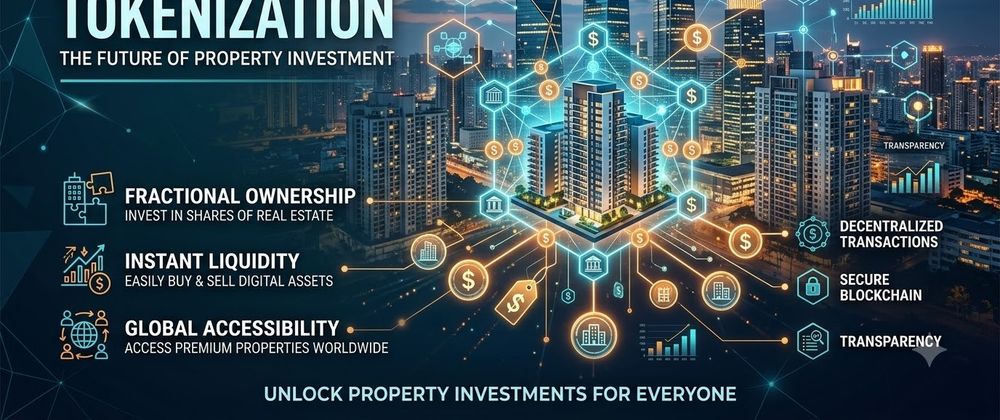


Real estate tokenization platforms combine blockchain infrastructure, smart contracts, digital identity, asset management, payment systems, and investor-facing applications into one technology ecosystem. Instead of treating a property as a single investment unit, the platform can represent ownership or economic rights through blockchain-based tokens, subject to the legal structure of the offering. This architecture can support fractional participation, automated administration, transparent ownership records, and programmable transfers.
The technical design is more complex than simply creating a token on a blockchain. A production-grade platform must connect the digital token to an underlying legal asset, verify investors, enforce transfer restrictions, manage distributions, protect sensitive information, and maintain accurate records throughout the asset lifecycle. Deloitte projects that tokenized real estate could reach approximately $4 trillion by 2035, compared with less than $0.3 trillion in 2024, highlighting the potential scale of the infrastructure being developed around this market.
Core Architecture Behind Real Estate Tokenization
At a high level, a real estate tokenization platform normally contains several interconnected layers. The blockchain layer provides the transaction ledger and token infrastructure. The smart contract layer manages issuance, ownership, transfers, and financial rules. The compliance and identity layer determines who can participate. The backend connects blockchain transactions with property, investor, payment, and administrative data. Finally, web and mobile interfaces allow issuers, administrators, and investors to interact with the system.
This layered architecture is important because property ownership involves information that does not naturally exist on a blockchain. Property deeds, valuation reports, leases, tax documents, corporate structures, investor records, and legal agreements may remain off-chain while their relevant references, proofs, or transaction events are connected to blockchain records.
A recent BIS working paper describes tokenization platforms as operating at the intersection of technology, finance, and property markets. This illustrates why successful systems need more than a token contract. They must connect blockchain functionality with existing real estate and financial-market processes.
Real Estate Tokenization Technology and Tokenization of Real Estate Assets
Real Estate Tokenization Technology typically begins with selecting an appropriate blockchain network and defining how ownership rights will be represented. The underlying model may use a special-purpose vehicle, fund, company, trust, or another legal structure that holds the property while blockchain tokens represent defined interests in that structure. Therefore, Tokenization of Real Estate Assets requires coordination between the technical representation and the legal ownership framework.
The blockchain network is responsible for recording token transactions and providing a tamper-resistant history of activity. Ethereum-compatible networks are commonly considered because of their mature smart-contract ecosystem and developer tooling, although other networks can be used depending on transaction costs, throughput, privacy requirements, and regulatory considerations.
Token standards are another major architectural decision. A simple fungible-token implementation may not provide enough controls for regulated real estate offerings. Permissioned standards such as ERC-3643 add identity and compliance mechanisms to token transfers. The standard includes components such as an identity registry, compliance modules, trusted issuer registry, and claim-topic registry.
This distinction matters because a real estate token may represent a regulated investment rather than an unrestricted cryptocurrency. The platform therefore needs to determine whether an investor is eligible before allowing a transfer.
Smart Contract Infrastructure
Smart contracts form the operational engine of a tokenization platform. They convert predefined business rules into blockchain-executed logic and can automate processes that would otherwise require manual administration.
A real estate platform may use several contracts rather than one large contract. A token contract can control the supply and ownership of fractional units. An issuance contract can manage the creation and distribution of tokens. Compliance contracts can verify transfer eligibility. Distribution contracts can calculate and distribute rental income or other payments according to predefined rules.
For example, suppose a property is represented by 1 million tokens. An investor purchasing 10,000 tokens could receive the economic rights defined by the offering documents. If the platform distributes rental income monthly, a smart contract or connected distribution system can calculate the investor's allocation based on their eligible holdings.
ERC-3643 demonstrates how token contracts can incorporate permissioned transfers, identity verification, minting, burning, freezing, pausing, recovery, and compliance checks.
However, smart contracts should not be treated as a replacement for legal agreements. They execute programmed rules, while legal documents establish the rights and obligations associated with the underlying property or investment structure.
Digital Identity, KYC, and AML Infrastructure
Identity management is one of the most important technical components because a blockchain wallet alone does not establish a person's legal identity. A regulated tokenization platform needs mechanisms for verifying investors before they receive or transfer tokens.
The onboarding workflow can connect the platform with identity verification and compliance providers. Investors may submit identification documents, proof of address, corporate information, beneficial ownership details, and other required information. Automated screening can then support KYC, AML, sanctions, and investor eligibility processes.
After verification, the platform can associate an approved identity with one or more blockchain wallets. ERC-3643, for example, uses on-chain identity infrastructure and compliance rules so that transfers can be checked against investor and offering requirements before execution.
A strong architecture should also minimize the amount of personally identifiable information stored directly on-chain. Sensitive documents can remain within secure off-chain systems while blockchain records contain suitable proofs, references, or verification states.
Property and Asset Management Backend
The backend is the bridge between blockchain activity and conventional real estate operations. It stores and processes property information that cannot be represented efficiently through smart contracts.
A platform may maintain property addresses, ownership structures, valuation information, lease details, income records, expenses, legal documentation, investor allocations, distributions, and transaction histories.
For example, an asset manager may update the property's rental income in the administrative system. The backend can calculate the distributable amount, determine eligible token holders, initiate payment processing, and record the relevant transaction. Blockchain records can then provide a transparent reference for token ownership and related events.
API architecture is particularly important here. APIs can connect the platform with KYC providers, banking systems, payment processors, custody services, property-management software, valuation systems, blockchain nodes, and external marketplaces.
Investor Dashboard and Front-End Application
The investor interface is the primary interaction layer for users. A well-designed dashboard should allow verified investors to review available properties, examine offering documents, complete onboarding, purchase eligible tokens, monitor holdings, view transaction history, and track distributions.
Property pages can display information such as asset location, valuation, token supply, minimum investment, expected income structure, ownership model, risk disclosures, and offering status.
The dashboard should also clearly separate blockchain information from investment information. A wallet balance tells an investor how many tokens they control, while the investment dashboard needs to explain what those tokens represent legally and economically.
For issuers and administrators, the platform requires a separate management dashboard. Administrators may use it to create offerings, configure token parameters, review investor applications, manage compliance permissions, monitor transactions, distribute income, and generate reports.
Wallet and Custody Infrastructure
Wallet integration allows investors to hold and transfer their tokens. Platforms can support self-custody wallets, custodial wallets, or hybrid models depending on the target market and regulatory structure.
Security is especially important because blockchain transactions are generally irreversible. The platform should therefore incorporate secure key-management practices, multi-factor authentication, transaction confirmation workflows, role-based permissions, and monitoring systems.
Institutional platforms may also integrate professional custody solutions. This can reduce operational risks associated with private-key management and provide additional controls for organizations managing substantial tokenized portfolios.
Wallet recovery is another consideration. ERC-3643 specifically includes mechanisms designed to support token recovery when an investor loses access to a wallet, demonstrating why regulated token platforms may require more sophisticated account-management capabilities than conventional cryptocurrency applications.
Payment and Distribution Engine
Real estate generates financial flows such as rental income, interest, property-sale proceeds, and management fees. A tokenization platform therefore needs a financial layer capable of connecting token ownership with these cash flows.
The distribution engine can calculate investor entitlements based on token holdings, eligibility rules, payment dates, and applicable deductions. Depending on the platform's architecture, payments may be made through bank transfers, stablecoins, or other approved payment mechanisms.
This component should maintain detailed records of payments, failed transactions, reconciliations, and reporting requirements. Automating these processes can reduce manual administrative work while creating a clearer audit trail.
Secondary Marketplace and Trading Infrastructure
Issuance is only one stage of a tokenized real estate platform. Investors may also require mechanisms for transferring or selling eligible tokens after issuance.
A secondary marketplace can provide order management, investor eligibility checks, transaction matching, settlement, and transfer recording. However, liquidity should not be assumed simply because an asset is tokenized. Buyers and sellers still need to exist, transfer restrictions must be satisfied, and applicable securities or financial-market rules must be followed.
A 2026 systematic review emphasizes that regulated real estate tokenization requires approval gates around identity verification, ownership validation, payment settlement, valuation, and other property-related processes. The research also stresses that blockchain can coordinate these processes, while official institutions may still be responsible for legal authorization.
Oracles and Off-Chain Data Integration
Smart contracts cannot independently access most real-world property information. They need reliable data feeds or trusted backend systems to receive external information.
Oracles can connect blockchain applications with information such as property valuations, currency exchange rates, interest rates, payment events, or other predefined data points. For example, if a distribution depends on verified rental income, the platform needs a trusted process for bringing that information into the blockchain environment.
Oracle architecture should include validation and fallback mechanisms because incorrect external data can trigger incorrect smart-contract outcomes.
Security, Monitoring, and Audit Infrastructure
Security must operate across every layer rather than being limited to smart-contract auditing. The platform should protect APIs, databases, wallets, administrative accounts, identity information, and blockchain contracts.
Smart contracts should undergo code review and independent security audits before deployment. The platform can also implement real-time transaction monitoring, anomaly detection, access logs, rate limiting, encryption, backup systems, and role-based access controls.
A useful security architecture separates administrative permissions so that no single compromised account can control every critical function. Sensitive actions such as minting tokens, changing compliance rules, upgrading contracts, or moving platform funds should require stronger authorization.
Real-World Examples of Technical Architecture
Existing projects demonstrate how these components can work together. In September 2025, RedSwan announced the tokenization of $100 million in commercial real estate assets on the Stellar network, using a regulatory-compliant tokenization system to distribute fractionalized real estate securities.
Another example comes from Sabai Property, which reported launching its platform in 2024 and a secondary market in 2025. Its published case study reported more than 20,000 registered users and more than $3.26 million in property value on the platform at the time of publication.
These examples illustrate that the technology stack extends beyond token creation. A functional ecosystem requires blockchain infrastructure, investor onboarding, property data, compliance controls, transaction management, and user interfaces to operate together.
How the Components Work Together
A typical transaction can demonstrate the complete architecture. First, an issuer structures the property and defines the legal rights attached to the offering. The platform creates the token and records its relationship with the underlying asset.
Next, an investor registers through the platform. The identity and compliance system verifies the investor and determines eligibility. Once approved, the investor connects an authorized wallet or receives a platform-managed account.
The investor then purchases tokens through the offering interface. The payment system processes the transaction, while the smart contract records the token allocation. If the investor later transfers the tokens, the compliance layer checks both parties before the smart contract executes the transfer.
If the property generates rental income, the distribution engine calculates the investor's entitlement. When secondary trading is permitted, the marketplace can facilitate eligible transactions while the blockchain records the resulting token ownership changes.
This interconnected architecture is what transforms tokenization from a simple blockchain issuance process into a complete digital asset-management platform.
Key Technical Components at a Glance
The most important components include:
- Blockchain network and node infrastructure
- Property and asset management backend
- Token and smart-contract layer
- Digital identity and KYC/AML integration
- Investor and administrator dashboards
- Wallet and custody infrastructure
- Payment and distribution engine
- Secondary marketplace
- Oracle and external-data integrations
- API and database architecture
- Security, monitoring, and audit systems
- Reporting and compliance infrastructure
Conclusion
A real estate tokenization platform requires a carefully integrated technology stack that connects blockchain records with legal ownership structures, investor verification, property data, payments, and compliant asset transfers. Smart contracts provide programmable automation, while identity systems, compliance modules, APIs, wallets, marketplaces, and backend infrastructure make the platform practical for real-world use. As tokenized real estate develops, technical architecture will remain closely connected to regulatory requirements and existing property-market processes. Blockchain App Factory provides best services for businesses looking to develop customized real estate tokenization platforms, combining blockchain infrastructure, smart contracts, investor management, wallet integration, and supporting platform capabilities to build scalable tokenization solutions.
FAQs
1. What is a real estate tokenization platform?
It is a digital platform that uses blockchain technology to represent defined rights or interests in real estate through tokens and manage related investor, compliance, and transaction processes.
2. Which blockchain is used for real estate tokenization?
Ethereum and EVM-compatible networks are common choices, but the appropriate blockchain depends on transaction costs, scalability, privacy, interoperability, and regulatory requirements.
3. Why are smart contracts important in real estate tokenization?
Smart contracts can automate token issuance, transfers, compliance checks, ownership records, and certain income-distribution processes according to predefined rules.
4. Does a token automatically represent legal property ownership?
No. The legal relationship between a token and a property must be established through the appropriate ownership structure, contracts, and jurisdiction-specific legal framework.
5. What security features should a tokenization platform include?
Important features include smart-contract audits, secure wallet management, encryption, role-based access control, identity verification, transaction monitoring, multi-factor authentication, and strong administrative controls.





Top comments (0)