

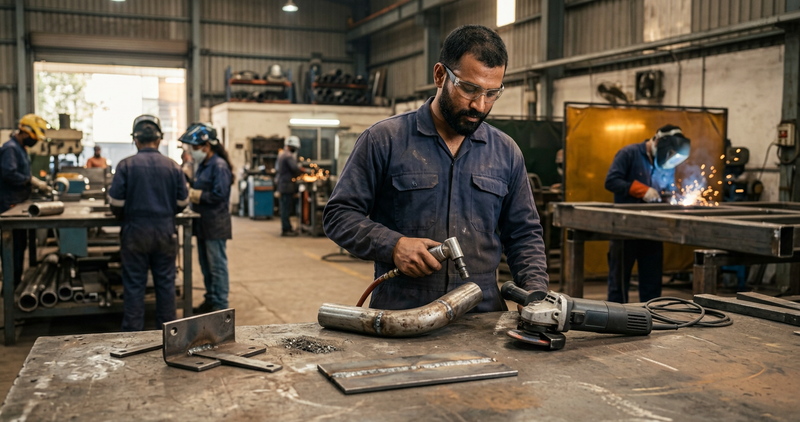
You've probably seen it happen on a job site—someone reaches for an angle grinder to clean up a tight weld on a bracket, then spends the next 20 minutes trying to reach an area the tool simply wasn't built for. Or worse, they use a die grinder for heavy material removal and wonder why it's taking forever. Both tools grind. Both use abrasives. But using the wrong one is like using a scalpel to chop vegetables—technically possible, thoroughly frustrating.
This guide breaks down exactly when to reach for each tool, what each one is built for, and how to make smarter calls on the shop floor or job site.
What Each Tool Is Actually Designed For
The Angle Grinder: Built for Brute Work
An angle grinder is a high-torque workhorse. It typically runs between 5,000 and 10,000 RPM and drives large discs—usually 4.5 to 9 inches in diameter—at a 90-degree angle to the shaft. That design makes it ideal for aggressive tasks: cutting through steel, removing heavy weld beads, surface prep on large flat areas, and stripping rust.
The tool is chunky by design. It needs to be—managing that much material removal requires mass and stability. Most angle grinders accept a wide range of attachments, including cutting tools, grinding discs, wire cup brushes, and flap discs for finishing.
The Die Grinder: Built for Detail
A die grinder is a different animal entirely. It runs at much higher RPMs—often between 20,000 and 30,000 RPM—but with significantly less torque. It's a smaller, pencil-shaped tool that accepts small rotary attachments: carbide burrs, mounted points, small flap wheels, and rubber-backed abrasive discs.
The die grinder was designed for precision. It reaches into places an angle grinder physically cannot—inside pipe bends, recessed cavities, tight corners on fabricated brackets, and small internal radii. Think of it as the tool you use when accuracy matters more than aggression.
Choosing by Task: Precision Work vs Heavy Removal
Here's where most tool misuse happens—and where supervisors can save a lot of time by setting clearer expectations.
Deburring brackets and machined parts: This is die grinder territory. A carbide burr or small flap wheel gives you the control to remove sharp edges without overshooting into the surrounding surface. An angle grinder, even on a light touch, is simply too wide and too aggressive for this job.
**Weld cleanup on large flat sections: **Angle grinder. A grinding disc or flap disc tears through excess weld material quickly. For large weld runs on structural steel or plate work, a die grinder would take three times as long and burn through attachments faster than you'd expect.
Edge blending on fabricated components: Depends on access. For open, reachable edges, a flap disc on an angle grinder delivers a smooth, consistent finish efficiently. For tighter or internal edges, a die grinder with a small flap wheel gives you the feedback and control to blend without gouging.
Surface prep before coating or painting: Angle grinder with a flap disc or surface conditioning disc. The broader contact area covers more ground faster and keeps the surface consistent. A die grinder is overkill for open surfaces—and honestly, your arm will give out before the job is done.
Internal pipe work or tight cavity grinding: Die grinder, full stop. No angle grinder attachment will get you into a 1.5-inch bore. A carbide burr on a die grinder slides right in.
Safety: Where the Real Differences Show Up
Both tools carry real risks, but they fail differently—and understanding that matters.
Angle grinders are responsible for a disproportionate share of serious workshop injuries. The main culprits are disc failure at speed and kickback. When a disc binds or shatters, the reaction is violent and fast. Guards exist for a reason—and yet, how often do you see them removed for "better visibility"? That's a decision that occasionally ends careers.
Kickback on an angle grinder happens when the disc catches unexpectedly, snapping the tool back toward the operator. The risk increases with worn discs, incorrect wheel selection, or working in awkward positions where the operator can't maintain a firm two-handed grip.
Die grinders carry lower kickback risk due to their smaller attachments and inline grip design. But they're not consequence-free. At 25,000 RPM, a carbide burr that contacts skin doesn't leave a scratch—it removes material. Operating without eye protection or with a loose workpiece is genuinely dangerous.
Key safety habits by tool:
- **Angle grinder: **Always use the guard, check disc condition before mounting, secure the workpiece, and maintain a two-handed grip.
- **Die grinder: **Use appropriate collet sizes, never exceed the attachment's rated RPM, and keep a firm hold—the high speed can cause vibration-related fatigue on long runs.
Surface Finish: Control vs Coverage
If finish quality is your benchmark, the die grinder wins on control and the angle grinder wins on consistency over large areas.
A die grinder lets you feel the surface as you work. The smaller contact patch means you can follow contours, respond to irregularities, and stop exactly where you need to. For blending welds on visible or cosmetic components, that tactile feedback is invaluable.
An angle grinder, especially with a quality flap disc, produces excellent surface finishes on flat or gently curved surfaces. The larger disc spans surface irregularities and leaves a more uniform scratch pattern. For surface prep that will go under primer or coating, this consistency is actually an advantage.
The mistake to avoid: using an angle grinder for finish work on a small or shaped part. The geometry is wrong, and you'll spend more time fixing overcutting than you saved on speed.
For top-quality finishing results, explore Yuri's range of flap discs, engineered for consistent material removal and smooth surface preparation across metal fabrication tasks.
Choose This Tool When…
Reach for the die grinder when:
- The work area is tight, recessed, or internally shaped
- You need precision deburring on brackets, ports, or machined surfaces
- Edge blending requires tactile control
- You're working on visible or cosmetic surfaces where overcutting isn't an option
Reach for the angle grinder when:
- You're removing significant material—weld beads, rust, surface scale
- The working surface is large, open, and relatively flat
- Speed of coverage matters more than fine control
- You're cutting or prepping before welding or coating
Both tools earn their place in a professional setup. The key is knowing which one the task is actually calling for—before you pick it up.
The Right Tool, Every Time
Getting this decision right isn't just about efficiency—it's about protecting your team, your components, and your project timelines. A die grinder used where an angle grinder belongs wastes time. An angle grinder used where a die grinder belongs damages parts and creates safety risks.
Yuri Smart Engineering supplies both die grinders and angle grinders built for professional use in fabrication, infrastructure, and industrial applications. Pair them with the right abrasives—from cutting wheels to grinding discs—and the work becomes noticeably smoother. Trusted by contractors and workshops across India, Yuri tools are designed to keep up with the demands of real job sites, not just catalogues.
The right call, made before you start grinding, is what separates a clean result from an expensive rework.







Top comments (0)