

Number patterns play an important role in reading structured numerical records. Charts, panels, figures, and historical entries often follow organized arrangements that help readers review information more efficiently. The DPBoss Matka format presents these numerical records in a consistent layout, making comparison between different entries much easier. Familiarity with common pattern structures supports accurate chart reading while improving recognition of organized numerical sequences.
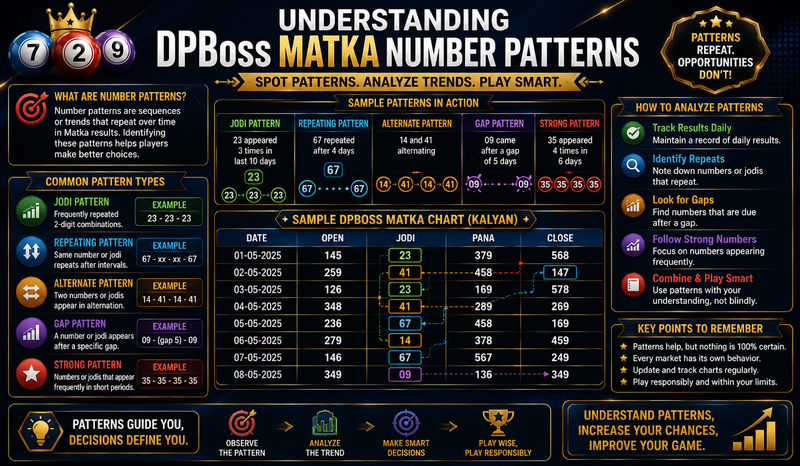
What Are Number Patterns?
Number patterns refer to recurring numerical arrangements that appear within structured records. Instead of viewing every number independently, readers examine how figures, panels, and combinations are organized.
Moreover, recognizing these arrangements improves chart readability and supports consistent interpretation.
Purpose of Number Patterns
Organized patterns help readers:
Review numerical records systematically
Compare historical entries
Identify recurring structures
Improve chart readability
Maintain consistent interpretation
Consequently, structured patterns simplify the process of reviewing larger collections of numerical information.
Main Elements That Form Number Patterns
Several components work together to create recognizable numerical arrangements.
Each contributes to the complete structure displayed inside historical charts.
Single Figures
Single figures represent individual numerical values appearing within larger records.
Although each figure stands alone, it also contributes to broader numerical arrangements.
Important characteristics include:
One numerical digit
Fixed placement
Clear presentation
Easy identification
Consistent formatting
Jodi Combinations
Jodi combinations contain two digits arranged together.
Their structured appearance supports organized comparison across multiple records.
Readers generally review:
Digit order
Placement
Associated record
Related panel
Historical position
Maintaining sequence accuracy remains important during every comparison.
Panels
Panels contain three-digit numerical combinations presented in a structured format.
These combinations contribute significantly to recognizable numerical arrangements.
Additionally, panels remain consistently positioned throughout organized chart layouts.
How Charts Display Number Patterns
Charts organize numerical records chronologically.
Instead of displaying isolated entries, charts preserve complete records in an ordered sequence.
Chronological Organization
Historical charts generally arrange entries according to publication order.
This structure helps readers:
Compare neighboring records
Review earlier entries
Maintain organized reading
Locate information quickly
Follow numerical progression
Consequently, chronological organization improves navigation throughout historical records.
Consistent Layout
Every chart follows similar formatting principles.
Important layout features include:
Uniform spacing
Consistent alignment
Clear panel placement
Structured rows
Organized columns
These characteristics improve readability while reducing unnecessary confusion.
Recognizing Repeated Numerical Structures
Some numerical arrangements appear repeatedly throughout historical records.
Recognizing these structures supports more organized chart reviews.
Repeated Digits
Certain panels contain repeated numerical values.
Readers commonly identify:
One repeated digit
Two repeated digits
Three matching digits
Balanced arrangements
Structured placement
These repeated structures create recognizable visual patterns inside charts.
Unique Digit Arrangements
Other panels contain three different digits.
Their balanced appearance allows readers to distinguish them quickly from repeated-digit combinations.
Furthermore, unique arrangements contribute additional variety to historical numerical records.
Relationship Between Patterns and Historical Records
Historical records preserve numerical information using one standardized format.
As new entries appear, they become part of the organized collection without changing the existing layout.
Important advantages include:
Better organization
Faster comparison
Improved readability
Consistent presentation
Easier navigation
Maintaining one structured format strengthens the usefulness of historical charts.
Reading Number Patterns Step by Step
A systematic reading approach improves accuracy while reducing interpretation mistakes.
Readers can follow this sequence:
Confirm the session information.
Review individual figures.
Read Jodi combinations.
Examine panel arrangements.
Compare historical records if required.
Following these steps creates a consistent process for reviewing organized numerical information.
Common Features of Structured Patterns
Organized numerical patterns generally share several recognizable characteristics.
These include:
Fixed positioning
Consistent formatting
Logical sequence
Clear spacing
Standardized presentation
Together, these features improve chart readability while supporting accurate comparison across multiple historical records.
Comparing Number Patterns Across Records
Comparing numerical arrangements becomes easier when every record follows the same layout. Instead of examining isolated figures, readers benefit from reviewing complete entries in sequence. Consequently, similarities and differences become easier to identify without disrupting the reading flow.
Reviewing Consecutive Entries
Looking at neighboring records supports consistent comparison because each entry appears in chronological order.
Readers should compare:
Session information
Opening figure
Opening panel
Closing panel
Closing figure
Additionally, following the same sequence for every record improves accuracy and reduces unnecessary confusion.
Observing Structured Arrangements
Patterns become clearer when every numerical section remains in its designated position.
This organized arrangement allows readers to:
Locate repeated structures
Compare panel layouts
Review figure placement
Follow chronological order
Maintain consistent reading habits
Therefore, structured presentation strengthens long-term chart readability.
Role of Panels in Number Patterns
Panels form an essential part of numerical organization because they group three digits into recognizable combinations.
Moreover, consistent panel placement supports easier comparison across historical records.
Single Panels
Single panels generally contain three different digits arranged in a balanced sequence.
Important characteristics include:
Distinct numerical values
Uniform formatting
Clear spacing
Predictable placement
Easy visual recognition
These features make single panels straightforward to identify during chart reviews.
Double and Triple Panels
Double panels contain repeated digits, while triple panels display three identical digits.
Although their structures differ, both categories remain organized using the same formatting principles.
Consequently, readers can distinguish each type quickly without changing their reading approach.
How Consistent Formatting Supports Pattern Recognition
A standardized layout improves recognition because every record follows the same visual structure.
Instead of searching for information, readers become familiar with predictable placement.
Key formatting features include:
Equal spacing
Consistent alignment
Structured rows
Organized columns
Standard panel positioning
Furthermore, these characteristics improve navigation through large historical records.
Common Mistakes While Reviewing Number Patterns
Even organized charts can be interpreted incorrectly if readers overlook important details.
Fortunately, careful observation helps prevent most mistakes.
Reading Digits Out of Sequence
Every numerical arrangement depends on the correct order of digits.
Before comparing any pattern, verify:
First digit
Second digit
Third digit
Complete panel
Overall arrangement
Maintaining sequence accuracy preserves the intended structure.
Ignoring Panel Placement
Some readers focus only on numbers while overlooking panel position within the chart.
Reviewing both placement and numerical arrangement creates a more accurate interpretation.
Comparing Different Sessions
Patterns should only be compared between matching record types.
Mixing unrelated sessions often produces misleading observations because each entry belongs to a different chronological position.
Practical Reading Habits
Organized reading habits improve consistency and make pattern recognition more efficient.
Helpful practices include:
Confirm the correct session.
Read each numerical section in order.
Check panel placement carefully.
Compare complete records instead of isolated values.
Review historical entries using the same method every time.
Following these habits supports accurate interpretation while reducing avoidable reading errors.
Benefits of Organized Pattern Reading
Recognizing structured numerical arrangements offers several practical advantages.
These include:
Faster chart navigation
Better historical comparison
Improved readability
Reduced interpretation mistakes
Greater consistency while reviewing records
As a result, readers can examine historical charts more efficiently while maintaining an organized reading process.
Developing a Consistent Pattern Reading Method
A structured reading method helps readers review numerical arrangements with greater clarity. Rather than concentrating on individual values alone, examining the complete record creates a more organized interpretation.
Helpful reading practices include:
Confirm the session information before reviewing numbers.
Read figures and panels in the published order.
Verify the placement of every numerical section.
Compare only complete historical records.
Follow the same reading sequence each time.
Review the full layout before concluding.
Moreover, consistent reading habits improve accuracy while making historical comparisons more efficient.
Why Organized Number Patterns Matter
Organized numerical patterns improve chart readability because every record follows a predictable structure. Consequently, readers can locate important information quickly without searching through scattered values.
Important advantages include:
Better visual organization
Faster comparison between records
Improved readability
Reduced interpretation errors
Consistent historical presentation
Similarly, standardized layouts make long-term numerical records easier to review while preserving clear separation between figures, panels, and complete entries.
Conclusion
The DPBoss Matka number pattern format organizes figures, Jodi combinations, panels, and historical records into a logical structure that supports accurate reading. Careful attention to sequence, placement, and formatting helps readers compare numerical arrangements more effectively. Consistent layouts and systematic reading habits together create a reliable approach for reviewing current and historical numerical records.
FAQs
What are DPBoss Matka number patterns?
DPBoss Matka number patterns refer to organized numerical arrangements displayed within figures, Jodi combinations, panels, and historical charts. These structured layouts make records easier to read, compare, and review while maintaining consistency across current and previous numerical entries.
Why are number patterns arranged in a fixed format?
A fixed format keeps every numerical section in a predictable position. This consistency improves readability, simplifies comparison between records, and helps readers locate figures, panels, and historical entries without confusion.
How do panels contribute to number patterns?
Panels organize three-digit numerical combinations into structured categories. Their consistent placement within charts supports easier identification, improves historical comparison, and strengthens the overall organization of numerical records.
Why are historical charts useful when reviewing patterns?
Historical charts preserve earlier numerical records using the same standardized format. This organization allows readers to compare different entries efficiently, review previous records systematically, and maintain a consistent reading process across multiple chronological records.
What mistakes should readers avoid while reviewing number patterns?
Readers should avoid changing digit order, skipping sections, ignoring panel placement, or comparing unrelated records. Reviewing every numerical component in sequence and confirming the correct session significantly improves interpretation accuracy.
How can readers improve their ability to read number patterns?
Readers can improve by following a consistent reading routine, checking every numerical section carefully, verifying panel placement, comparing complete records, and reviewing historical charts using the same structured method. These habits encourage accurate interpretation and organized chart reading.





Top comments (0)