
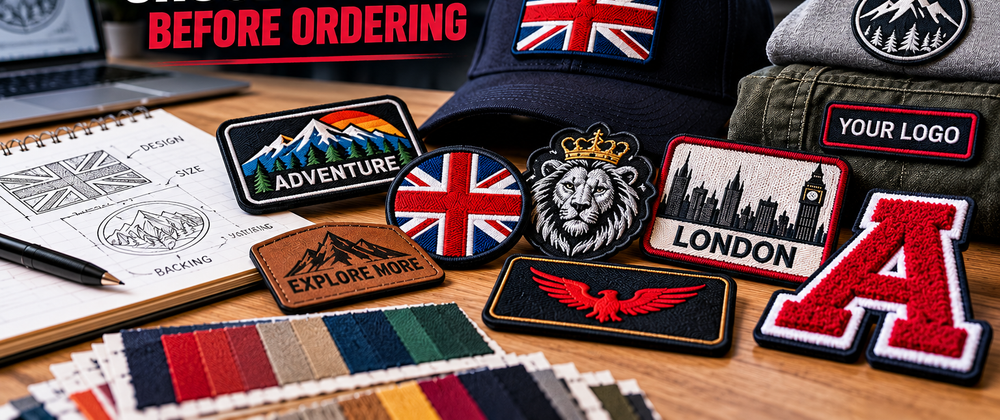

Your company has approved a new logo, the uniforms are ready, and the marketing team wants branded merchandise for an upcoming event. There's just one problem: nobody has ordered the patches yet.
Buying custom patches UK businesses can use across different products requires more planning than uploading a logo and choosing a quantity. Materials, attachment methods, artwork details, and delivery schedules can all affect the finished order.
A patch that looks excellent on a denim jacket might not work as well on a lightweight polo shirt. Understanding these differences before contacting suppliers can help businesses avoid expensive mistakes.
Why UK Businesses Are Choosing Custom Patches
Custom patches give companies a practical way to add branding to uniforms, promotional merchandise, bags, and clothing without printing or embroidering every garment directly.
Businesses can use the same approved patch design across different products, provided the size, backing, and garment materials are compatible.
They are also useful when companies need to update employee identification, introduce promotional collections, or prepare merchandise for events.
Branding for Employee Uniforms
Uniform patches help employees maintain a consistent appearance across departments and locations. They can display company logos, staff names, and department identifiers without requiring completely different clothing designs.
For companies with changing staff numbers, keeping approved patch specifications on file can simplify future uniform orders.
Custom Patches for Promotional Merchandise
Patches can turn ordinary caps, jackets, tote bags, and backpacks into branded products. They're particularly useful for businesses preparing giveaways, customer gifts, or promotional merchandise collections.
However, the patch should complement the product rather than overwhelm it. A large embroidered design may look impressive on a jacket but feel awkward on a smaller accessory.
Merchandise for Clothing Brands
Fashion and streetwear businesses often use patches as part of their product design rather than simply displaying a logo.
Textured embroidery, bold chenille lettering, and detailed woven labels can help create different visual styles across a clothing collection.
The material choice should reflect the garment's design, price positioning, and intended customer.
Understanding the Different Types of Custom Patches
One of the most important decisions is choosing the correct patch material. Different manufacturing methods produce different textures, levels of detail, and finishes.
Businesses should evaluate their artwork and intended application before selecting a particular construction.
Custom Embroidered Patches UK
Traditional embroidery remains a practical choice for company logos, club badges, uniforms, and promotional clothing.
Custom embroidered patches UK buyers can order use coloured threads stitched onto a fabric base. The raised stitching creates a textured appearance that works especially well for bold logos and clearly defined lettering.
Businesses can explore custom embroidered patches when planning uniform branding or traditional stitched merchandise.
However, extremely small lettering and complicated illustrations may require adjustments before production.
Custom PVC Patches
Custom PVC patches use flexible moulded material instead of embroidery thread. Their raised and recessed sections create a distinctive rubber-style finish.
They can be suitable for certain outdoor accessories, bags, uniforms, and branded equipment where moisture resistance is particularly useful.
Businesses considering this material can review custom PVC patches to compare moulded design options and backing requirements.
Traditional PVC production works best with clearly separated colours and defined shapes. Photographic gradients generally require another manufacturing method.
Custom Chenille Patches
Custom chenille patches are made using soft, raised yarn that produces a plush texture. They're particularly associated with varsity jackets, college clothing, and bold decorative lettering.
Their construction makes them suitable for relatively large shapes and simple designs that benefit from a distinctive textured appearance.
Clothing businesses creating varsity-inspired collections can explore custom chenille patches before finalising their artwork.
Chenille isn't always suitable for extremely detailed lettering, so the design should be developed with the material's characteristics in mind.
Custom Woven Patches
Custom woven patches use fine threads to reproduce detailed designs with a relatively flat finish.
They're particularly useful for smaller logos, detailed lettering, clothing labels, and lightweight garments where thick embroidery may not be appropriate.
Businesses needing compact branding can compare custom woven patches with traditional embroidery before choosing a material.
Although woven construction can accommodate finer details, the artwork still needs sufficient contrast and readable lettering.
Which Patch Type Works Best for Your Business?
There isn't one material that works best for every application. A uniform supplier, outdoor equipment brand, and fashion retailer may all need different patch constructions.
The following comparison provides a useful starting point.
| Patch type | Suitable applications | Main consideration |
|---|---|---|
| Embroidered | Uniforms, caps, jackets | Raised stitching and bold artwork |
| PVC | Outdoor accessories, bags | Moulded details and moisture resistance |
| Chenille | Varsity jackets, fashion | Plush texture and large shapes |
| Woven | Clothing labels, compact logos | Fine detail and flatter finish |
| Sublimated | Detailed artwork, colourful graphics | Printed detail and gradients |
| Leather | Hats, bags, premium apparel | Material appearance and finishing |
These are general recommendations rather than fixed manufacturing rules. The best option ultimately depends on the actual design and garment.
Before placing an order, ask the supplier to review your artwork and explain which manufacturing method will reproduce it most effectively.
What Businesses Should Know About Bulk Custom Patches UK
Ordering patches in larger quantities can help businesses manage branded merchandise projects and maintain consistent specifications.
However, bulk purchasing requires careful quantity planning. Ordering more patches than necessary can create inventory costs, even when the unit price is lower.
Businesses searching for bulk custom patches UK suppliers should compare complete quotations rather than relying solely on advertised starting prices.
When Does Bulk Ordering Make Sense?
Bulk orders are particularly useful when companies need patches for multiple uniforms, event merchandise, retail collections, or repeated promotional campaigns.
For example, a business preparing 300 work jackets may benefit from ordering all the required logo patches together.
The company should still consider replacement stock, future staff requirements, and whether its branding is likely to change.
How Many Patches Should You Order?
Start with the number of products requiring patches, then allow for realistic replacement or contingency requirements.
A business producing 200 branded hoodies and 100 promotional caps may require 300 patches if the same design and dimensions work for both products.
However, different garment shapes may require separate patch sizes or designs. This should be confirmed before combining quantities.
Comparing Custom Patches in Bulk UK
Businesses researching custom patches in bulk UK should request quotations at several relevant quantities.
For example, comparing 100, 250, and 500 pieces can help identify whether a larger order provides meaningful savings.
The supplier should receive the same artwork, material, backing, and dimensions for every quotation.
This makes pricing comparisons more useful and reduces confusion about what each supplier is offering.
How Much Do Custom Patches Cost in the UK?
Custom patch pricing depends on several factors, including material, dimensions, design complexity, embroidery coverage, backing, and order quantity.
A small embroidered logo typically has different production requirements from a large chenille letter or detailed PVC design.
Businesses should avoid choosing materials based entirely on the lowest advertised price.
Understand the Complete Project Cost
Patch manufacturing may represent only one part of the overall merchandise budget.
Companies should also consider garment purchases, attachment labour, packaging, and distribution costs.
For example, patches intended for staff jackets may need professional sewing after delivery. That additional work should be included when comparing suppliers.
Avoid Paying for Unnecessary Features
Not every design requires full embroidery coverage, complex borders, or special backing.
A relatively simple woven patch may reproduce detailed lettering more effectively than a heavily embroidered alternative.
Ask suppliers whether minor design adjustments could improve the finished result without compromising your brand identity.
For a more detailed breakdown, businesses can consult this guide explaining how much custom patches cost in the UK.
It provides additional context on how materials, sizes, and quantities influence purchasing decisions.
Choose the Correct Size Before Manufacturing
Patch dimensions can affect appearance, comfort, and manufacturing requirements.
A design that looks balanced on a computer monitor may become difficult to read when reduced for a small cap or shirt.
Measure the intended garment rather than estimating available space from photographs.
Match the Patch to the Product
For work shirts, chest logos should remain proportionate to the garment and avoid interfering with pockets or seams.
Caps usually have more limited available space, especially around curved front panels.
Jackets can accommodate larger patches, but heavy designs may affect how lightweight garments hang.
Check Lettering at Actual Size
Before approving artwork, print the design at its intended dimensions.
If the company name or other text becomes difficult to read, consider adjusting the lettering or simplifying decorative elements.
This small check can prevent expensive mistakes during bulk manufacturing.
Choose the Right Backing for Your Patches
Backing determines how patches attach to garments and accessories. The wrong attachment method can create problems even when the patch itself is manufactured correctly.
Businesses should consider fabric compatibility, washing requirements, and whether the patch needs to be removable.
Sew-On Backing
Sew-on patches are attached using stitching around the edges.
They're suitable for many uniforms, jackets, and clothing items requiring dependable long-term attachment.
However, businesses should account for sewing labour when estimating the complete project cost.
Iron-On Backing
Iron-on patches use heat-activated adhesive to attach to compatible fabrics.
They can be convenient for some merchandise applications, but delicate or heat-sensitive materials may not tolerate the required temperatures.
Testing the application method before processing an entire order is advisable.
Hook-and-Loop Backing
Hook-and-loop backing allows patches to be attached and removed from compatible surfaces.
This can be useful for certain uniforms, staff identification, and interchangeable accessories.
The garment must have a matching attachment panel, which may require additional preparation.
Prepare Your Artwork Before Requesting a Quote
Clear artwork helps suppliers understand exactly what needs to be manufactured.
For business logos, vector files such as AI, EPS, or SVG are useful because the design can be scaled without losing its original graphic definition.
High-resolution image files may also be accepted, depending on the supplier.
Include the Important Specifications
A useful artwork brief should identify the intended dimensions, colours, material, backing, and quantity.
Businesses should also mention where the patch will be applied and whether existing brand guidelines must be followed.
If the design contains gradients, tiny lettering, or intricate illustrations, ask whether adjustments are necessary.
Review the Digital Proof Carefully
A digital proof helps buyers confirm the expected design before production.
Check spelling, proportions, thread colours, borders, and backing requirements before approving the artwork.
For substantial orders, ask whether a physical production sample is available if material texture or garment compatibility needs to be verified.
How to Choose a Custom Patch Supplier in the UK
Choosing a supplier involves more than comparing prices and product photographs.
Businesses should evaluate manufacturing capabilities, artwork support, communication, production schedules, and quality assurance procedures.
A dependable supplier should explain the available materials and identify potential design limitations before manufacturing begins.
Review Previous Work
Look for finished patch examples similar to your intended design.
If your company needs small embroidered uniform badges, review similar products rather than relying only on photographs of large decorative patches.
Pay attention to readable lettering, consistent borders, and appropriate thread coverage.
Confirm Manufacturing and Delivery Arrangements
A supplier serving UK customers does not necessarily manufacture every product within the country.
If local manufacturing or production origin matters to your business, ask directly where the patches will be made.
Also confirm whether quoted delivery times begin when the order is placed or after artwork approval.
Ask About Quality Control
Businesses placing large orders should understand how the manufacturer checks finished patches.
Ask about inspection procedures for colours, dimensions, stitching, and border finishing.
It's also useful to clarify how the supplier handles products that don't match the approved specifications.
Common Mistakes Businesses Make When Ordering Patches
One common mistake is selecting a patch material before checking whether it can reproduce the artwork.
A detailed digital illustration may need simplification for embroidery, while a design containing photographic gradients may require sublimation rather than standard PVC.
Another mistake is approving dimensions without testing the patch on the actual garment.
Businesses may also underestimate attachment costs or leave insufficient time for design revisions.
Finally, ordering unnecessary quantities solely to qualify for a discount can increase overall spending.
These issues are easier to prevent through clear specifications and careful purchasing decisions.
A Practical Custom Patch Ordering Checklist
Before approving your order, review the following:
- Purpose: Identify whether the patches are for uniforms, merchandise, or promotional products.
- Material: Compare embroidered, PVC, woven, chenille, and other suitable constructions.
- Artwork: Prepare clear design files and confirm required colours.
- Dimensions: Test the intended size on actual garments.
- Backing: Choose an attachment method compatible with the product.
- Quantity: Calculate realistic needs and replacement requirements.
- Pricing: Compare complete supplier quotations.
- Proof: Review the artwork before manufacturing begins.
- Delivery: Confirm production and shipping schedules.
- Quality: Understand how manufacturing issues will be handled.
Keeping these details documented can also simplify repeat orders and help maintain consistent branding across future merchandise collections.
Frequently Asked Questions
What types of custom patches are best for UK businesses?
Embroidered patches suit bold logos and traditional uniforms, while woven patches offer finer detail. PVC, chenille, leather, and sublimated patches provide alternatives for different merchandise applications.
Can businesses order custom patches in bulk in the UK?
Yes. Many suppliers offer quantity-based ordering for uniforms, promotional merchandise, and clothing collections. Businesses should compare pricing, artwork requirements, and delivery arrangements before approving a large order.
Are custom embroidered patches suitable for work uniforms?
Yes. Embroidered patches are commonly used for work uniforms because they provide a traditional stitched appearance and can reproduce clear company logos.
What's the difference between PVC and woven patches?
PVC patches have a flexible moulded finish, while woven patches use fine threads to produce relatively flat designs with detailed lettering and graphics.
How can I get an accurate quote for custom patches?
Provide the supplier with your design, intended dimensions, quantity, material, backing requirements, and delivery deadline. Clear specifications help make quotations easier to compare.
Final Thoughts
Ordering custom patches for a UK business requires more than finding an attractive design at a reasonable price.
Material selection, artwork preparation, garment compatibility, quantity planning, and supplier communication all influence the finished product.
Businesses should compare complete quotations and confirm production details before committing to manufacturing.
With a clear brief and realistic expectations, custom patches can become a practical branding solution for uniforms, promotional merchandise, and retail clothing collections.







Top comments (0)