
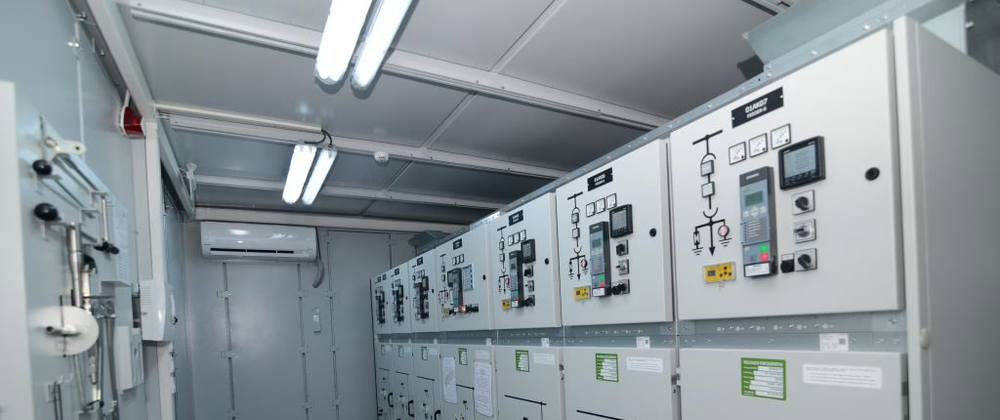


Every industrial facility needs a safe and dependable place to house its electrical equipment. For decades, the default choice was a conventional substation built on site using bricks, concrete and steel. Today, prefabricated Electrical Houses (E-Houses) offer a modern alternative. If you are planning a new plant or expanding an existing one, understanding the differences between these two approaches can help you make a smarter, more cost-effective decision.
What Is a Conventional Substation Building?
A conventional electrical room is constructed directly at the project site. Civil teams build the structure first, and then electrical contractors install switchgear, panels, transformers and cabling inside it. Each stage depends on the previous one being finished, and multiple contractors work in sequence.
What Is an E-House?
An E-House is a prefabricated, modular enclosure that is designed, assembled, wired and tested in a factory. It arrives on site as a complete or near-complete unit, ready for foundation placement, cable termination and commissioning.
Comparing the Two Approaches
- Project Schedule Conventional construction follows a linear path: civil work, then equipment installation, then wiring and testing. Weather, labor shortages and material delays can push timelines back. With an E-House, factory fabrication runs alongside site preparation, so schedules are much shorter and more predictable.
- Quality Control On-site work is exposed to dust, rain and varying workmanship standards. In a factory, skilled teams work in controlled conditions with standardized processes. Every E-House undergoes Factory Acceptance Testing, so defects are corrected before the unit ever leaves the facility.
- Cost A conventional building may appear cheaper at first glance, but hidden costs add up: extended labor, site supervision, rework, delays and multiple contractor interfaces. E-Houses reduce these overheads and offer clearer, fixed pricing, which often results in a lower total installed cost.
- Safety Fewer workers and less activity on site mean reduced risk of accidents. E-Houses are also designed with integrated fire detection, suppression, arc-flash protection and proper ventilation from the start, rather than added later.
- Space and Flexibility Conventional buildings are permanent and hard to modify. E-Houses can be skid-mounted, relocated or expanded with additional modules as power needs grow. This makes them ideal for mining sites, temporary projects and phased plant expansions.
- Environmental Performance E-Houses can be built for extreme conditions, including high temperatures, humidity, corrosive atmospheres and seismic zones. Insulated panels and efficient HVAC systems help control internal temperature and reduce energy consumption.
When a Conventional Building Still Makes Sense
Conventional construction can still suit very large, permanent installations where space is abundant, schedules are relaxed and local construction resources are readily available. Some projects may also have specific architectural requirements that favor traditional buildings.
When an E-House Is the Better Choice
An E-House is usually the stronger option when:
- The project has a tight deadline.
- The site is remote or has limited skilled labor.
- Environmental conditions are harsh.
- Future expansion or relocation is likely.
- Consistent quality and reduced site risk are top priorities.
Industries such as oil and gas, steel, cement, mining, renewable energy, water treatment, metro rail and data centers increasingly prefer E-Houses for these reasons.
Making the Right Decision
The right choice depends on your project's budget, timeline, location and long-term plans. For most modern industrial projects, the speed, quality and flexibility of a prefabricated solution make a compelling case.
Working with an experienced e house manufacturer ensures your E-House is engineered to your exact requirements, tested thoroughly and supported throughout its life cycle. The result is a reliable power distribution system that keeps your operations running safely and efficiently for years to come.





Top comments (0)