
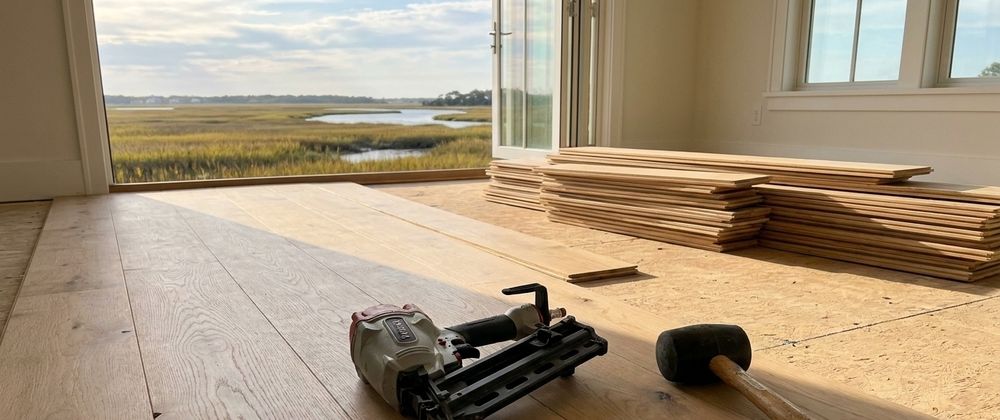

Few flooring materials match the warmth, character, and timeless quality that hardwood brings to a room. On Sullivan’s Island, where homes tend to have a relaxed refinement that suits the island’s particular character, hardwood flooring is one of the most consistent design choices that homeowners want to make. The question is not whether it is possible. It is which approach is right for the specific home, the specific conditions, and the specific way the home is lived in.
This guide covers what Sullivan’s Island homeowners need to know about hardwood flooring before they make a decision: the difference between solid and engineered wood in a coastal environment, the species and finish choices that hold up well, the installation considerations that matter on the island, and how to work with professionals who understand what the coastal context actually requires.
Solid Hardwood vs Engineered Wood
Solid hardwood and engineered hardwood are both real wood products, but their construction is fundamentally different, and that difference matters significantly in Sullivan’s Island’s coastal climate.
Solid hardwood flooring on Sullivan’s Island is a single piece of wood from top to bottom. It is the most premium option in terms of longevity, as it can be sanded and refinished multiple times over its lifespan. However, solid hardwood is susceptible to seasonal movement as humidity levels change, expanding in humid months and contracting in dry ones. On Sullivan’s Island, where relative humidity can vary considerably between summer and winter, this movement is real and must be accommodated in the installation.
Engineered hardwood has a real wood veneer layer over a cross-ply core of plywood or high-density fiberboard. That cross-ply construction provides dimensional stability that solid hardwood lacks. It resists seasonal movement and can be installed in conditions and over substrates where solid hardwood would not perform acceptably. For Sullivan’s Island properties with elevated humidity levels, vacation properties with occupancy gaps, or homes with concrete or radiant heat substrates, engineered hardwood is often the more appropriate choice.
Species Selection for the Island
The species you choose for hardwood flooring on Sullivan’s Island affects both the aesthetic result and how the floor performs in the coastal environment. Denser species are generally more resistant to the denting and wear that comes with the active lifestyle of island living.
White oak is currently one of the most popular and most appropriate choices for coastal homes. It has a beautiful natural grain, accepts a wide range of stain colors and natural finishes, and performs well in engineered construction. Its natural hardness makes it durable under everyday use. Wide-plank white oak in a natural or light whitewash finish is a particularly strong choice for Sullivan’s Island homes, as it works with the island’s palette and light without imposing a design direction that fights the setting.
Hickory, maple, and Brazilian cherry are among the harder species that perform well in active household conditions. White ash is worth considering for its combination of hardness and beautiful grain. Pine and softer domestic species, while beautiful, show wear more readily and may not be ideal for homes that see heavy use.
Finish Selection in a Coastal Environment
The finish on a hardwood floor affects both its appearance and its performance, and in a coastal environment, finish selection deserves careful attention. Oil-based finishes provide excellent durability and a warm, slightly amber tone that deepens naturally over time. Water-based finishes cure faster, emit less odor during application, and produce a clearer, more neutral result that is appropriate when the goal is to preserve the natural tone of the wood.
For hardwood flooring on Sullivan’s Island, a finish with good moisture resistance and UV stability is worth specifying. Rooms with significant direct light exposure are particularly worth addressing with a UV-resistant finish coat, as direct sunlight will affect the color of wood flooring over time regardless of species.
Installation Considerations
Hardwood flooring installation on Sullivan’s Island should always begin with a thorough assessment of the subfloor and the room’s moisture conditions. A moisture meter reading taken before installation establishes a baseline and identifies any problem areas that need to be addressed before material goes down. Acclimating the wood on site before installation, allowing the boards to adjust to the home’s temperature and humidity conditions, is standard practice for solid hardwood and recommended for engineered wood as well.
Working with a contractor who is experienced in hardwood flooring installation in coastal environments is not optional. Contractors who have worked primarily in non-coastal markets may not account for the specific moisture management practices that Sullivan’s Island conditions require, which can lead to floor performance problems over time that a more knowledgeable installation would have prevented.
The Professional Perspective
Interior designers and flooring specialists who work regularly on Sullivan’s Island, like the team at Home Life led by Rose Ann Humphrey, bring specific knowledge of how hardwood flooring performs in the island’s conditions. They specify materials, finishes, and installation approaches based on what actually holds up on the island, not on what the general market recommends.
For homeowners committed to hardwood flooring on Sullivan’s Island, that knowledge is what ensures the beautiful result they are imagining is also the durable result they are still enjoying years later.






Top comments (0)