
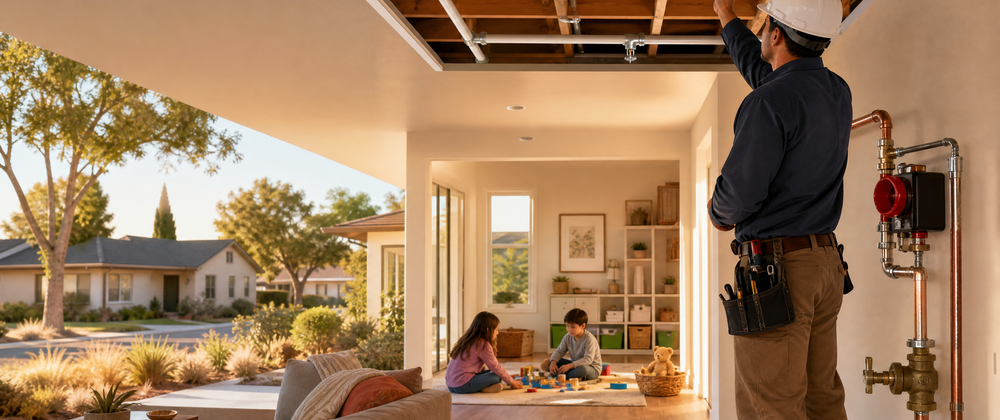

California's Central Valley is home to some of the state's fastest-growing residential communities. From new subdivisions outside Fresno to custom builds near Stockton and Modesto, families are putting down roots in communities where new construction is happening at a rapid pace. And with every new home that goes up comes a code-mandated requirement that has been state law since 2011: residential fire sprinklers.
But here is something worth thinking about beyond the legal requirement. Residential fire sprinkler installation in Central Valley homes is not just about satisfying a building code. It is about making one of the most consequential investments in your family's safety that a homeowner can make. The life safety data backs it up, the financial benefits are real, and the peace of mind it provides is something no smoke detector alone can deliver. Here is why this matters for every family in the Valley.
What California Law Requires
California became a national leader in residential fire safety when it mandated automatic fire sprinklers in all new one- and two-family residential dwellings beginning in 2011. This requirement applies throughout the state, including in all Central Valley jurisdictions. Any new home, whether a tract home in a Fresno subdivision or a custom estate outside Bakersfield, must include a residential fire sprinkler system as a condition of receiving a certificate of occupancy.
Residential systems in California are designed under NFPA 13D, the standard for one- and two-family dwellings and townhouses. NFPA 13D focuses on life safety, giving residents enough time to safely evacuate while the system controls or suppresses the fire. The standard is intentionally designed to be cost-effective for homebuilders while delivering meaningful protection for occupants.
The Life Safety Case: Real Numbers, Real Outcomes
The National Fire Protection Association has tracked fire outcomes in homes with and without automatic sprinklers for decades. The findings are consistent: the death rate in home fires is 81 percent lower in homes with automatic sprinklers than in homes without them. That is not a modest improvement. It is a fundamental shift in the probability of surviving a residential fire.
When you think about why residential fire sprinkler installation matters, this statistic is the clearest argument. A fire sprinkler system responds in seconds once heat from a fire reaches activation temperature, typically between 135 and 165 degrees Fahrenheit. In most residential fires, a single activated sprinkler head is all it takes to contain or extinguish the fire before it can spread to adjacent rooms. That response happens whether or not anyone is awake in the house to call 911.
The Financial Case: It Pays Back Over Time
One of the most common questions about residential fire sprinkler installation in Central Valley projects is whether the cost is justified. For new construction, the answer is emphatically yes, and not just for safety reasons.
Many homeowners insurance providers offer premium discounts for homes with certified residential fire sprinkler systems. The discount varies by insurer and by the specific policy, but even a modest five to ten percent annual reduction begins to offset installation costs over the typical homeownership horizon. On a policy with an annual premium of several thousand dollars, that adds up to meaningful savings over a ten- or twenty-year ownership period.
Beyond insurance, consider the cost of fire damage itself. The average residential fire in an unsprinklered home causes dramatically more property damage than a fire in a sprinklered home, where the system may contain the event to a single room. The difference between a contained kitchen incident and a total structural loss is the difference between a manageable insurance claim and a life-altering catastrophe.
What NFPA 13D Installation Looks Like in Practice
For Central Valley homebuilders and homebuyers, understanding what residential fire sprinkler installation actually involves helps set expectations for the project and the finished product.
NFPA 13D systems are designed to integrate with the home's existing domestic water supply in most cases, which keeps the installation less invasive and more cost-effective than a fully dedicated fire protection water supply. Sprinkler heads are required in living areas, kitchens, hallways, and other specified spaces. Certain areas like small bathrooms under 55 square feet and small closets may be excluded under 13D.
Modern concealed sprinkler heads sit behind flat decorative cover plates that are flush with the ceiling surface, making the system virtually invisible in finished living spaces. This addresses one of the most common aesthetic concerns homeowners raise about sprinkler systems.
Trusted companies like Freedom Fire Protection have been designing and installing NFPA 13D residential systems throughout the Central Valley since 2006, working with builders, developers, and individual homeowners on everything from custom estates to large-scale tract developments.
A Smart Investment for the Long Term
Choosing quality residential fire sprinkler installation in the Central Valley is not just about meeting the code requirement that took effect in 2011. It is about choosing to protect your family's home and your family's future with a system that has proven, generation after generation, to work exactly when it is needed. Work with a licensed, experienced fire protection contractor to make sure that investment is built right the first time.







Top comments (0)