

Professional printing projects demand accuracy, consistency, and high-quality artwork. Whether a business is producing banners, brochures, vehicle graphics, promotional products, signage, or branded apparel, the quality of the artwork used can significantly impact the final result. One of the most important steps in preparing artwork for printing is ensuring that it is converted into a clean and scalable vector format.
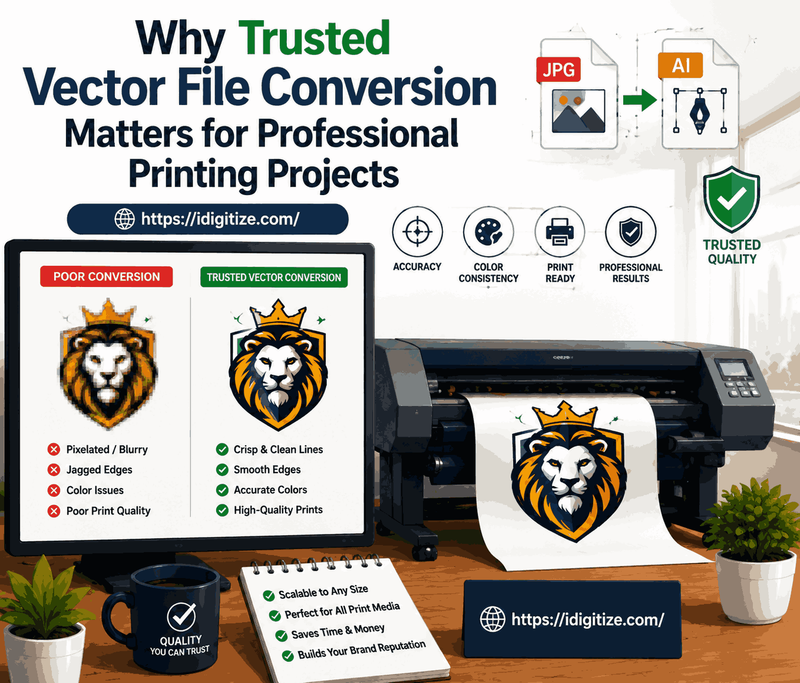
This is where Trusted Vector File Conversion becomes valuable. Proper vector conversion helps maintain design quality, supports large-format printing, and ensures that logos and graphics remain sharp regardless of size. Businesses that invest in professional vector conversion often experience better print results and fewer production issues.
Understanding Vector File Conversion
Vector file conversion is the process of transforming raster images or low-quality graphics into scalable vector artwork. Unlike pixel-based images, vector files use mathematical paths to define shapes, lines, and curves.
Common vector formats include:
AI
EPS
SVG
PDF (vector-based)
These formats allow artwork to be resized without losing quality, making them ideal for professional printing applications.
Why Print Quality Depends on Artwork Quality
Printing equipment can only reproduce the information contained within the artwork file. If the artwork is blurry, pixelated, or poorly constructed, those imperfections often appear in the final print.
High-quality vector files help ensure:
Sharp graphics
Clean edges
Accurate shapes
Professional appearance
This makes artwork quality a critical factor in successful printing projects.
Scalability Without Quality Loss
One of the biggest advantages of vector artwork is scalability. A logo may need to appear on a small business card today and a large storefront sign tomorrow.
With trusted vector conversion, artwork can be enlarged or reduced without becoming blurry or distorted.
This flexibility is especially important for businesses that use the same branding across multiple marketing materials.
Improved Logo Accuracy
Business logos are central to brand identity. Any distortion or inconsistency can affect how customers perceive a company.
Professional vector conversion helps preserve:
Original proportions
Design details
Text structure
Graphic elements
Accurate logo reproduction supports stronger and more consistent branding.
Better Results for Large Format Printing
Large-format printing often exposes flaws that may not be visible at smaller sizes.
Applications such as:
Trade show displays
Vehicle wraps
Outdoor signage
Banners
Wall graphics
require artwork that remains sharp when enlarged.
Vector files provide the quality needed for these demanding print environments.
Cleaner Text Reproduction
Text quality plays an important role in professional printing. Low-resolution artwork can cause letters to appear blurry or uneven.
Trusted vector file conversion improves:
Character clarity
Font accuracy
Readability
Edge sharpness
This helps ensure that business names, contact information, and marketing messages remain professional.
Consistency Across Multiple Print Products
Businesses often use the same logo and graphics across various printed materials.
Examples include:
Flyers
Brochures
Business cards
Packaging
Promotional items
Vector artwork helps maintain a consistent appearance across all applications, supporting a stronger brand image.
Easier Editing and Design Updates
Marketing materials frequently require updates or modifications.
Professionally converted vector files make it easier to:
Change colors
Adjust text
Resize graphics
Update branding elements
This flexibility can save time and reduce future design costs.
Reduced Production Problems
Poor-quality artwork often causes delays during the printing process.
Common issues include:
File rejection
Artwork reconstruction
Resolution problems
Print inconsistencies
Professional vector conversion helps eliminate many of these challenges before production begins.
Better Color Accuracy
Consistent color reproduction is important for branding and marketing materials.
Clean vector artwork allows designers and printers to manage colors more effectively, helping maintain uniform brand standards across different products and print methods.
Long-Term Business Value
A professionally converted vector file is a long-term business asset. Once created, the artwork can often be reused across numerous projects without requiring additional reconstruction.
This provides value through:
Consistent branding
Faster project preparation
Reduced artwork costs
Greater production flexibility
Businesses that invest in quality vector files often benefit from years of reliable use.
Why Professional Conversion Outperforms Auto-Tracing
Automated conversion tools can quickly generate vector files, but the results are often inconsistent.
Auto-traced artwork may contain:
Excessive anchor points
Rough edges
Distorted shapes
Poor text quality
Professional vector artists manually refine artwork to ensure accuracy, usability, and print readiness.
Supporting Multiple Printing Methods
Vector artwork works well across a wide range of printing processes, including:
Screen printing
Digital printing
Offset printing
Large-format printing
Promotional product printing
This versatility makes vector files essential for businesses that use multiple marketing channels.
Choosing a Reliable Vector Conversion Provider
Not all vector conversion services provide the same level of quality. When selecting a provider, businesses should consider:
Experience
Portfolio quality
Turnaround time
Attention to detail
Revision support
Working with an experienced provider helps ensure that artwork is prepared correctly for professional printing.
Conclusion
Trusted Vector File Conversion plays a critical role in professional printing projects by ensuring artwork remains sharp, scalable, and accurate across all applications. From improved logo quality and cleaner text reproduction to better production efficiency and stronger branding consistency, professional vector conversion provides benefits that extend far beyond a single print job.
Businesses that invest in high-quality vector artwork often achieve better print results, reduce production challenges, and create a stronger visual presence across their marketing materials. For companies that value professional branding, trusted vector conversion is an investment that continues to deliver long-term value.
FAQs
Q: What is vector file conversion?
Vector file conversion is the process of converting raster images into scalable vector artwork suitable for professional printing and design applications.
Q: Why are vector files important for printing?
Vector files maintain quality at any size, making them ideal for both small and large-format printing projects.
Q: Can vector artwork improve print quality?
Yes. Clean vector files provide sharper graphics, clearer text, and more accurate design reproduction.
Q: Is professional vector conversion better than auto-tracing?
In most cases, yes. Professional conversion produces cleaner, more accurate artwork that is better suited for printing.
Q: What file formats are commonly used for vector artwork?
AI, EPS, SVG, and vector-based PDF files are among the most common vector formats used in professional printing.





Top comments (0)