
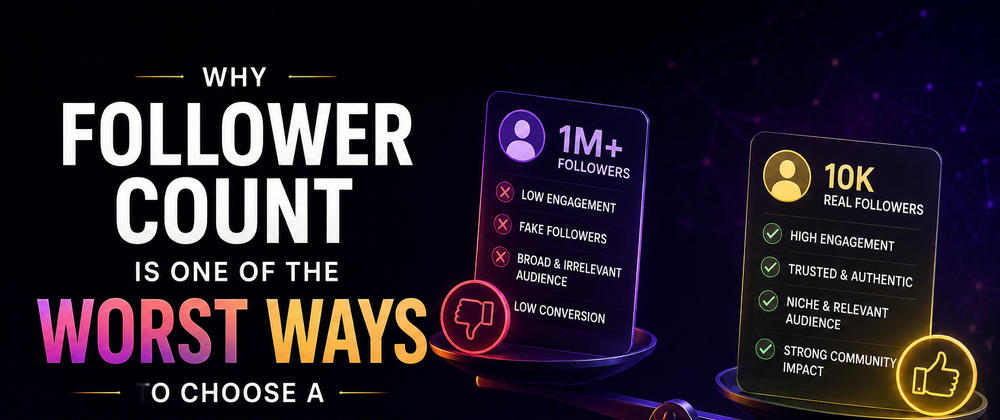

A Bigger Audience Doesn't Always Mean Bigger Influence
When a Web3 project starts looking for crypto influencers, one number usually gets attention first:
Followers.
It is easy to understand.
One creator has 50,000 followers.
Another has 500,000.
Another has 2 million.
On paper, the choice seems obvious.
But influencer marketing doesn't work quite that way.
A large audience can create visibility, but visibility alone doesn't guarantee relevance, engagement, trust, or conversions.
A creator with 40,000 highly relevant followers may be far more useful to a DeFi project than an account with 800,000 followers whose audience is mostly interested in unrelated crypto narratives.
That's why follower count should be treated as one data point, not the foundation of your KOL selection strategy.
Why Follower Count Can Be Misleading
Follower numbers tell you how many accounts have chosen to follow someone.
They don't tell you:
- How many people actively see their content
- Whether those followers are genuine
- Whether the audience matches your target market
- How much people trust the creator
- Whether followers engage with recommendations
- Whether the creator influences purchasing or product decisions
Two creators with the same follower count can therefore deliver completely different campaign results.
This is especially important in crypto, where audiences are spread across highly specialized niches.
Relevance Often Beats Reach
Imagine you're marketing a new DeFi protocol.
You have two options.
Creator A
600,000 followers
Broad crypto content, frequent promotional posts, limited DeFi specialization.
Creator B
70,000 followers
Deep DeFi analysis, active discussions, highly relevant audience.
Which one is better?
There isn't an automatic answer.
But if your objective is to reach people who are genuinely interested in DeFi, Creator B may be the more relevant option.
The question shouldn't be:
"How many people follow this KOL?"
It should be:
"How many of the right people are likely to listen to this KOL?"
That is a much more useful question.
Engagement Needs Context
Engagement is often used as the next metric after followers.
That's a step in the right direction.
But engagement rate shouldn't be viewed in isolation either.
Look at what the audience is actually doing.
Are followers:
- Asking questions?
- Sharing opinions?
- Discussing the topic?
- Reposting content?
- Bookmarking educational posts?
- Responding to recommendations?
Or are most interactions simply generic comments?
A crypto KOL with a smaller audience but genuine conversations can sometimes have stronger influence than a larger account with shallow engagement.
Quality matters alongside quantity.
Look at the Audience, Not Just the Account
A KOL's audience should be examined just as carefully as the creator themselves.
Consider:
Geographic Distribution
Are followers located in markets relevant to your campaign?
Interests
Are they actually interested in your category?
Experience Level
Are they beginners, active traders, developers, investors, or experienced Web3 users?
Platform Behavior
Do they actively participate in conversations, or are they mostly passive followers?
Community Overlap
Does the creator already have influence within the communities you're trying to reach?
This information can tell you much more than a follower number.
A Smaller KOL Can Have Stronger Influence
Not every campaign needs a massive influencer.
Micro and mid-tier creators can be particularly valuable for niche Web3 campaigns.
Why?
Because their audiences may be more focused.
A creator with 25,000 followers focused entirely on blockchain infrastructure may have more relevant influence for a developer-focused project than a general crypto account with 1 million followers.
Smaller creators can also offer:
- Stronger community interaction
- More specialized expertise
- More focused content
- Better audience relationships
- Greater flexibility
This doesn't mean large KOLs aren't valuable.
It means creator size should match the campaign objective.
Don't Ignore Content Quality
Before hiring a crypto KOL, study their content.
Ask yourself:
Would I trust this person to explain our product?
If the answer is no, follower count becomes almost irrelevant.
Look for creators who:
- Understand their niche
- Explain ideas clearly
- Produce original content
- Research topics
- Have a recognizable voice
- Engage with their audience
- Can discuss products without sounding like a generic advertisement
For technical Web3 products especially, communication ability can be more valuable than raw reach.
Check How They Handle Sponsored Content
Scroll through previous brand collaborations.
This can reveal whether an influencer is selective about partnerships.
Look for:
- How frequently they promote projects
- Whether sponsored posts fit their normal content
- How audiences respond
- Whether they explain the product
- Whether they add their own perspective
If every other post is a promotion for a different project, audiences may become less responsive.
On the other hand, creators who carefully select partnerships may have stronger credibility.
Watch for Artificial Numbers
Follower count can also be inflated or misleading.
That doesn't mean every large account has fake followers.
But unusual patterns deserve investigation.
For example:
- Rapid unexplained follower growth
- Extremely high views with almost no discussion
- Repetitive comments
- Large follower numbers but consistently weak engagement
- Audiences that don't appear connected to the creator's niche
These aren't automatic proof of manipulation.
They're simply reasons to look deeper.
A professional KOL marketing agency should be able to help evaluate audience quality rather than simply handing you a list of accounts sorted by followers.
Consider Consistency
Another useful indicator is consistency.
Look at a creator's content over several weeks or months.
Do they regularly produce content?
Do their views fluctuate dramatically?
Do they suddenly experience unusual spikes?
Does their audience consistently engage?
One viral post can make an account look more influential than it actually is.
A longer performance history provides more context.
Match the KOL to Your Campaign Objective
Different goals require different types of creators.
If You Want Awareness
Larger creators may provide broader reach.
If You Want Education
Look for analysts, researchers, and knowledgeable educators.
If You Want Community Growth
Creators with highly engaged niche communities may be valuable.
If You Want Product Adoption
Look for creators whose audiences are likely to actually use the product.
If You Want Credibility
Consider respected voices with established expertise.
The best KOL depends on what you want the audience to do after seeing the content.
Build a KOL Scorecard
Instead of ranking creators by followers, create a simple evaluation framework.
| Factor | What to Evaluate |
|---|---|
| Audience relevance | Does the audience match your target users? |
| Expertise | Does the creator understand your niche? |
| Engagement | Are interactions genuine and meaningful? |
| Content quality | Can they communicate your message effectively? |
| Credibility | Does the audience trust their opinions? |
| Platform fit | Does the creator use the platform your audience prefers? |
| Campaign history | Have previous partnerships performed well? |
| Audience quality | Does the following appear authentic and relevant? |
| Cost | Does the expected value justify the fee? |
| Conversion potential | Can the audience realistically take your desired action? |
Now follower count becomes just one factor among many.
Think About Cost Per Relevant Audience
Instead of comparing influencers by total followers, consider the cost of reaching the people who actually matter.
For example:
KOL A
500,000 followers
$20,000 campaign fee
KOL B
80,000 followers
$4,000 campaign fee
If only a small portion of KOL A's audience is relevant while most of KOL B's audience matches your target market, the second campaign may offer much better value.
This is why campaign economics should focus on relevant reach and outcomes, not vanity metrics.
The Goal Isn't Maximum Exposure
There's a subtle but important difference between:
Getting seen
and
Getting remembered
A large influencer can put your brand in front of thousands of people.
But if nobody remembers the message or takes action, the exposure has limited value.
A smaller, trusted creator might introduce your project to a highly relevant community and create meaningful conversations around it.
For many Web3 projects, that can be more valuable than a massive but disconnected audience.
What Should You Measure Instead?
Follower count is useful for understanding scale.
But your campaign should go much further.
Awareness
- Reach
- Impressions
- Views
- Mentions
Engagement
- Comments
- Shares
- Reposts
- Saves
- Discussion quality
Traffic
- Link clicks
- Website visits
- Referral traffic
Community
- Telegram joins
- Discord joins
- Active members
- Event participation
Conversion
- Sign-ups
- Product usage
- Leads
- Purchases
- Other campaign-specific actions
These metrics provide a much clearer picture of whether your KOL campaign is actually working.
The Best KOL Isn't Always the Biggest KOL
There is nothing inherently wrong with working with large crypto influencers.
In fact, they can be extremely valuable for major awareness campaigns.
The mistake is assuming that larger automatically means better.
The right KOL is the one that fits your:
Audience + Objective + Product + Budget + Message
A 1-million-follower account may be perfect for one campaign.
A 30,000-follower specialist may be perfect for another.
The size of the audience doesn't determine the quality of the match.
How a KOL Marketing Agency Can Help
For projects running larger campaigns, influencer research can quickly become a full-time task.
A specialized crypto KOL marketing agency can help evaluate:
- Creator relevance
- Audience quality
- Engagement patterns
- Previous campaigns
- Pricing
- Content fit
- Platform distribution
- Campaign performance
More importantly, an agency can help connect KOL selection to the wider marketing strategy.
Instead of simply asking:
"Which influencer has the most followers?"
the conversation becomes:
"Which creators can help us reach the people most likely to care about our project?"
That's a much stronger foundation for a campaign.
Final Thoughts
Follower count is easy to understand.
That's exactly why it's so tempting to use it as the primary way to choose a crypto KOL.
But influence is more complicated than a number displayed next to an account.
A successful influencer campaign depends on relevance, credibility, audience quality, engagement, content, and the ability to move people toward meaningful action.
So the next time you're comparing crypto influencers, don't immediately sort them from highest to lowest followers.
Look deeper.
Study their audience.
Read their comments.
Review their content.
Analyze their previous partnerships.
Understand what their followers actually care about.
Then ask the question that matters most:
"If this person recommends our project, are the right people going to pay attention?"
If the answer is yes, you may have found the right KOL, regardless of whether their follower count has six digits or six million.







Top comments (0)