
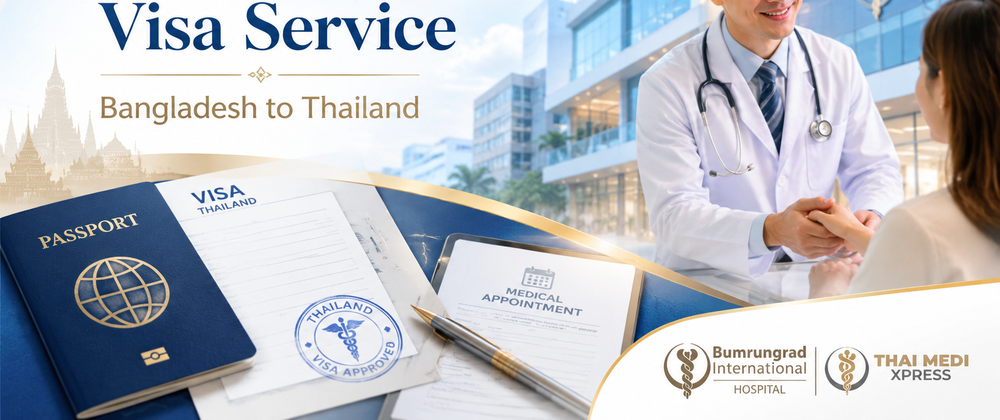

For Bangladeshi patients traveling to Thailand for healthcare, understanding the Thailand Medical Visa Service From Bangladesh process can make international medical travel much easier. From choosing the appropriate visa category to preparing hospital documents and completing the application, careful planning helps patients and families avoid unnecessary complications. Thai Medi Xpress can assist with relevant travel coordination.
Understanding Medical Travel to Thailand
Thailand is a popular destination for international patients seeking specialist consultations, advanced diagnostics, surgery, rehabilitation, and other medical services.
For a first-time patient from Bangladesh, however, traveling abroad for treatment involves more than selecting a hospital.
The process generally includes:
Selecting a suitable hospital or specialist
Obtaining a medical appointment or hospital confirmation
Preparing medical documents
Determining the appropriate Thai visa category
Completing the visa application
Arranging flights and accommodation
Traveling to Thailand
Attending the medical appointment
Completing treatment and follow-up care
The exact visa requirements can change, so applicants should always verify the latest information through official Thai government sources before applying.
The official Thai e-Visa website currently lists Medical Treatment among its available visa categories and provides an online application process.
What Is a Thailand Medical Visa?
A medical visa is intended for eligible travelers whose purpose of visiting Thailand involves healthcare or medical treatment.
However, applicants should not assume that there is only one visa option for every medical traveler.
Thailand's official e-Visa system provides several visa categories, including tourist visas that can cover medical treatment in applicable circumstances and a separate Medical Treatment category.
Therefore, the appropriate category depends on the patient's circumstances, intended stay, and current immigration and visa rules.
For this reason, first-time applicants should verify the applicable category rather than relying on outdated information found online.
Why Visa Preparation Matters for Medical Patients
Medical travel can already be stressful.
A patient may be managing a serious diagnosis while also arranging:
Hospital appointments
Medical records
Flights
Accommodation
Family travel
Treatment schedules
Visa documentation
An incomplete or incorrect visa application can create additional stress.
Preparing documents in advance can help make the process more organized.
Step 1: Confirm the Purpose of Your Trip
Before starting a visa application, clearly identify why you are traveling to Thailand.
For example, you may be traveling for:
Specialist consultation
Diagnostic evaluation
Surgery
Cancer treatment
Cardiac treatment
Orthopedic treatment
Neurological care
Rehabilitation
A second medical opinion
Follow-up treatment
The purpose of travel should be consistent with the information and documents submitted with the visa application.
Step 2: Choose a Thai Hospital
The next step is identifying an appropriate hospital or medical provider.
Bangladeshi patients commonly research hospitals based on:
Medical specialty
Doctor qualifications
Available technology
International patient services
Treatment experience
Location
Appointment availability
Follow-up arrangements
If you already have a diagnosis, you can use your medical records to identify the relevant department.
If you are uncertain about the correct specialty, a medical coordinator or hospital international-patient team may help direct your inquiry.
Step 3: Obtain Medical Documentation
Medical documentation is an important part of international treatment planning.
Depending on the patient's situation, useful documents can include:
Doctor's referral letter
Diagnosis report
Blood test results
CT scan
MRI report
X-ray
ECG
Biopsy report
Previous surgery report
Hospital discharge summary
Current medication list
Medical history
Keep your documents organized.
If the documents are in Bangla, determine whether the receiving hospital or visa authority requires an English translation or another specific format.
Step 4: Obtain Hospital Appointment or Supporting Documentation
Patients should communicate with their selected hospital before traveling.
Depending on the circumstances, the hospital may provide an appointment confirmation or other documentation related to the planned medical visit.
This can be particularly useful when demonstrating the genuine purpose of travel.
The Royal Thai Embassy in Dhaka's published visa information illustrates that applicants traveling for medical treatment may need supporting documentation such as a hospital appointment letter in relevant visa circumstances.
Because requirements can vary by visa category, applicants should verify the current checklist applicable to their case.
Step 5: Understand the Thailand E-Visa Process
Thailand's official e-Visa system provides an online application process.
The official process is broadly structured as follows:
Create an Account
Applicants begin by creating an account on the official e-Visa platform.
Complete the Application
Enter personal, passport, travel, and visa-related information carefully.
Upload Supporting Documents
Supporting documents are uploaded according to the requirements for the selected visa category.
Pay the Applicable Visa Fee
The official platform provides payment instructions as part of the application process.
Wait for Processing
The application is reviewed by the relevant Thai diplomatic mission or authority.
Receive the E-Visa Confirmation
If approved, the applicant receives an e-Visa confirmation by email.
Applicants should keep the confirmation accessible for travel.
Step 6: Complete Your Application Carefully
Small errors can cause unnecessary complications.
Before submitting the application, check:
Passport details:
Make sure the name, passport number, date of birth, and other details match the passport exactly.
Travel information:
Review intended travel dates and other requested details.
Medical information:
Ensure the stated purpose of travel is consistent with your supporting documents.
Hospital information:
Check that hospital names, appointment information, and supporting letters are accurate.
Uploaded documents:
Make sure documents are readable and complete.
Never submit false or misleading information.
Step 7: Prepare Supporting Documents
The exact document requirements depend on the visa category and applicant's circumstances.
However, medical travelers should generally be prepared to provide relevant evidence supporting their trip.
This may include:
Valid passport
Completed visa application
Recent photograph where required
Hospital appointment confirmation
Medical referral
Medical records
Travel information
Accommodation information
Financial or other supporting documents where applicable
Additional documents requested by the authorities
The official Thai e-Visa system states that the embassy or consulate may request an interview or additional documents and that submitting an application does not guarantee approval.
Step 8: Check Your Passport
Before applying, check your passport carefully.
Look at:
Expiration date
Available pages
Damage
Name spelling
Passport number
Your passport details must match the information entered in your application.
If the passport contains an error or is close to expiration, resolve the issue before proceeding with travel arrangements.
Step 9: Plan Your Medical Travel Dates
Medical patients should coordinate their visa and travel timeline with their medical appointment.
Avoid making assumptions about how quickly a visa will be approved.
The official e-Visa platform provides a processing framework but also makes clear that applications are subject to review and that additional documentation or an interview may be requested.
Therefore, allow adequate time for processing.
Step 10: Avoid Booking Non-Refundable Travel Too Early
Patients may feel tempted to finalize every travel detail immediately.
However, it is safer to coordinate major travel arrangements with the status of the medical appointment and visa application.
If circumstances change, the patient's treatment schedule may also change.
Discuss travel timing with the hospital and verify visa requirements before finalizing important arrangements.
How Thai Medi Xpress Can Help
For Bangladeshi patients traveling to Thailand for treatment, Thai Medi Xpress can provide practical assistance with relevant medical travel coordination.
Depending on the patient's requirements, support may involve:
Hospital communication
Appointment coordination
Medical document organization
Travel planning
Visa-related document coordination
Airport transfer planning
Accommodation assistance
Ground transportation
Medical transportation coordination
The purpose of such assistance is to help families manage the administrative and logistical aspects of medical travel.
However, patients should understand that visa approval is determined by the relevant Thai authorities.
A private medical travel company cannot guarantee that a visa will be approved.
The Difference Between Visa Assistance and Visa Approval
This distinction is important.
A service provider can help you:
Understand the application process
Organize documents
Check application information
Coordinate hospital documentation
Assist with submission procedures where permitted
But the final decision belongs to the appropriate Thai government authority.
The official Thai e-Visa website specifically notes that applications are subject to approval and that additional documents or interviews may be requested.
A trustworthy service provider should therefore never promise guaranteed visa approval.
Step 11: Prepare for Your Journey After Visa Approval
Once your visa is approved, begin preparing for the actual medical trip.
Create a travel folder containing:
Passport
E-Visa confirmation
Hospital appointment letter
Medical reports
Medication list
Doctor's referral
Insurance documents
Accommodation confirmation
Emergency contacts
Flight information
Keep digital copies as well.
It is useful for both the patient and accompanying family member to have access to the documents.
Step 12: Plan Accommodation Near the Hospital
Accommodation should be selected based on the patient's medical needs.
For a routine consultation, standard accommodation may be adequate.
For patients undergoing surgery or intensive treatment, accessibility and proximity to the hospital become more important.
Consider:
Distance from hospital
Transportation options
Elevator access
Room accessibility
Family requirements
Expected length of stay
A medical coordinator may help with practical arrangements.
Step 13: Organize Airport Transportation
After arriving in Thailand, patients need reliable transportation to their accommodation or hospital.
Healthy patients may be able to use ordinary airport transportation.
Patients with significant mobility limitations or serious medical conditions may require specialized transportation.
For critically ill patients, medical transportation should be planned with qualified professionals.
Step 14: Carry Your Medical Records to Thailand
Do not rely only on electronic records stored in Bangladesh.
Carry important medical information with you.
A useful medical travel file can contain:
Diagnosis
A concise summary of the patient's condition.
Previous Treatment
Details of surgeries, procedures, and medications.
Recent Tests
Laboratory results and imaging reports.
Medication List
Current medicines, dosage, and frequency.
Doctor's Referral
The treating doctor's recommendation for international treatment.
This information can help the Thai medical team understand the patient's history.
Step 15: Attend the Medical Consultation
Once you arrive in Thailand, attend your scheduled appointment.
The doctor may:
Review your medical history
Perform a physical examination
Request additional testing
Confirm or reassess the diagnosis
Discuss treatment options
Recommend surgery
Suggest medication
Recommend follow-up care
Do not be surprised if the treatment plan changes after an in-person examination.
Medical decisions are based on the patient's actual condition and available clinical evidence.
Step 16: Understand That the Treatment Plan May Change
A hospital appointment does not automatically mean that a particular procedure will take place.
The doctor may determine that:
More tests are required
Another specialist should evaluate the patient
Surgery is not currently necessary
Medication should be changed
Additional treatment is appropriate
This is a normal part of professional medical evaluation.
Patients should ask questions and discuss their options with the treating physician.
What About Accompanying Family Members?
Many medical travelers do not travel alone.
A spouse, parent, child, sibling, or another caregiver may accompany the patient.
Each traveler should verify their own visa and entry requirements.
Do not assume that the patient's medical visa automatically covers every accompanying person.
The accompanying traveler may have different documentation requirements depending on their nationality, purpose of travel, and applicable Thai visa rules.
Emergency Medical Travel Is Different
A standard medical visa process is designed for planned travel.
If a patient is critically ill and requires immediate international transfer, the situation is different.
The first priority should always be medical stabilization.
Doctors must determine whether the patient is fit to travel.
If specialized transportation is required, an air ambulance and ground medical transportation may need to be arranged.
Visa and immigration arrangements should be coordinated alongside qualified medical teams rather than treated as a substitute for emergency medical care.
Common Mistakes First-Time Patients Should Avoid
Applying Without Checking the Current Visa Category
Visa categories and requirements can change.
Always verify current information through official sources.
Providing Inconsistent Information
Your passport, hospital documents, and application should contain consistent information.
Using Outdated Checklists
Old blog posts may contain requirements that no longer apply.
Waiting Until the Last Moment
Medical travel involves several steps, so early preparation is helpful.
Assuming Approval Is Guaranteed
No service provider should promise guaranteed visa approval.
Booking Treatment Before Medical Confirmation
Patients should communicate with the hospital before making major treatment decisions.
Forgetting Accompanying Travelers
Each family member should verify their own travel requirements.
How to Verify Official Visa Information
The safest approach is to use official sources.
The Royal Thai Embassy in Dhaka maintains a dedicated visa-information section covering applicable visa categories and related information.
The official Thai e-Visa website is operated by Thailand's Ministry of Foreign Affairs and provides the online application system and visa-category information.
Applicants can also use the Royal Thai Embassy in Dhaka's official contact channels for visa inquiries.
Because requirements may change, always verify the latest information before submitting an application.
A Simple Checklist for First-Time Medical Travelers
Before leaving Bangladesh, confirm the following:
Passport is valid
Correct visa category has been identified
Hospital appointment is confirmed
Medical documents are organized
Visa application information is accurate
Supporting documents are complete
E-Visa confirmation has been received, if applicable
Flight arrangements are appropriate
Accommodation is arranged
Airport transportation is planned
Medication is packed
Emergency contacts are available
Digital copies of important documents are stored securely
Why Professional Assistance Can Be Useful
First-time medical travelers often have many questions.
They may need to coordinate between a hospital in Thailand, doctors in Bangladesh, family members, airlines, accommodation providers, and visa procedures.
This can become particularly challenging when the patient is seriously ill.
Thai Medi Xpress can help families coordinate relevant medical travel logistics and documentation while they focus on preparing for the patient's treatment.
Professional assistance can make the process more structured, but patients should still verify important visa information through official Thai authorities.
Final Advice for First-Time Patients
Medical travel should be approached as a planned process rather than a single transaction.
Start with the medical requirement.
Choose the appropriate hospital and specialist.
Prepare complete medical records.
Obtain the relevant hospital documentation.
Identify the appropriate visa category.
Submit accurate information.
Then organize travel and accommodation after confirming the necessary arrangements.
Most importantly, do not rely on promises of guaranteed visa approval or guaranteed treatment outcomes.
Reliable medical travel planning is based on accurate information, proper documentation, transparent communication, and respect for official immigration procedures.
Conclusion
For first-time Bangladeshi patients, the Thailand Medical Visa Service From Bangladesh process becomes easier to manage when medical, visa, and travel preparations are handled systematically. Verify current requirements through official Thai sources, prepare complete hospital documents, and coordinate your appointment before traveling. Thai Medi Xpress can assist with relevant medical travel coordination while final visa decisions remain with the Thai authorities.







Top comments (0)