

Introduction
A retailer wants an AI agent to handle order questions without sending every request to its support team. During a demonstration, the agent answers quickly. After launch, however, it cannot find current stock information, repeats questions customers have already answered, and occasionally offers refunds that employees never approved. The problem is not necessarily the AI model. The application is missing features that make it useful and safe at work.
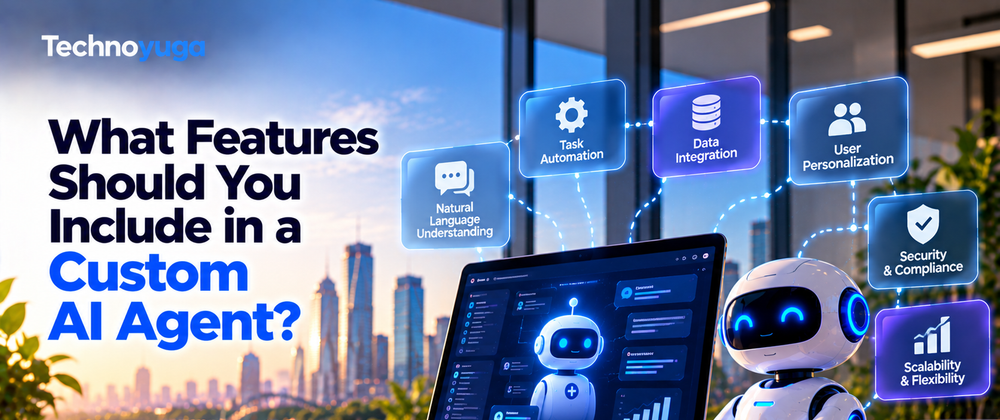
A custom agent needs more than a chat window. It must understand its assigned task, retrieve reliable information, interact with existing systems, and recognize when it should stop. Those requirements differ for a sales assistant, an internal research agent, and a system that prepares purchase orders. This distinction matters in production.
An experienced AI agent development company can help businesses decide which capabilities belong in the first version and which can wait. Technoyuga offers custom agent development and integration services, but the same questions should guide any provider.
Before investing, consider these ten features. Each addresses a practical issue that can determine whether employees trust the agent or return to manual work.
Key Takeaways
- Define actions and limits before development.
- Connect agents to trustworthy systems.
- Include approval, security, and failure controls.
- Measure completed tasks, not chat volume.
1. Clear Instructions and Business-Specific Workflows
Defined responsibilities and boundaries. An agent needs a specific job. "Handle customer support" is vague; "check delivery status and prepare return requests" is easier to test. Describe which information it may use, what it can change, and when to escalate. A return agent, for instance, should not create exceptions to company policy. Make those boundaries visible to staff so they know what to expect.
Task planning and progress tracking. Multi-step work requires a clear sequence. The agent may need to verify an order, check eligibility, and create a draft request. It should track completed steps so it does not repeat an action when a customer sends another message. Start with one well-defined workflow before attempting a network of agents.
2. Reliable Integrations, Knowledge Access, and Memory
Secure connections to business tools. AI agents become useful when they can retrieve records or take approved actions through CRM, inventory, scheduling, or ticketing systems. An agent confirming delivery status must check the actual shipment record rather than guess from a previous conversation.
Reliable knowledge retrieval. For policy questions, the agent should search current approved documents and provide references where useful. Outdated information needs clear version control. Access rules should apply to retrieved documents, not only to the agent's tools.
Context and selective memory. Remembering a customer's order number during an interaction prevents repeated questions. Longer-term memory should be limited to necessary information, with retention and deletion rules. Memory is not a reason to store everything a person says.
3. Security and Human Approval for Sensitive Actions
Role-based access and safety controls. A support agent may read an order status but should not automatically see payment credentials or edit financial records. Use authentication, limited permissions, and checks against suspicious instructions hidden in retrieved content. Standard software security still applies.
Human approval and handoff. The agent should pause before issuing large refunds, deleting records, or performing other high-impact actions. When it cannot verify a fact or complete a task, it should transfer the case with the information already collected. That prevents customers from starting over and keeps employees responsible for consequential decisions.
4. Error Recovery and Transparent Task Status
- Failure handling and safe retries. Real systems time out, return incomplete records, or go offline. An agent should explain when a task is pending and avoid pretending it succeeded. A payment-related action must not be repeated blindly after a network error, or duplicate transactions may occur.
Give the user a clear status: completed, awaiting approval, or unable to proceed. Record actions so support staff can investigate. Reliable AI agent development solutions need these safeguards just as much as they need accurate language responses. Otherwise, an automated workflow can create more manual corrections than it removes.
5. Testing, Monitoring, and Performance Measurement
- Evaluations and activity monitoring. Test routine requests as well as ambiguous instructions, missing data, and failed integrations. Measure whether the agent completes tasks correctly, how often employees intervene, and whether it follows approval rules.
After launch, track tool calls, errors, response times, and changes in outcomes. A customer support agent that responds instantly but closes the wrong tickets is not successful. Monitoring should respect privacy and avoid collecting unnecessary personal information. Check results by task type because one overall success rate can hide repeated failures.
Regular testing is essential when company policies, connected systems, or models change. Useful AI agent development services include post-launch improvement, not only the initial build.
6. Cost Controls and Room to Grow
- Usage limits and scalable design. Each model request, database query, and external service can add operating costs. Set limits on repeated attempts, monitor cost per completed task, and use simpler automation for predictable steps when possible.
An enterprise may eventually need separate agents for sales, support, and internal operations. That does not mean a startup needs multi-agent architecture immediately. Begin with one agent that solves a measurable problem. Add new capabilities only when usage data supports them. Document who can change these limits as more departments adopt the tool.
An experienced AI agent development company should explain how the architecture can grow without increasing complexity before it is necessary.
Why Choose Technoyuga?
Businesses selecting a development partner need someone who can connect AI capabilities with existing software and day-to-day workflows. Technoyuga provides AI agent development services covering strategy, custom agent development, enterprise integrations, multi-agent systems, deployment, and ongoing monitoring.
Its published approach includes understanding requirements, designing agent workflows, connecting data sources, testing performance, and improving systems after launch. That range is relevant when an agent needs to do more than respond to messages.
For example, a distributor might want an agent that checks shipment records, prepares customer updates, and routes unusual cases to staff. The practical questions concern permissions, data accuracy, and what happens when an integration fails.
As an AI agent development company in India, Technoyuga is one option for organizations comparing development partners. Ask for relevant project examples, security responsibilities, maintenance terms, and measurable acceptance criteria before committing. Those details matter more than claims about offering the "best AI agent development services."
Conclusion
The right features in a custom AI agent depend on the work it must complete. Clear instructions, reliable integrations, trusted knowledge, selective memory, and sensible permissions form the foundation. Human approvals, safe retries, monitoring, and cost controls help the application perform reliably after launch.
Before hiring an AI agent development company, choose one repetitive workflow and decide what success looks like. Test difficult situations, not just prepared demonstrations, and include employees in reviews. Avoid adding features that make the product harder to operate without improving results.
Technoyuga is one provider businesses can evaluate for custom agent development and system integration. Choose a partner that can explain how every proposed feature will make work safer, faster, or easier to manage consistently.




Top comments (0)