

Universities manage large numbers of students, courses, assignments, assessments, and learning activities. Monitoring student performance across all these areas can be challenging, especially when academic information is spread across different systems.
Traditional methods of tracking performance often depend on attendance registers, examination results, assignment records, and manual reports. While these methods provide useful information, they may not always give educators a complete picture of how students are progressing throughout a semester.
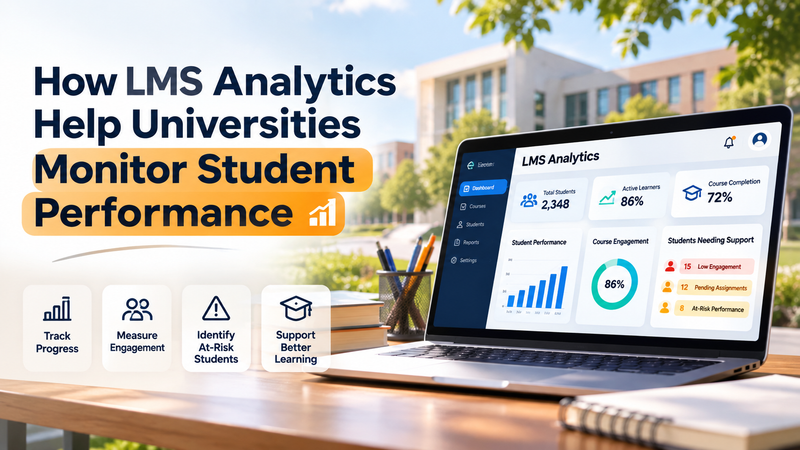
This is where LMS analytics can help. By collecting and organizing learning-related data, a Learning Management System (LMS) can help universities understand student engagement, monitor academic progress, identify learning difficulties, and make more informed academic decisions.
In this article, we explore how LMS analytics work, which metrics universities can monitor, and how learning analytics can support better student performance management.
What Is LMS Analytics?
LMS analytics refers to the collection, measurement, and analysis of data generated through a Learning Management System. It helps universities understand how students interact with digital learning materials, participate in academic activities, and perform in assessments.
An LMS can record different types of learning activities, depending on its available features. These may include:
- Course access and login activity
- Learning material views and downloads
- Assignment submissions
- Assessment scores
- Course completion progress
- Participation in online learning activities
- Student engagement patterns
Universities can use this information to understand how students are progressing through their courses.
For example, if a student regularly accesses course materials but performs poorly in assessments, educators may need to investigate whether the student is facing difficulties understanding particular subjects.
LMS analytics makes it easier to identify such patterns and take appropriate academic action.
Why Is Student Performance Monitoring Important for Universities?
Student performance monitoring is an important part of academic management. Universities need to understand whether students are attending to their learning responsibilities, completing coursework, meeting academic expectations, and progressing towards their educational goals.
Without consistent monitoring, academic difficulties may only become visible during semester examinations or final assessments.
Effective performance monitoring helps universities:
- Identify students who may need additional academic support.
- Understand student participation in online learning.
- Monitor assignment and assessment progress.
- Evaluate course engagement.
- Identify subjects where students commonly struggle.
- Support faculty members with academic progress information.
- Make informed decisions about teaching and learning activities.
By using learning analytics, universities can move beyond relying only on final examination results and gain a broader understanding of student progress.
7 Ways LMS Analytics Help Universities Monitor Student Performance
1. Track Student Learning Progress
One of the most useful applications of LMS analytics is tracking student progress throughout a course.
Universities can use available LMS reports to understand whether students are accessing learning materials, completing assignments, and progressing through course activities.
For example, faculty members may identify students who have not completed important learning modules or who are falling behind on coursework.
This information helps educators follow up with students before academic difficulties become more serious.
Progress monitoring can also help universities understand how different groups of students are progressing across subjects and semesters.
2. Monitor Student Engagement
Student engagement provides useful information about how learners interact with their academic content.
LMS analytics can help universities examine indicators such as:
- Frequency of course access
- Time spent on learning activities, where available
- Learning material interactions
- Participation in online activities
- Assignment submission activity
These indicators can help faculty members understand whether students are actively participating in digital learning.
However, engagement data should be interpreted carefully. A student who spends less time on the LMS may still be studying through textbooks, classroom sessions, or other learning resources.
Therefore, universities should combine LMS activity data with classroom observations, faculty feedback, attendance information, and assessment results.
3. Identify Students Who May Need Academic Support
Early identification of academic difficulties is one of the important benefits of monitoring student performance.
LMS reports may help universities identify patterns such as:
- Repeatedly missed assignments
- Low assessment scores
- Incomplete course modules
- Reduced participation
- Limited access to learning resources
For example, if a student repeatedly misses assignment deadlines and receives low assessment scores, faculty members may consider providing additional guidance.
Early intervention can include mentoring, additional learning materials, remedial sessions, or individual academic discussions.
It is important to remember that LMS analytics should support academic decisions rather than automatically label students as underperforming.
4. Analyse Assignment and Assessment Performance
Assignments and assessments help educators evaluate how well students understand course topics.
An LMS can organize assessment-related information, including assignment submissions, quiz results, and test scores, depending on the platform's capabilities.
Universities can use this information to:
- Monitor assignment completion.
- Review assessment scores.
- Identify frequently misunderstood topics.
- Compare performance across different assessments.
- Understand subject-level learning difficulties.
For example, if many students perform poorly in the same assessment, faculty members may need to review the teaching approach, learning materials, or assessment difficulty.
This makes assessment analytics useful not only for monitoring individual students but also for improving course delivery.
5. Compare Performance Across Courses and Departments
Universities offer multiple programmes, departments, and subjects. Monitoring performance across these areas can help academic administrators understand broader learning patterns.
Depending on the LMS reporting capabilities, universities may analyse:
- Course completion rates
- Assignment submission trends
- Assessment performance
- Student participation
- Learning activity completion
For example, academic administrators may notice that students in one course consistently struggle with a particular module.
This information can encourage departments to review the course structure, learning resources, and academic support methods.
Performance comparisons should consider differences in course difficulty, assessment methods, and student backgrounds rather than relying on raw scores alone.
6. Support Faculty Members with Learning Insights
LMS analytics can help faculty members understand how students interact with their course content.
Instead of relying entirely on examination results, educators can review available learning activity information throughout the semester.
These insights may help faculty members:
- Identify topics that require additional explanation.
- Monitor assignment completion.
- Review student participation.
- Recognize students who may need extra attention.
- Evaluate the effectiveness of learning materials.
For example, if a large number of students repeatedly perform poorly in assessments related to one topic, the faculty member can provide additional explanations or supplementary resources.
This supports a more informed approach to teaching and academic support.
7. Make Data-Informed Academic Decisions
Universities need reliable information when making decisions about academic planning and student support.
LMS analytics can organize learning data into reports that help administrators and faculty members understand student progress.
These insights can contribute to decisions related to:
- Academic mentoring programmes
- Additional learning support
- Course content improvements
- Faculty planning
- Student engagement initiatives
- Academic performance reviews
When learning data is reviewed consistently, universities can identify patterns and make decisions based on evidence rather than assumptions.
Important LMS Analytics Metrics Universities Should Monitor
The metrics available depend on the LMS platform, its integrations, and the way the university uses it. However, the following indicators can provide useful information about student performance.
Student Progress Metrics
- Course completion rate
- Learning module completion
- Assignment completion rate
- Assessment completion
These metrics help universities understand whether students are progressing through their academic activities.
Student Engagement Metrics
- Course access frequency
- Learning material interactions
- Participation in online activities
- Time spent on learning activities, where available
These indicators help educators understand how students interact with digital learning environments.
Academic Performance Metrics
- Assignment scores
- Quiz results
- Test performance
- Assessment score trends
- Subject-level performance
These metrics help faculty members evaluate student understanding and identify areas that may require additional support.
Course-Level Metrics
- Course completion trends
- Assessment performance by course
- Learning activity completion
- Participation across subjects
These indicators can help academic administrators review course effectiveness and identify opportunities for improvement.
LMS Analytics vs Traditional Student Performance Monitoring
Traditional academic monitoring and LMS analytics both support student performance management, but they provide information in different ways.
| Area | Traditional Monitoring | LMS Analytics |
|---|---|---|
| Data collection | Often involves manual records and separate systems | Can organize learning activity data within the LMS |
| Progress tracking | Commonly based on attendance and examination results | Can include course and learning activity progress |
| Assignment monitoring | May require manual tracking | Can provide assignment-related reports |
| Student engagement | Often depends on classroom observation | Can include digital learning activity indicators |
| Reporting | May require manual report preparation | Can provide reports based on available LMS data |
| Academic support | Often depends on periodic performance reviews | Can help identify patterns throughout the course |
An LMS does not necessarily replace traditional academic monitoring. Instead, it can complement classroom observations, faculty assessments, attendance records, and other institutional data.
How Universities Can Use LMS Analytics Effectively
Having access to learning data is only the first step. Universities also need a clear process for using analytics to improve student learning.
Step 1: Define Academic Monitoring Goals
Universities should first identify what they want to monitor.
For example, goals may include improving assignment completion, monitoring course progress, understanding student engagement, or identifying students who need academic support.
Clear goals help institutions focus on meaningful metrics.
Step 2: Select Relevant Performance Metrics
Not every available metric is equally useful.
Universities should select indicators that support their academic objectives. For example, assignment completion and assessment scores may be more relevant when monitoring academic progress, while course access and participation may help understand digital engagement.
Step 3: Review Reports Regularly
Faculty members and academic administrators should review LMS reports at appropriate intervals.
Weekly or monthly reviews can help identify changes in student activity and performance.
Regular monitoring also makes it easier to follow up on incomplete academic activities.
Step 4: Take Action Based on Insights
Analytics becomes valuable when universities use the information to improve learning outcomes.
If reports indicate that students are struggling with a particular subject, faculty members can provide additional learning resources, mentoring, or revision sessions.
Step 5: Evaluate the Results
After introducing academic support measures, universities should review whether student participation, assignment completion, or assessment performance has improved.
This creates a continuous improvement process for teaching and learning.
Challenges Universities Should Consider When Using LMS Analytics
Although LMS analytics can support academic monitoring, universities should consider a few important challenges.
Data Accuracy
Analytics is only useful when the underlying information is accurate. Incomplete records, inconsistent student activity, or incorrect data can affect the quality of reports.
Student Data Privacy
Universities handle sensitive academic information. They should establish appropriate access controls and follow applicable data protection requirements when collecting, storing, and analysing student information.
Correct Interpretation of Data
Low LMS activity does not always mean poor academic performance. Students may use offline learning resources or attend classroom sessions without accessing digital materials frequently.
Therefore, analytics should be considered alongside other academic information.
Faculty Training
Faculty members and administrators need to understand how to interpret LMS reports and use them effectively.
Training can help institutions avoid relying on misleading metrics or making decisions based on incomplete information.
Integration with Existing Systems
Universities may already use student information systems, attendance platforms, examination systems, and other academic tools.
The ability to integrate relevant information can improve the overall understanding of student performance.
How an LMS Supports Better Academic Management
A Learning Management System provides a centralized digital environment for managing learning activities and academic resources.
For universities, an LMS can support course delivery, learning material management, student participation, and academic administration, depending on the features available in the platform.
When combined with analytics and reporting capabilities, an LMS can help institutions understand how students interact with digital learning environments.
Universities looking to improve their digital learning processes can explore LMS solutions for educational institutions to understand how learning management systems support institutional requirements.
They can also learn more about the role of digital learning platforms in modern education.
For universities evaluating their LMS requirements, understanding the available features, reporting options, usability, and institutional needs is an important part of the selection process.
The Future of Learning Analytics in Higher Education
Learning analytics is becoming an important area of digital education as universities increasingly use technology to manage academic activities.
As learning platforms develop, institutions may gain access to more advanced reporting, data visualization, and analytical capabilities.
These developments can help universities understand learning patterns, evaluate academic activities, and provide more timely support to students.
However, technology alone cannot improve academic performance. Meaningful results depend on how universities combine learning data with faculty expertise, student feedback, academic planning, and effective teaching practices.
The goal should be to use analytics to support students and improve the overall learning experience.
Conclusion
LMS analytics can help universities monitor student performance by organizing information about course progress, learning engagement, assignments, and assessments.
These insights can help faculty members identify students who may need additional academic support, understand learning patterns, and make more informed teaching decisions.
By combining LMS reports with classroom observations and regular academic reviews, universities can develop a more complete understanding of student progress.
As higher education continues to adopt digital learning technologies, learning analytics can play an important role in supporting effective academic management and continuous improvement.







Top comments (0)