

From smart home appliances and wearable devices to connected traffic systems, the Internet of Things (IoT) is changing how people interact with technology. Devices can collect information, communicate with other systems, and perform tasks using connected networks. Understanding these technologies is becoming increasingly valuable for students, particularly as schools look for practical ways to introduce digital skills and real-world applications into education.
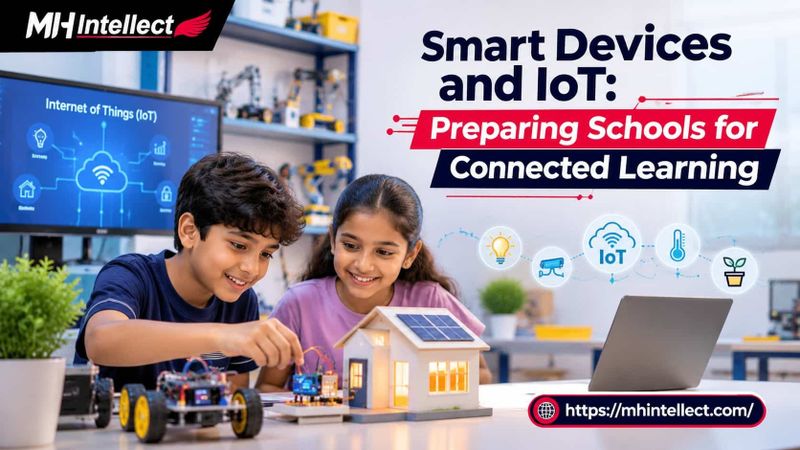
Exploring Smart devices and IoT helps students understand how everyday objects use sensors, software, and internet connectivity to exchange information and perform specific functions. It also creates opportunities for schools to connect technology concepts with practical STEM learning.
Understanding How IoT Devices Work
The Internet of Things connects physical devices to networks, allowing them to collect, exchange, and process information. Learning how IoT devices work introduces students to the relationship between sensors, connectivity, data, and automated actions.
A smart temperature sensor, for example, can measure the surrounding temperature and send readings to a connected system. The system can then display the information or trigger an action based on predefined conditions.
Most basic IoT systems involve four important elements:
- Sensors: Collect information such as temperature, light, movement or humidity.
- Connectivity: Transfers collected information between devices and systems.
- Data processing: Interprets the information and determines what action may be required.
- Output: Displays information or activates a connected device.
Understanding these elements helps students see how connected technologies operate beyond the screens they use every day.
Why IoT Education Matters for Schools
Introducing IoT concepts into classrooms allows students to explore how technology solves practical problems. Instead of learning only through theoretical explanations, they can investigate sensors, experiment with electronic components, and understand how connected systems respond to different conditions.
IoT education in UAE schools can create opportunities to connect classroom learning with areas such as smart infrastructure, environmental monitoring, automation, and digital innovation.
For schools, these experiences can support the development of:
- Computational thinking and logical reasoning
- Basic electronics and programming knowledge
- Data interpretation and analytical skills
- Practical problem-solving and experimentation
- Collaboration and engineering design
These skills help students understand the technologies influencing modern industries and everyday life.
Practical IoT Projects for Students
Hands-on activities make IoT concepts easier to understand because students can observe the results of their programming and experiments.
IoT projects for students can begin with simple sensor-based activities and gradually progress towards more integrated systems.
Some suitable classroom project ideas include:
- Smart temperature monitoring: Use a sensor to collect and display temperature readings.
- Automated lighting: Explore how light sensors can control lighting based on environmental conditions.
- Smart plant monitoring: Measure soil moisture and understand how connected systems can support plant care.
- Environmental monitoring: Collect basic information about surrounding conditions and interpret the results.
These projects encourage students to design, build, test and improve their solutions while connecting scientific concepts with technology.
Understanding IoT Security Challenges
As connected devices collect and exchange information, security and privacy become important considerations. Exploring IoT security challenges helps students understand why connected systems need appropriate protection.
Schools can introduce basic concepts such as secure passwords, responsible data sharing, software updates, device permissions and the importance of protecting personal information.
Teaching these principles alongside practical IoT activities helps students develop responsible digital habits rather than focusing only on how devices function.
Connecting IoT with STEAM Education
IoT becomes even more meaningful when combined with Science, Technology, Engineering, Arts and Mathematics. IoT and STEAM education can bring different learning areas together through projects that involve observation, design, coding, measurement, and experimentation.
For example, a smart plant monitoring project combines scientific understanding of plant growth, electronic sensors, programming logic, and mathematical interpretation of moisture readings.
Schools can use these integrated activities to encourage creativity, collaboration and practical problem-solving while helping students understand how different subjects contribute to real-world technology.
Building Future-Ready Learning Through IoT
Introducing IoT into school education requires more than purchasing connected devices or electronic kits. Effective implementation needs structured learning objectives, age-appropriate projects, teacher guidance, and a clear progression of technical skills.
Schools can explore IoT Education for Schools to understand how connected technology can become part of a broader educational approach.
Conclusion
Smart devices and IoT are creating new possibilities across homes, businesses, industries and educational environments. Helping students understand connected systems through practical projects can strengthen their technical knowledge, digital awareness and problem-solving abilities.
By integrating IoT into structured STEM and STEAM learning, schools can give students meaningful opportunities to explore technology, understand real-world applications and develop skills for an increasingly connected future.







Top comments (0)