

Education is evolving beyond traditional classroom instruction. Students need more than subject knowledge to understand real-world challenges. They need the ability to connect ideas, think creatively and develop practical solutions. This is why STEAM education is becoming an important approach for schools preparing students for a technology-driven future.
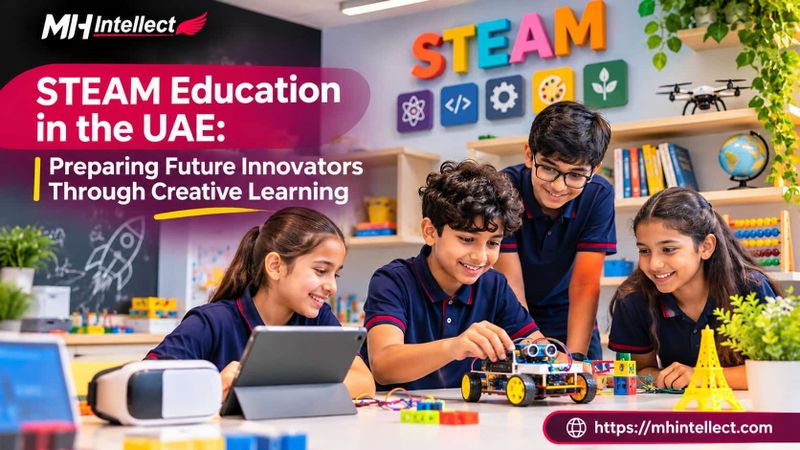
STEAM brings together Science, Technology, Engineering, Arts and Mathematics through interdisciplinary learning. Instead of studying these subjects separately, students apply knowledge from different areas to investigate problems, design solutions and test their ideas. For UAE schools, this approach creates opportunities to connect classroom learning with robotics, artificial intelligence, sustainability and engineering.
Understanding the Difference Between STEM and STEAM Education
The main difference in STEM vs STEAM education is the integration of Arts into technical learning. Arts does not simply mean drawing or decoration. It includes design thinking, visual communication, creativity and understanding how people interact with the solutions students develop.
For example, a robotics project can teach students how to build and programme a working robot. A STEAM approach takes the activity further by encouraging them to consider its design, usability and how effectively they can communicate its purpose.
This combination helps students understand that successful innovation requires both technical knowledge and creative thinking.
Why STEAM Education Matters for UAE Schools
The UAE continues to focus on innovation, technology, sustainability and future-ready skills. Through UAE Vision 2031, also known as We the UAE 2031, developing knowledge, creativity and innovation remains an important national priority.
Schools can support these ambitions by giving students opportunities to apply classroom concepts to practical challenges. STEAM projects involving robotics, AI, environmental monitoring and engineering design help students understand how different subjects contribute to solving real-world problems.
Some important skills developed through STEAM learning include:
- Critical thinking and problem-solving: Students investigate open-ended challenges and evaluate different solutions.
- Creativity and innovation: Design activities encourage students to develop original ideas and improve their work.
- Collaboration and communication: Group projects help students share responsibilities, explain decisions and present outcomes.
- Technology literacy: Practical activities introduce students to coding, robotics, AI and connected technologies.
- Real-world application: Students connect academic concepts with challenges they can observe in their surroundings.
These skills develop through consistent learning experiences supported by clear educational objectives.
Building a Progressive STEAM Curriculum Across School Levels
A meaningful STEAM curriculum should develop progressively as students gain knowledge and confidence. Learning activities need to match their age, abilities and curriculum requirements.
At the earliest stage, Early Years STEM Education introduces curiosity, observation, construction and simple cause-and-effect activities. As children progress into primary school, they can explore structured experiments, introductory robotics, visual coding and creative design challenges through a Primary School STEM Programme.
Middle school learning becomes more challenging, with students exploring engineering design, environmental monitoring, coding and collaborative projects through a Middle School STEM Programme. At secondary level, learning connects with more advanced applications such as artificial intelligence, IoT systems, engineering projects and research-based innovation through a Secondary School STEM Programme.
This progression helps students build strong foundations before moving towards more complex interdisciplinary challenges.
What Makes a Successful STEAM Program for Schools?
A successful STEAM program requires more than introducing new technology or organising occasional workshops. Schools need structured planning, curriculum alignment and teachers who can guide students through practical investigations.
A strong programme should include clearly defined learning objectives, age-appropriate projects, teacher development, opportunities for experimentation and assessment of both learning processes and project outcomes.
Schools can begin with manageable classroom activities and gradually expand their programmes based on available resources, teacher readiness and student learning needs. Working with an experienced STEM Implementation Partner can support curriculum planning, teacher training and consistent programme delivery.
Preparing the Next Generation of Innovators
STEAM education is not about replacing traditional subjects. It strengthens them by helping students connect academic knowledge with creativity, practical application and independent thinking.
Through structured STEM programs for schools, students can develop the confidence to investigate challenges, test ideas and create meaningful solutions. MH Intellect supports schools in building progressive, practical learning experiences that connect classroom education with future-focused skills.
By integrating creative and technical learning from Early Years to Secondary School, UAE schools can create stronger foundations for students to become the innovators, designers and problem-solvers of tomorrow.







Top comments (0)