

Education plays a vital role in preparing the next generation for a rapidly changing world. As technology transforms industries and creates new career opportunities, schools need learning approaches that develop creativity, critical thinking, problem-solving and technological understanding. STEM Education brings science, technology, engineering and mathematics together through practical activities that help students apply classroom knowledge to real-world challenges.
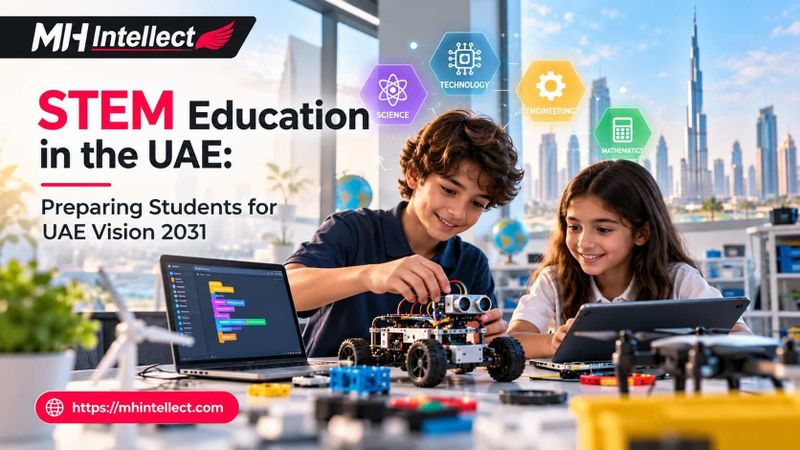
How STEM Education Supports UAE Vision 2031
The UAE continues to emphasise innovation, education, sustainability and the development of future-ready capabilities. UAE Vision 2031 provides a national framework for advancing the country's development priorities, making education and skills development important considerations for schools preparing students for the future.
Through UAE Vision 2031 education initiatives and the broader ambitions of We the UAE 2031, schools can consider how practical STEM learning supports scientific understanding, digital skills and innovation. Activities involving robotics, coding, engineering design and experimentation help students understand how technology works rather than simply learning about it theoretically.
For school leaders and academic coordinators, the challenge is to translate these ambitions into meaningful classroom experiences. Structured STEM learning can help bridge the gap between academic concepts and practical applications while encouraging students to explore emerging technologies responsibly.
Why Schools Need Structured STEM Programs
Effective STEM Programs provide students with opportunities to investigate questions, build models, test ideas and improve their solutions. These activities connect mathematics and scientific principles with engineering challenges and technological applications, making learning more engaging and relevant.
For example, students can build a simple robotic system to explore movement, programme a device to follow instructions or design a model that demonstrates energy efficiency. Such activities encourage learners to analyse results, communicate their reasoning and collaborate with classmates.
A successful approach to STEM Education for schools also requires curriculum alignment, appropriate learning resources, teacher training and measurable outcomes. When activities are carefully planned, STEM becomes a progressive part of education rather than an occasional enrichment session.
Developing STEM Skills at Every School Stage
Students benefit from STEM experiences that match their age, abilities and existing knowledge. Early learning should encourage curiosity and exploration, while later stages can introduce increasingly complex engineering and programming challenges.
Early Years STEM Education can introduce foundational concepts through building, sorting, observing and simple experiments. These experiences help young learners develop curiosity, spatial awareness and early problem-solving skills.
During primary education, students can explore basic scientific principles, mathematics and introductory coding. A Primary School STEM Programme can connect these concepts through guided projects that encourage experimentation and teamwork.
At the middle school level, learners can investigate robotics, programming and engineering design. A Middle School STEM Programme supports more advanced challenges that develop logical reasoning and analytical thinking.
Secondary school students can progress towards complex projects involving automation, electronics, artificial intelligence and engineering. A Secondary School STEM Programme can help learners connect classroom knowledge with further education and future career pathways.
Practical Ways to Strengthen STEM Learning
Schools can build meaningful STEM experiences by focusing on activities that connect theory with application. Key priorities include:
- Hands-on projects: Encourage students to build, test and improve practical solutions.
- Robotics and coding: Introduce programming logic, automation and computational thinking.
- Engineering challenges: Help learners investigate structures, motion, materials and design.
- Collaborative learning: Give students opportunities to share ideas and solve problems in teams.
- Teacher development: Equip educators with the knowledge and confidence to facilitate practical activities.
- Progressive assessment: Evaluate students' understanding, reasoning and ability to improve their designs.
These approaches help schools develop skills progressively while keeping learning purposeful and connected to curriculum objectives.
Choosing the Right STEM Education Partner
Successful implementation requires a clear plan, suitable resources and support for teachers. Schools can explore Why MH Intellect to learn more about its approach to supporting institutions with structured STEM education.
MH Intellect helps schools explore practical STEM learning approaches that connect educational objectives with technology, robotics, coding and engineering activities. Schools can also visit the MH Intellect Gallery to explore examples of student projects and hands-on learning experiences.
Ready to prepare your students for a technology-driven future? Contact MH Intellect to discuss your school's educational goals and explore curriculum-aligned STEM programmes that encourage innovation, practical problem-solving and future-ready skills in support of the UAE's educational ambitions.






Top comments (0)