


Industrial connectivity has changed fast. Businesses no longer connect only office PCs and a few branch devices. They now connect sensors, PLCs, cameras, kiosks, meters, gateways, field assets, and mobile machines across many locations.
That shift is putting pressure on old network setups. Traditional wired systems often struggle in remote, moving, temporary, or hard-to-wire environments. At the same time, industrial systems now need better uptime, faster failover, and more secure remote access.
The market data shows why this matters. Ericsson forecasts cellular IoT to reach around 5 billion by 2025, with roughly 2.6 billion being 4G/5G‑based Broadband and Critical IoT connections. It also expects Broadband and Critical IoT, largely powered by 4G and 5G, to reach 2.6 billion connections by the end of 2025. Ericsson also notes that many 2G and 3G networks are being phased out, which is pushing industrial deployments toward modern cellular connectivity.
That is one big reason Dual SIM 4G LTE Industrial Routers are replacing traditional network systems. They offer mobility, redundancy, remote control, and industrial-grade resilience in a way older architectures often cannot match.
What Are Dual SIM 4G LTE Industrial Routers?
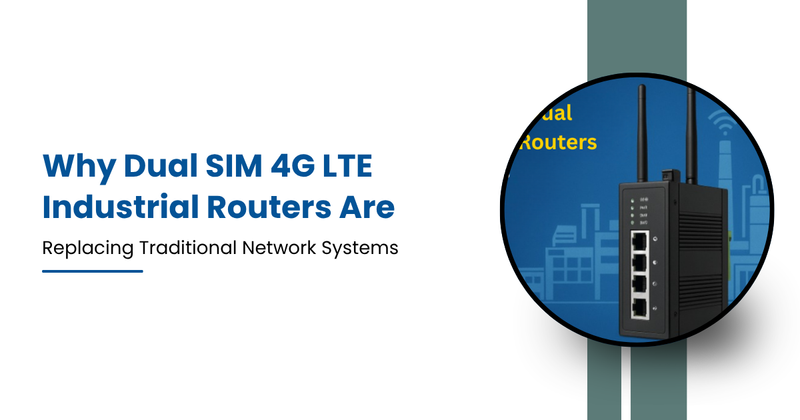
A Dual SIM 4G LTE Industrial Router is a rugged networking device designed for industrial and field environments. It connects machines, controllers, edge devices, and local networks to the internet or private enterprise systems using cellular connectivity.
The “dual SIM” part matters. It means the router can work with two SIMs, often from different telecom operators. That allows better uptime, carrier failover, and deployment flexibility.
These routers are commonly used in:
- Factories
- Utilities
- Transportation
- Oil and gas sites
- Warehouses
- ATMs and kiosks
- Smart city infrastructure
- Remote monitoring systems
Unlike home or office routers, industrial models are built for rough conditions, remote administration, and machine-to-machine communication.
Why Traditional Network Systems Are Starting to Fall Behind
Traditional network systems were built for a different operating model. They worked best when devices stayed in one place, traffic stayed predictable, and network changes happened slowly.
That is no longer how many industrial environments work.
A legacy setup often depends on:
- Fixed broadband
- Wired Ethernet backhaul
- Manual failover
- Site-by-site network maintenance
- Limited mobility support
This creates problems in modern industrial deployments, especially when operations spread across moving assets, temporary sites, or harsh outdoor locations.
The issue is not that traditional systems are useless. The issue is that many of them were not designed for distributed, always-on, data-heavy operations.
Why Modern Industrial Networks Need More Than Fixed Connectivity
Industrial systems now operate in more dynamic environments. Machines move. Temporary sites go live quickly. Field teams work across wide geographies. Devices generate constant telemetry and event traffic.
This creates several technical demands:
- High availability
- Low-touch deployment
- Remote visibility
- Secure device access
- Carrier flexibility
- Better resilience during outages
Even small delays can matter. Cloudflare explains that network latency directly affects how quickly systems and applications respond. In industrial environments, this can affect alerts, dashboards, remote sessions, and machine-level communication.
That is why many businesses are replacing fixed-only network systems with more flexible industrial cellular architectures.
Key Reasons Dual SIM 4G LTE Industrial Routers Are Replacing Traditional Network Systems
Traditional network setups often struggle with downtime, limited flexibility, and single-point failures. That is why Dual SIM 4G LTE industrial routers are becoming a more reliable choice for modern business connectivity.
1) They Provide Better Network Uptime
Uptime is one of the biggest reasons businesses switch. Traditional networks often depend on one ISP or one WAN path. If that connection fails, the site can go offline. Dual SIM 4G LTE Industrial Routers reduce this risk with carrier failover.
This helps protect:
- Remote SCADA access
- ATM connectivity
- Fleet tracking
- Site telemetry
- Industrial monitoring
2) They Work Better in Remote and Hard-to-Wire Locations
Many industrial sites do not have reliable fiber or broadband access. In these environments, traditional networking becomes slow and expensive to deploy. Cellular industrial routers offer a faster and more practical option.
Common deployment areas include:
- Solar farms
- Water treatment sites
- Mining zones
- Roadside cabinets
- Construction sites
- Agricultural sites
3) They Support Faster Failover Than Legacy Setups
Industrial operations need continuity, not just internet access. A network failure can interrupt visibility, alerts, and device communication. Dual SIM routers reduce this risk by switching networks automatically.
This is especially useful for:
- Unattended sites
- Utility networks
- Retail edge systems
- Remote equipment monitoring
4) They Fit Mobile and Distributed Operations Better
Traditional networks work best in fixed locations. Many modern industrial assets do not stay in one place. Dual SIM 4G LTE Industrial Routers are better suited for moving and distributed operations.
Common use cases include:
- Vehicles
- Mobile clinics
- Field trailers
- Temporary command units
- Portable industrial equipment
5) They Are Better for Edge and IoT Deployments
Industrial networks now support much more than office traffic. They often carry telemetry, protocol traffic, edge workloads, and machine communication. That makes industrial routers part of the operational stack.
They often support:
- PLC communication
- Edge gateways
- Sensor telemetry
- Local dashboards
- VPN access
- Firewall controls
6) They Help Reduce Downtime During Carrier Issues
Carrier performance changes by location, building, and region. A single-SIM setup creates unnecessary risk when coverage weakens or one network becomes unstable. Dual SIM support improves connectivity resilience.
This helps with:
- Carrier failover
- Signal-based fallback
- Regional coverage flexibility
- Backup network availability
7) They Make Remote Network Management Easier
Industrial deployments often involve many distributed endpoints. Managing them manually takes time and resources. Industrial cellular routers make this easier through remote visibility and control.
This helps teams manage:
- Configuration updates
- SIM status
- Signal quality
- Connection health
- Data usage
- Remote diagnostics
8) They Support Secure Industrial Connectivity More Effectively
Security is a major reason businesses replace older network systems. Many legacy environments still rely on weak or fragmented remote access. Industrial routers support stronger and more controlled connectivity.
Common security features include:
- IPsec or OpenVPN
- Private APN support
- Firewall rules
- Network segmentation
- Controlled remote access
9) They Are Easier to Scale Across Many Sites
Traditional network expansion often takes too much time and coordination. New sites may require ISP setup, cabling, and on-site engineering. Industrial cellular routers reduce this deployment friction.
This is especially useful for:
- Retail chains
- EV charging networks
- Smart utility rollouts
- Branch industrial sites
- Logistics networks
10) They Offer a Better Bridge Between 4G Today and 5G Tomorrow
Many businesses assume 4G is outdated. In industrial networking, that is not true. What matters more is reliability, coverage, compatibility, and deployment maturity.
4G LTE remains valuable because it offers:
- Stable coverage
- Proven field performance
- Wide device compatibility
- Lower deployment risk
- Practical migration to 5G
That is why Dual SIM 4G LTE Industrial Routers remain a strong long-term connectivity choice.
Also Read: Smart, Secure, and Always Online: The Dual SIM 4G LTE Industrial Router Advantage
Why Dual SIM Matters More Than Many Buyers Realize
Many people focus on LTE speed first. In industrial use, that is often the wrong first question.
The more important question is: What happens when the connection fails?
That is where dual SIM changes the value of the router.
It helps with:
- Carrier failover
- Uptime resilience
- Regional deployment flexibility
- Better field reliability
- Reduced service interruption risk
For industrial operations, that often matters more than peak throughput alone.
Technical Features That Make Industrial Routers Different
A home router and an industrial router are not built for the same job. Industrial-grade models usually offer more than just LTE access.
Common technical features include:
- Dual SIM failover
- VPN support
- Serial or industrial interface support
- DIN rail or panel mounting
- Remote management
- Harsh environment tolerance
- Better power input flexibility
For example, industrial models such as the RUTX12 support dual LTE, failover logic, load balancing, and industrial monitoring features designed for field deployments.
This is what makes them suitable for production operations, not just internet access.
Where Businesses Are Using Dual SIM 4G LTE Industrial Routers Today
Adoption is growing because the use cases are practical.
Common deployment areas include:
1. Manufacturing
Factories use them for machine telemetry, edge gateways, remote diagnostics, and backup connectivity.
2. Utilities
Power, water, and energy operators use them for remote substations, metering, and control-site communication.
3. Transportation and Fleet
Vehicle systems, onboard gateways, and fleet edge devices often depend on resilient cellular networking.
4. Retail and Kiosks
Retail chains use them for branch backup, POS continuity, kiosks, and unattended endpoints.
5. Smart Infrastructure
Cities and infrastructure operators use them for cameras, signage, traffic systems, and environmental sensors.
These are not edge cases anymore. They are becoming normal deployment patterns.
What Businesses Should Evaluate Before Replacing Traditional Network Systems
Not every router fits every industrial use case. Businesses should check carrier coverage at each site. They should define failover behavior clearly. Security and VPN needs must be considered. Data usage patterns also matter.
Remote management capability is important. Device and protocol compatibility should be verified. Installation conditions, indoor or outdoor, must be assessed. Future 5G plans should not be ignored.
The final decision should depend on workload, site conditions, and operational risk, not just cost.
Conclusion
Traditional network systems are being replaced because industrial operations now need more resilience, flexibility, and control than older architectures can easily provide.
Dual SIM 4G LTE Industrial Routers solve practical problems that fixed-only or single-path systems often cannot solve well. They improve uptime, support remote environments, reduce failover risk, and fit modern IoT and edge deployments much better.
That is why they are no longer seen as niche hardware. They are becoming a core part of how modern industrial connectivity is built in 2026.




Top comments (0)