

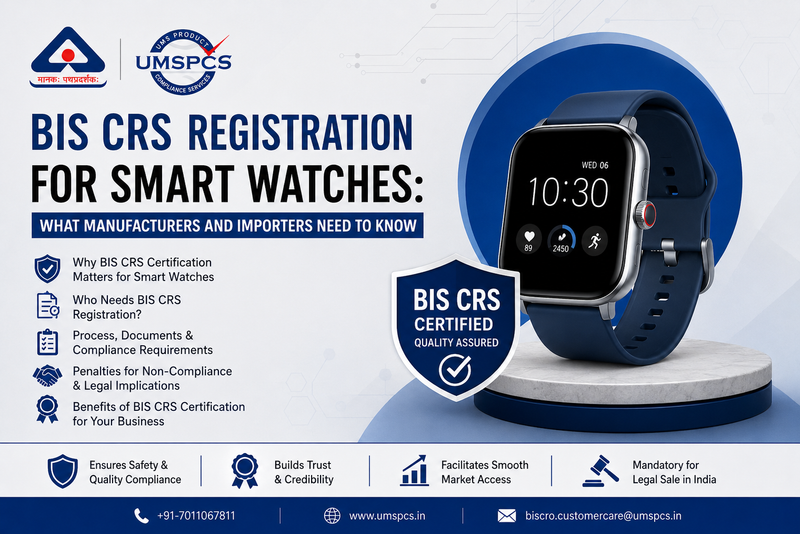
Smart watches have moved from a niche gadget category to one of the fastest-growing electronics segments in India. With that growth has come tighter regulatory scrutiny. If you manufacture, import, or sell smart watches in India, BIS registration under the Compulsory Registration Scheme (CRS) is no longer optional — it's a legal requirement that determines whether your product can be sold in the market at all.
This guide walks through what BIS CRS registration for smart watches its means for smart watches specifically, why it applies to this category, and what the registration process actually looks like in practice.
Why Smart Watches Fall Under BIS CRS
The Compulsory Registration Scheme exists to ensure that electronics and IT products sold in India meet baseline safety standards, particularly around electrical safety and electromagnetic interference. Smart watches, being battery-powered electronic devices with wireless connectivity, fall squarely into the categories notified under CRS by the Ministry of Electronics and Information Technology (MeitY).
Because smart watches combine a lithium-ion battery, a charging circuit, and wireless communication components, they are evaluated against safety standards that address risks like overheating, short circuits, and battery failure. Without CRS registration, these products cannot be legally imported, manufactured, stored for sale, or sold in India — regardless of how popular the brand is internationally.
Read More:- BIS ISI certification In India
What CRS Registration Actually Requires
Unlike voluntary certifications, CRS registration is mandatory for notified products, and it follows a defined process administered through BIS. For smart watches, this typically involves:
- Identifying the applicable Indian Standard Smart watches are generally tested against safety standards relevant to battery-operated electronic devices, often referencing IS 13252 (Information Technology Equipment Safety) or relevant standards for lithium-ion battery safety, depending on the product's specific configuration and components.
- Sample testing at a BIS-recognized lab Before registration, samples of the product must be tested at a laboratory recognized by BIS. The test report needs to confirm compliance with the applicable safety standard, covering parameters like electrical safety, battery performance under stress conditions, and electromagnetic compatibility where relevant.
- Application submission through the BIS portal Once test reports are in hand, the registration application is submitted online, along with supporting technical documentation, product details, and manufacturer information.
- Authorized Indian Representative (AIR) for overseas manufacturers If the smart watch is manufactured outside India, the foreign manufacturer must appoint an Authorized Indian Representative to handle registration and compliance matters on their behalf within India.
- Registration certificate and marking Once approved, BIS issues a registration number that must be displayed on the product, along with required compliance markings, before the product can be sold. Read More:- FMCS Registration in India Common Challenges Specific to Smart Watches Smart watches present a few registration challenges that are less common in simpler electronic devices: Multiple product variants — Brands often release smart watches in several colors, strap types, or minor hardware revisions. Each variant may need to be assessed to determine whether it requires separate registration or falls under an existing one. Battery and charging components — Since smart watches use compact lithium-ion batteries with proprietary charging mechanisms, test labs scrutinize these components closely, and any deviation from declared specifications can trigger additional testing. Frequent product refreshes — The smart watch market moves quickly, with new models launched every few months. Each significant change in hardware or wireless module may require a fresh registration rather than an amendment to an existing one. Documentation in the right format — Test reports and technical files need to align precisely with what BIS expects; generic manufacturer documentation often needs to be restructured before submission. Read More:- TEC Certification How UMSPCS Supports Smart Watch BIS CRS Registration UMSPCS works with smart watch manufacturers and importers — both Indian brands and overseas companies entering the Indian market — to manage the registration process end-to-end. This typically includes: Confirming which Indian Standard applies to your specific smart watch configuration Coordinating sample testing with BIS-recognized laboratories and tracking turnaround Preparing and structuring technical documentation for submission Acting as or coordinating with the Authorized Indian Representative for overseas manufacturers Managing the application process through the BIS portal and responding to queries Advising on whether product variants need separate registrations or can be covered under amendments Supporting renewal and compliance tracking after the registration is granted Because the smart watch category moves fast, UMSPCS also helps brands plan their compliance timeline alongside product launch schedules, so registration doesn't become the bottleneck that delays a market launch. What Happens If You Skip Registration Selling smart watches without valid CRS registration carries real consequences. Customs authorities can detain shipments at the port, e-commerce platforms increasingly ask sellers for BIS registration details before listing electronics, and regulatory inspections can result in penalties or forced product recalls. For brands that have invested in marketing and distribution for a launch, an unregistered product can mean the entire go-to-market plan stalls at the last step. Planning Ahead for New Launches Given how frequently smart watch models are refreshed, it's worth building BIS registration into your product development timeline rather than treating it as a final step before launch. Submitting samples for testing while finalizing other launch materials — packaging, marketing, retail tie-ups — can prevent registration delays from pushing back your entire release date. Final Thoughts BIS CRS registration for smart watches isn't just a regulatory checkbox; it's a gating requirement that determines whether your product reaches the Indian market at all. Given the pace of product refreshes and the technical scrutiny on battery and connectivity components, working with a BIS consultant who understands this specific category can meaningfully shorten your path to market. UMSPCS supports manufacturers and importers through every stage of this process, from standard identification to ongoing compliance after registration is granted.
Frequently Asked Questions
Q1. Is BIS CRS registration mandatory for all smart watches sold in India? Yes. Smart watches fall under products notified by MeitY for mandatory registration under the Compulsory Registration Scheme. Selling them without valid registration is not permitted.
Q2. Which Indian Standard applies to smart watches? This depends on the specific hardware configuration, but smart watches are generally assessed against safety standards for IT equipment and battery safety, such as those referencing IS 13252, alongside applicable battery safety standards.
Q3. Do I need separate registration for each smart watch model or color variant? Not always. Minor variations like strap color may not require separate registration, but significant hardware changes, including different battery specifications or wireless modules, typically do. UMSPCS can assess this on a case-by-case basis.
Q4. What is an Authorized Indian Representative, and do I need one?
If your smart watch is manufactured outside India, you need an Authorized Indian Representative to handle BIS registration and compliance matters on your behalf within the country. UMSPCS can support this requirement.
Q5. How long does CRS registration take for smart watches?
Timelines depend on lab testing turnaround and documentation readiness, but the process commonly takes several weeks from sample submission to registration approval.
Q6. What happens if my smart watch fails the required testing?
If a sample doesn't meet the applicable safety standard, the manufacturer needs to identify and correct the issue — often related to battery safety or electrical insulation — before resubmitting for testing.
Q7. Can UMSPCS help with both registration and ongoing compliance?
Yes. UMSPCS supports the full lifecycle, including initial registration, variant assessments for new models, and compliance tracking as your product line evolves.
Read More:- https://umspcs.in/local-service/bis-certification-consultant-in-gujarat/
Read More:- https://umspcs.in/local-service/isi-consultant-in-gujarat/
Read More:- https://umspcs.in/local-service/crs-consultant-in-gujarat/







Top comments (0)