

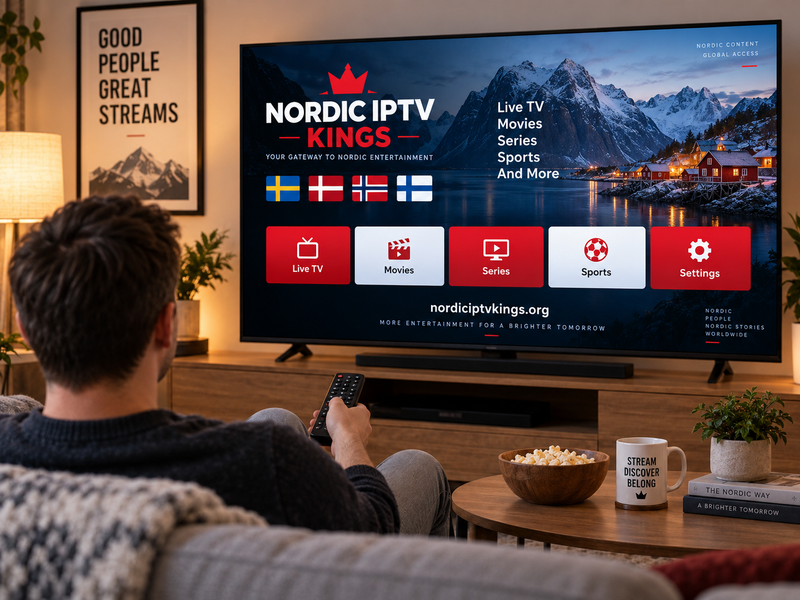
Your internet connection, streaming device, IPTV player, home network, electronic program guide, subtitles, and the quality of the content source can all influence everyday viewing. Understanding these factors makes it easier to build a setup that is convenient, organized, and suitable for your household.
Understand the Basic IPTV Setup
An IPTV system usually consists of two separate parts: a service that provides access to content and an application or player that displays the streams.
The IPTV player itself generally does not provide television channels. Instead, it loads compatible account information or playlists supplied by a service.
Depending on the player, common configuration methods can include:
M3U or M3U8 playlists
Username and password credentials
Server or portal information
Xtream-compatible login details
EPG data for television schedules
Keeping the player and the content source separate in your mind makes troubleshooting much easier. If one application has a problem, for example, the underlying stream may still work correctly in another compatible player.
Choose a Device That Fits Your Viewing Habits
One advantage of internet-based television is the variety of devices that can support compatible IPTV applications.
Smart TVs
Smart TVs are convenient because they allow viewers to watch directly on the main television without adding another device.
Samsung and LG televisions have their own app ecosystems, so application availability depends on the model, operating system, country, and app store.
Before choosing a player, check whether it officially supports your particular television.
Android TV and Streaming Boxes
Android TV and Google TV devices offer considerable flexibility because users can choose between multiple compatible media players.
Android-based boxes can also be useful for older televisions that do not provide the apps you need.
Performance still matters. A device with limited processing power or memory may feel slower when navigating large channel lists, EPG information, or video libraries.
Apple TV and Mobile Devices
Apple TV, iPhone, and iPad users can also access IPTV through compatible applications available for their platforms.
Mobile devices are particularly useful when watching around the home, while Apple TV provides a dedicated television interface.
Computers
Windows and other desktop systems can be practical options for IPTV viewing. Media players such as VLC can handle certain compatible network streams and playlists, although dedicated IPTV applications may provide better organization for large channel collections.
Pay Attention to Your Home Network
A fast internet package does not automatically guarantee smooth streaming. Stability is just as important as headline download speed.
Video buffering can be caused by several factors, including:
Weak Wi-Fi signal
Network congestion
Other devices using large amounts of bandwidth
Router placement
Device performance
Streaming bitrate
Problems affecting the original stream
Before changing IPTV applications, test the network itself.
Ethernet Can Provide Greater Consistency
If your television or streaming box is close to the router, an Ethernet connection can provide a more consistent connection than Wi-Fi.
This does not mean Ethernet is required. Modern Wi-Fi networks can handle video streaming effectively when coverage is strong.
Improve Wi-Fi Coverage
If Ethernet is impractical, place the router in an open and reasonably central location.
Homes with several floors or large rooms may benefit from a properly configured mesh Wi-Fi system. The objective is to maintain a strong connection where streaming devices are actually being used.
Organize Channels With an EPG
An Electronic Program Guide, usually called an EPG, provides scheduling information for television channels.
Instead of opening channels individually to discover what is playing, a properly configured EPG can show:
Current programs
Upcoming programs
Start and finish times
Channel schedules
Program information when available
For people following Nordic television or live sports, an organized EPG can make a large channel list considerably easier to navigate.
The availability and accuracy of EPG information depend on the source and player configuration.
Use Favorites Instead of Browsing Huge Lists
Large IPTV channel collections can quickly become difficult to navigate.
Creating a favorites list is one of the simplest improvements you can make.
For example, you might create a practical collection containing frequently watched:
Swedish channels
Nordic television
News
Sports
Entertainment
Children's channels
Movie channels
Some players also allow users to hide unwanted categories or reorganize groups. Taking a few minutes to customize the interface can save considerable time later.
Check Subtitle and Language Support
Subtitle support matters for households that watch programming from several countries.
Different IPTV players handle subtitles differently. Some can display embedded subtitles, while others support external subtitle formats or multiple audio tracks.
Nordic viewers may want to check support for Swedish, Norwegian, Danish, Finnish, or English subtitles depending on what they watch.
When comparing IPTV-related options, services such as Nordic IPTV King are particularly relevant to viewers researching Nordic-focused streaming, device compatibility, channel organization, and setup information.
Understand HD, Full HD, and 4K Streaming
Higher resolution does not automatically mean a better viewing experience.
An HD stream that plays consistently can provide a better experience than a high-bitrate 4K stream that repeatedly buffers.
Picture quality depends on several elements working together:
Stream Quality
The original video source and encoding strongly affect the final picture.
Internet Connection
Higher-resolution streams normally require more bandwidth than lower-resolution video.
Device Capability
The television, box, phone, or computer must be able to decode the format efficiently.
Display Resolution
Watching a 4K stream on a screen that cannot display 4K will not provide the full benefit of the higher resolution.
For most households, reliability should be considered alongside resolution rather than focusing on resolution alone.
Troubleshoot IPTV Problems Systematically
When a stream stops working, changing random settings often makes troubleshooting more complicated.
A simple process can help identify the problem faster.
Step 1: Test Your Internet
Open another streaming service or perform a connection test.
If everything is slow, the issue may be related to your home network or internet provider rather than the IPTV application.
Step 2: Try Several Channels
If only one channel has a problem, the issue may affect that particular stream.
If every channel fails, investigate the application, account details, network, or service connection.
Step 3: Restart the Application
Close the IPTV player completely and reopen it.
Step 4: Restart the Device
A restart can clear temporary software or memory problems.
Step 5: Compare Another Compatible Device or Player
When possible, test the same legitimate access details on another supported application or device.
This can help determine whether the issue follows the stream or remains with the original device.
Keep Applications and Devices Updated
Streaming applications and operating systems receive updates for compatibility, security, and performance.
Check periodically for updates to:
Smart TV firmware
IPTV applications
Android or Google TV
Apple TV
Streaming boxes
Router firmware
Avoid installing applications from untrusted sources simply because they promise additional features. Official app stores and reputable developers are generally safer options.
Consider Content Rights and Legitimacy
IPTV is a delivery technology, not a guarantee that every stream available online is authorized.
Traditional broadcasters, telecommunications companies, streaming platforms, and other legitimate services can all use internet-based television technology.
Before subscribing to any service, users should consider whether the provider has the appropriate rights to distribute the content being offered. Local copyright and broadcasting rules should also be respected.
A very large channel catalogue or an unusually low price should not by itself be treated as evidence that a service is legitimate.
Build the Setup Around Your Household
There is no single IPTV configuration that is best for everyone.
Someone who mainly watches sports on a large Smart TV may prioritize a stable wired connection and an easy-to-read EPG. Another household may prefer Android TV because several family members use different applications. Mobile viewers might care more about simple navigation and subtitle support.
Focus on the parts that have the biggest effect on everyday use:
Reliable internet
Good Wi-Fi or Ethernet connectivity
A compatible device
A well-supported IPTV player
Organized favorites
Accurate EPG information
Suitable subtitles
Legitimately sourced content
Final Thoughts
A good IPTV experience is created by the complete setup rather than a single application or device. A stable network, compatible hardware, properly configured player, useful EPG, organized channel list, and reliable content source all contribute to smoother viewing.
For Nordic households, it is especially useful to consider device compatibility, regional channel organization, language preferences, subtitles, and network performance. Taking time to configure these elements properly can create a simpler and more dependable television experience across Smart TVs, streaming boxes, computers, and mobile devices.







Top comments (0)