

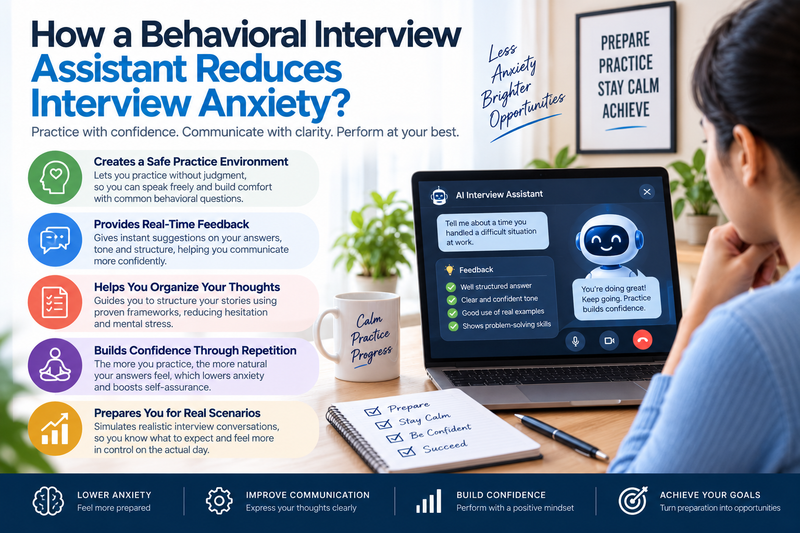
Behavioral interviews can create uncertainty because candidates must recall relevant experiences, organise them quickly, speak clearly, and respond to follow-up questions without knowing exactly what will be asked. Structured preparation may make these demands feel more familiar. An AI-assisted interview tool can support mock questioning, answer organisation, repeated speaking practice, and targeted feedback, while leaving the candidate responsible for genuine examples and final judgement. Such preparation cannot guarantee calmness or interview success. However, it may reduce avoidable nervousness linked to unfamiliar formats, weak recall, unclear responses, and limited opportunities to rehearse aloud.
Why Behavioral Interviews Can Create Nervousness
Behavioral questions combine memory, interpretation, speaking, and time pressure. Candidates may worry about unpredictable questions, weak recall, unstructured answers, excessive detail, forgotten facts, unclear personal contributions, interviewer expectations, or unexpected follow-ups.
Common pressure points include:
Finding a relevant example quickly.
Explaining personal actions clearly.
Keeping an answer focused.
Adapting one experience to different competencies.
Responding when an interviewer probes further.
However, identifying these practical sources of uncertainty makes preparation more targeted and avoids treating ordinary interview nervousness as a clinical issue.
How Familiarity Can Reduce Uncertainty
Repeated exposure can make interview formats less unfamiliar. A useful assistant may present opening prompts, competency questions, experience-based questions, clarification requests, and follow-ups about conflict, leadership, teamwork, deadlines, failure, or problem solving.
Question wording should vary. Teamwork, for example, might appear through disagreement, collaboration, shared deadlines, or cross-functional work. Leadership might involve initiative, influence, delegation, or decision making.
Consequently, candidates practise recognising what a question seeks and selecting relevant evidence rather than relying on memorised wording. Familiarity may reduce uncertainty, although it cannot guarantee confidence.
Why Realistic Mock Interviews Matter
Reading question lists does not recreate the demands of speaking under interview conditions. Mock sessions require candidates to retrieve examples, organise details, monitor relevance, and respond while another party controls the conversation.
A useful assistant may:
Ask one question at a time.
Allow uninterrupted answers.
Ask relevant follow-ups.
Change the competency being assessed.
Repeat difficult categories.
Introduce time pressure where appropriate.
Provide feedback after an answer or session.
Realistic behavioral interview practice may reduce uncertainty because candidates rehearse retrieval, speaking, follow-ups, and recovery.
Using STAR Without Sounding Scripted
STAR organises experience-based answers into Situation, Task, Action, and Result. A strong assistant should assess whether each element adds useful information rather than merely checking four labels.
What Each STAR Element Should Accomplish
Situation gives concise context. Task clarifies the responsibility, challenge, or objective. Action explains what the candidate personally did and why. Result describes the outcome, impact, consequence, or relevant reflection.
Action often needs more detail because it reveals individual contribution. However, candidates should not force identical proportions into every response.
Accordingly, STAR works best as a flexible framework. Remembering facts, decisions, and outcomes preserves adaptability better than memorising polished paragraphs word-for-word.
Building a Genuine Experience Bank
Candidates can prepare a manageable set of genuine professional, academic, volunteer, project, or leadership experiences instead of creating one story for every possible question.
Useful competency categories include:
Leadership and initiative.
Teamwork and conflict resolution.
Problem solving and adaptability.
Communication and prioritisation.
Decision making and accountability.
Failure and feedback.
Customer or stakeholder management.
One genuine experience may support several competencies when framed accurately. For instance, the same project might demonstrate prioritisation or stakeholder communication through different truthful details. An assistant should improve selection and framing without encouraging invented achievements.
Making Relevant Examples Easier to Recall
Candidates may fear having no example available when a question arrives. Structured recall can make retrieval easier without requiring complete scripts.
A practical method associates each experience with short prompts: competency, challenge, personal action, turning point, and outcome. Candidates can then practise accurate variations of the same story for differently framed questions.
Short prompts preserve flexibility because they trigger facts rather than exact sentences. Furthermore, reviewing personal actions and results prevents answers from becoming mostly background. The candidate can listen carefully and adapt the example to the question actually asked.
Why Over-Memorised Answers Can Backfire
Complete scripts can create problems when interviewers change wording or ask unexpected follow-ups.
Warning signs include:
Robotic or unusually polished delivery.
Difficulty adapting to another competency.
Losing flow after forgetting one sentence.
Answering the prepared question instead of the actual one.
Missing follow-up cues.
Repeating identical wording across answers.
Flexible preparation offers a stronger approach. Candidates can retain factual anchors, actions, outcomes, and reflections while allowing wording to change. Therefore, a useful assistant should reward relevance and specificity rather than exact repetition between attempts.
Preparing for Follow-Up Questions
Interviewers may probe vague claims, clarify responsibility, or test reflection after an initial response. Follow-up preparation can make that interaction less surprising.
Useful prompts include:
What specifically did you do?
Why did you choose that approach?
What was the hardest part?
How did others respond?
What happened afterward?
What would you do differently?
A strong assistant should connect follow-ups to the candidate's actual answer rather than follow a fixed script. Moreover, it should give the candidate an opportunity to clarify independently before supplying missing detail.
What Useful Behavioral Feedback Should Assess
Effective feedback identifies a specific weakness, explains its effect, and suggests a practical revision. Vague advice such as “be more confident” offers little direction.
Useful review may assess:
Relevance and question alignment.
Structure and sequencing.
Specificity and evidence.
Clarity and conciseness.
Personal contribution.
Outcome and reflection.
Excessive background.
Missing context or unclear actions.
Automated observations still deserve scrutiny because valid responses can use different structures and communication styles.
Improving Communication Clarity and Pacing
Speaking aloud exposes problems that written preparation can hide, including long pauses, filler language, repetition, abrupt endings, weak transitions, or delayed main points.
Where supported, some systems may flag pacing or repeated fillers. However, candidates should not assume automated systems accurately interpret voice, tone, facial expression, or body language.
Finding an Appropriate Answer Length
No universal duration suits every response. Instead, practice can help candidates reduce irrelevant context, reach personal actions sooner, explain results clearly, and finish naturally.
Answer length should serve clarity and evidence. A short response can still omit essential contribution, while a longer answer may remain effective when each detail supports the question.
Clarifying Personal Contribution Without Diminishing Teamwork
Interviewers often need to distinguish team achievements from individual contribution. “We solved the issue” may leave the candidate's role unclear.
A stronger response can describe the shared challenge, then identify the candidate's responsibilities, decisions, communication, or execution before returning to the broader team outcome.
This does not require claiming sole credit. Accurately recognising colleagues' work can demonstrate collaborative awareness. Therefore, preparation should clarify what the group faced, what the candidate personally handled, how that contribution affected the work, and what happened afterward.
Practising Difficult Behavioral Questions
Questions about failure, mistakes, conflict, negative feedback, missed deadlines, difficult stakeholders, changing priorities, or unsuccessful decisions can create extra uncertainty.
Candidates can structure these examples around:
What genuinely happened.
Which responsibility belonged to them.
What action they took.
What consequences followed.
What changed afterward, where relevant.
A useful assistant should encourage accurate reflection rather than unrealistic perfection. Acknowledging a mistake can be more credible than turning every failure into disguised success. Candidates should choose examples they can discuss truthfully and professionally without inventing favourable outcomes.
Adapting Questions to Roles and Competencies
Preparation becomes more relevant when questions reflect job level, function, team environment, project ownership, customer interaction, and decision-making responsibility.
A graduate applicant might face teamwork prompts about shared projects, while a senior manager may receive deeper questions about delegation or broader decisions.
Competency mapping can organise preparation around leadership, collaboration, ownership, communication, adaptability, problem solving, initiative, accountability, resilience, and decision making. However, one question may test several areas, so mapping should not claim to predict employer scoring.
Tracking Patterns Across Practice Sessions
Single-session scores can create false precision. More useful tracking focuses on recurring, observable patterns.
Candidates might monitor:
Missing results.
Excessive background.
Overlong answers.
Difficult competency categories.
Repeated filler language.
Weak personal-action explanations.
Trouble with unexpected follow-ups.
Progress tracking should support targeted revision rather than act as an objective measure of employability. For example, if conflict answers repeatedly omit decision reasoning, the next session can focus on explaining choices. Consequently, preparation becomes purposeful rather than endless repetition.
How Preparation May Reduce Interview Nervousness
Structured preparation may reduce practical triggers of interview-related nervousness by making the process more predictable. Candidates can organise genuine examples, speak answers aloud, and experience follow-up questioning before the actual interview.
Preparation does not mean nervousness disappears. Even well-prepared candidates may remain apprehensive because the interviewer, conversation, and outcome remain uncertain.
The useful goal is readiness rather than emotional perfection. Familiar question formats can reduce uncertainty, while prepared examples may reduce fear of having nothing relevant to say. Similarly, speaking aloud reveals pacing and structure problems before interview pressure makes them harder to address.
Creating a Sustainable Preparation Routine
Practice works better when each session has a purpose. A flexible routine can combine preparation, speaking, review, and realistic simulation.
One sequence is:
Identify target competencies.
Select genuine experiences.
Organise examples flexibly.
Answer questions aloud.
Review specific feedback.
Repeat weak categories.
Practise unexpected follow-ups.
Conduct an uninterrupted mock session.
Review recurring patterns rather than individual scores.
Reduce intensive rehearsal if it creates fatigue immediately before the interview.
More repetition is not automatically better.
Limitations of AI-Generated Interview Feedback
Automated feedback can misread context, favour rigid structures, interpret tone incorrectly, or produce generic recommendations. It may also encourage wording that sounds less natural than the candidate's normal communication.
Limitations may include:
Inconsistent scoring.
Limited cultural or organisational context.
Difficulty judging authenticity.
Excessive preference for formulaic responses.
Incorrect interpretation of speech patterns.
Limited awareness of interviewer expectations.
Therefore, candidates should treat feedback as one preparation input rather than unquestionable authority. Persistent or severe anxiety may require support beyond interview-preparation technology, which is not a treatment or substitute for appropriate professional support.
Protecting Authenticity and Privacy
Preparation should improve communication of genuine experiences, not manufacture stronger-looking stories. Candidates should avoid fabricated achievements, false metrics, invented conflicts, exaggerated responsibilities, and misrepresented team contributions.
Privacy also matters. Confidential customer information, employer secrets, unreleased products, internal financial data, proprietary processes, and personal information about colleagues may be inappropriate to enter into preparation systems.
Where suitable, candidates can generalise names, figures, projects, and identifying details while preserving the relevant experience. The goal remains truthful preparation without unnecessary disclosure of protected or sensitive information.
Using AI Responsibly During Interviews
Pre-interview mock sessions differ from undisclosed real-time assistance during an interview that requires independent responses.
Candidates should follow:
Interview instructions.
Employer rules.
Assessment policies.
Confidentiality requirements.
Restrictions on outside assistance.
Professional integrity expectations.
If outside tools are prohibited, candidates should not conceal their use or bypass assessment controls. When instructions are unclear, they can ask which resources are permitted.
Preparation should strengthen independent recall and communication. Ultimately, candidates must listen, select genuine experiences, answer questions, and handle follow-ups themselves when independent performance is required.
Preparing for Behavioral Interviews With Greater Familiarity
Structured preparation may make behavioral questioning more familiar by helping candidates organise genuine examples, speak answers aloud, practise follow-ups, and identify recurring weaknesses. Mock sessions can reduce avoidable uncertainty, while specific feedback can sharpen relevance, clarity, pacing, and personal-action explanations. However, preparation cannot guarantee calmness, confidence, interview success, or a particular emotional response. Candidates should retain independent judgement, protect authenticity and privacy, and use automated feedback critically. Strong preparation builds flexible recall and clear communication rather than memorised scripts, leaving candidates better equipped to respond thoughtfully when real interview questions take an unexpected direction.
FAQs
1. Can mock behavioral interviews make interviews feel less stressful?
Mock sessions may make questioning, speaking aloud, and follow-up prompts feel more familiar, which can reduce some uncertainty. However, candidates respond differently to interview pressure, and practice cannot guarantee calmness. Its practical value lies in rehearsing controllable tasks such as example recall, structure, relevance, and communication.
2. How can candidates prepare examples without memorising scripts?
Candidates can remember factual anchors rather than complete sentences. Useful anchors include the situation, responsibility, personal actions, key decision, outcome, and reflection. Short competency labels can also support recall. This approach preserves accurate details while leaving enough flexibility to adapt the example to differently worded questions and follow-ups.
3. Does every behavioral answer need to follow STAR exactly?
No. STAR can provide a useful sequence for organising context, responsibility, actions, and outcomes, but rigid delivery can sound unnatural. Some questions need less background or more reflection than others. Candidates should use the framework to maintain clarity while adapting the emphasis and wording to the specific question.
4. Why are follow-up questions useful during mock interviews?
Follow-ups test whether candidates can clarify details, explain decisions, separate personal contributions from team work, and reflect beyond a prepared opening response. Repeated exposure may make probing questions less surprising. Strong practice uses follow-ups connected to the candidate's actual answer rather than unrelated questions from a fixed script.
5. Can AI feedback accurately judge communication skills?
Accuracy varies by system and input type. Some systems may identify structural issues, repetition, pacing patterns, or filler language, while nuanced interpretation of tone, authenticity, body language, and cultural communication can be difficult. Candidates should treat automated observations as prompts for review rather than definitive judgements about communication ability.
6. How should candidates prepare for questions about failure?
Candidates should choose genuine examples they can discuss professionally and accurately. A useful response can explain the situation, personal responsibility, actions, consequences, and relevant reflection. There is no need to transform every mistake into a perfect outcome. Clear accountability and truthful detail are more useful than manufactured success stories.
7. Can repeated interview preparation eliminate nervousness?
No. Repetition may reduce uncertainty by making question formats, spoken responses, and follow-ups more familiar, but some nervousness can remain even after extensive preparation. Candidates can focus on controllable areas such as example selection, answer structure, listening, relevance, and pacing without expecting practice to guarantee a particular emotional state.
8. How should candidates evaluate automated interview feedback?
Candidates should check whether feedback is specific, relevant to the question, consistent with the genuine experience, and supported by observable details. Generic or overly rigid suggestions deserve caution. Automated feedback can identify useful patterns, but it should remain one input alongside independent judgement and, where available, appropriate human feedback.
9. What privacy precautions matter during interview preparation?
Candidates should avoid sharing confidential employer information, customer data, proprietary processes, unreleased products, internal financial details, or identifying information about colleagues unnecessarily. Examples can often be anonymised or generalised while preserving the relevant actions and outcomes. Existing confidentiality obligations should continue to shape what information candidates share externally.
10. Is real-time AI assistance acceptable during behavioral interviews?
That depends on the interview rules. Employers may permit, restrict, or prohibit outside assistance, so candidates should follow the instructions provided. They should not conceal prohibited support or bypass controls. If expectations are unclear, asking which resources are permitted protects integrity and avoids misrepresenting independently demonstrated interview ability.







Top comments (0)