
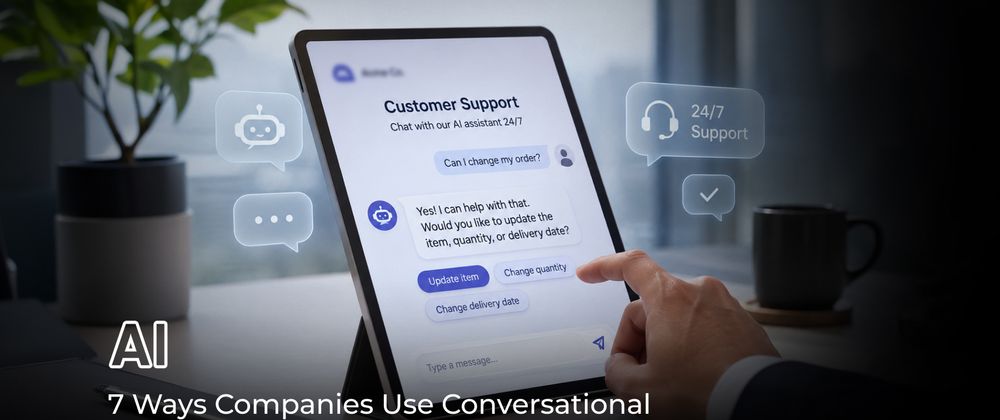

Customer service is evolving beyond traditional question-and-answer interactions as businesses increasingly adopt conversational AI to improve customer experiences. AI-powered chatbots and virtual assistants allow organizations to provide 24/7 support, understand customer queries, and deliver relevant responses in real time. From answering frequently asked questions to helping customers resolve common issues, these technologies make support services more accessible and efficient without requiring human agents to manage every interaction.
Conversational AI uses technologies such as Natural Language Processing (NLP), machine learning, and generative AI to understand customer intent and respond naturally. Businesses are using these capabilities to automate everyday tasks, including order tracking, delivery updates, appointment scheduling, booking modifications, and account-related requests. Voice AI agents are also improving phone support by understanding spoken questions, handling routine inquiries, and transferring complicated cases to the appropriate human representatives. Additionally, intelligent query routing helps direct customer requests to specialized teams, reducing unnecessary transfers and response delays.
The growing adoption of # AI In Customer Service is also changing how businesses support their employees and customers. AI-powered assistants can help human agents by suggesting relevant responses, retrieving information from knowledge bases, and generating conversation summaries for future reference. Organizations are also using conversational AI to deliver multilingual and personalized assistance based on customer preferences, previous interactions, and available account information. These applications make customer support more convenient while allowing human representatives to focus on complex issues that require empathy, judgment, and problem-solving.
However, implementing conversational AI successfully requires more than simply deploying chatbots or virtual assistants. Businesses must integrate these systems with existing CRM platforms, helpdesk software, and communication channels while maintaining strong data protection measures. Regular performance monitoring, response accuracy checks, identity verification, and clear escalation procedures are equally important. As conversational AI continues to develop, organizations that combine intelligent automation with human expertise can deliver faster, more consistent, and personalized customer service experiences.







Top comments (0)