
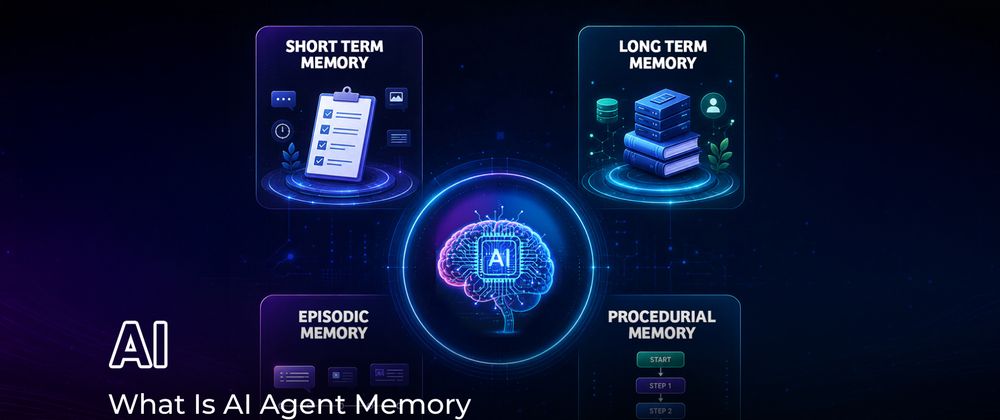

AI agents are evolving from systems that simply respond to prompts into intelligent systems capable of planning, reasoning, learning, and completing tasks over time. A key capability driving this evolution is memory. AI agent memory enables systems to retain relevant context, recall previous interactions, learn from outcomes, and use past information to make better decisions. Unlike traditional AI interactions that often begin from scratch, memory-enabled agents can provide more consistent, personalized, and context-aware experiences across sessions.
AI agent memory can be divided into several types, each serving a different purpose. Short-term or working memory maintains current conversations, instructions, and intermediate task information, while long-term memory preserves useful details across sessions. Semantic memory helps agents retain facts, concepts, and relationships, whereas episodic memory records specific experiences, actions, and outcomes. Procedural memory, meanwhile, stores workflows, rules, and task-related knowledge, allowing agents to perform recurring activities more efficiently.
These capabilities are becoming increasingly important as the AI Agent takes on more complex responsibilities across customer service, coding, enterprise operations, and personal assistance. However, effective memory management requires more than simply storing information. Agents must determine what information is valuable, retrieve the right memories when needed, and update or remove outdated details. Poorly managed memory can introduce irrelevant context, increase costs, reduce accuracy, and create privacy and governance concerns.
As AI agents become more deeply integrated into everyday and enterprise workflows, memory will become a fundamental part of their intelligence. Strong LLM memory management can help agents maintain continuity, personalize interactions, learn from previous experiences, and execute long-running tasks more effectively. The future of agentic AI will therefore depend not only on increasingly capable models, but also on smarter memory architectures that allow systems to remember the right information, use it at the right time, and adapt as circumstances change.







Top comments (0)