
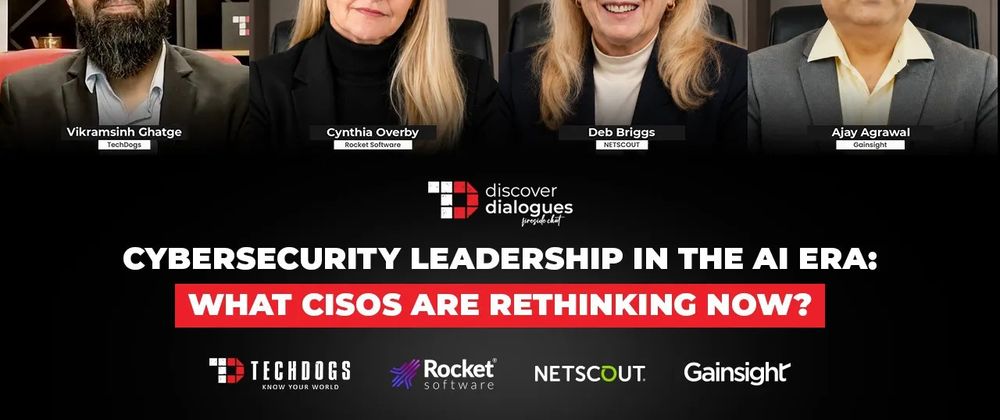

In this episode of TechDogs Discover Dialogues Fireside Chat, host Vikramsinh Ghatge brings together Deb Briggs, VP and Chief Information Security Officer at NETSCOUT; Cynthia Overby, Director, Strategic Security Solutions, zCOE at Rocket Software; and Ajay Agrawal, Chief Information Security Officer at Gainsight, for a practical discussion on cybersecurity leadership in the AI era. The CISO roundtable explores how security leaders are moving beyond AI experimentation toward stronger governance and disciplined risk management, covering emerging cyber threats, shadow AI, identity security, third-party dependencies, supply chain exposure, vulnerability management, and the growing challenge of communicating cyber risk to business leaders and boards.
A key theme of the conversation is the systemic risk created by third-party and cloud concentration. As organizations increasingly depend on a limited number of cloud providers, managed service providers, and technology partners, a single outage or security incident can have widespread consequences. The panel also highlights how supply chain security is evolving, with customers demanding more proactive and continuous approaches to vulnerability management rather than relying on static assessments of whether a vulnerability is currently exploitable. At the same time, identity has emerged as a critical attack surface, with cybercriminals increasingly using legitimate credentials, service accounts, machine identities, and other non-human identities to gain access.
The discussion also examines how Cybersecurity Leadership is changing as AI becomes embedded across the enterprise. Shadow AI is creating new visibility and governance challenges as employees adopt unapproved tools that may expose sensitive data or introduce compliance risks. The panel emphasizes that organizations should begin establishing AI governance frameworks now, defining clear responsibilities across security, privacy, legal, compliance, IT, and business teams. While AI can strengthen threat hunting, incident response, and vulnerability prioritization, it can also expand the attack surface through unmanaged applications, employee-built tools, and rapidly evolving AI agents.
Ultimately, the conversation reinforces that modern CISOs must operate as business risk leaders, not just technical security experts. Cybersecurity decisions increasingly need to be connected to operational resilience, regulatory obligations, customer trust, financial impact, and the organization's ability to grow. From managing third-party concentration and supply chain exposure to securing identities and governing AI adoption, security leaders must translate complex technical risks into clear business language while building practical, continuous defenses for an increasingly interconnected digital environment.






Top comments (0)