
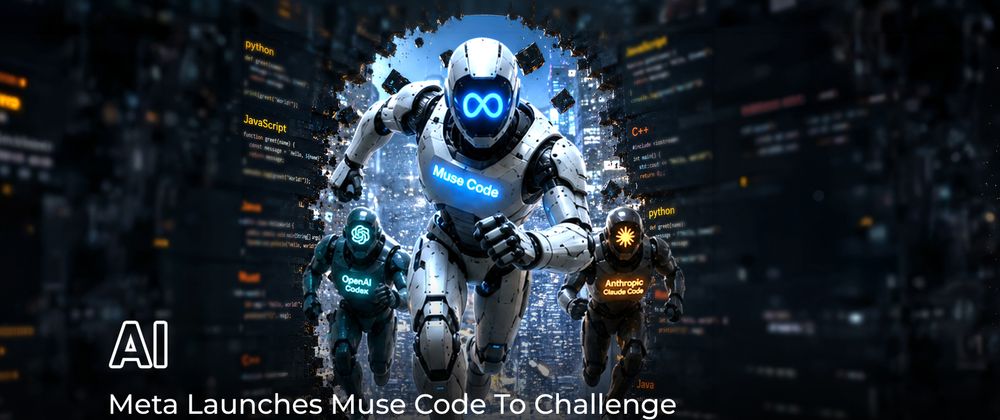

Meta has entered the AI coding-agent market with the beta launch of Muse Code, a terminal-based assistant powered by the Muse Spark 1.2 model. Introduced on August 5, 2026, the tool is designed for repository-scale software development, enabling developers to plan code changes, edit files, execute commands, validate results and coordinate persistent background subagents. Its restart-safe local event log also allows interrupted tasks to resume without losing completed progress.
Unlike traditional AI coding assistants that mainly generate code suggestions, Muse Code is built to work directly within terminal and CI workflows. It supports built-in planning and execution commands while enabling asynchronous background agents to continue analyzing repositories and preparing tasks. Meta is also competing on affordability, offering lower token pricing than many rivals, although organizations handling proprietary code should carefully review the contributor tier's data-use terms.
Competition in the AI development space is heating up as Meta joins Anthropic and OpenAI with its new AI Coding Agent. According to Meta, Muse Code achieved an 82.9% score on Terminal-Bench 2.1, placing it between Claude Code and OpenAI Codex in its evaluation. While benchmark results demonstrate strong performance, long-term success will depend on reliability, security, governance and the overall developer experience.
Muse Code strengthens Meta's AI developer ecosystem by combining the coding agent with Muse Spark 1.2 and the Meta Model API. Rather than replacing existing solutions, it provides developers and enterprises with another capable option as AI coding agents continue to reshape modern software development.







Top comments (0)