
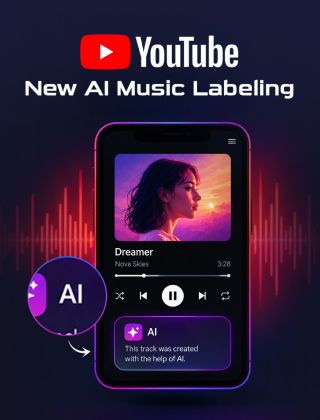

Artificial intelligence is increasingly transforming music production, enabling creators to generate complete songs, synthetic vocals, instrumental arrangements, and melodies within minutes. As AI-generated tracks become more common across streaming platforms, distinguishing human performances from machine-created music is becoming increasingly challenging. To improve transparency, digital music services are introducing disclosure systems that help listeners understand how generative AI contributed to the songs they hear.
YouTube Music began rolling out AI music labels on October 14, 2026, identifying tracks that contain significant generative AI contributions. These notices appear directly on the music player page, allowing listeners to access additional information about a song's creation. The initiative also extends YouTube's existing AI disclosure practices, with similar labels planned for the main YouTube application. The system focuses on substantial generative involvement rather than treating every automated audio-editing feature as AI-generated content.
The new Smart TV Ads labels are actually YouTube's Fully Gen AI, Partly Gen AI, and No Gen AI classifications, which distinguish entirely AI-generated songs from music combining human creativity with generative tools. Fully Gen AI describes tracks created entirely through AI, including vocals and instrumental arrangements, while Partly Gen AI covers songs incorporating AI-generated lyrics, melodies, or musical elements. No Gen AI applies to music without generative contributions, including conventional pitch correction and automated mastering. Artists and music partners can disclose these details through delivery metadata, CSV templates, or YouTube Studio, while platform detection systems may also identify generative content.
These labels could help listeners make informed decisions while giving artists greater transparency about their creative processes. However, incomplete disclosures and inaccurate classifications remain possible, and an AI label does not determine copyright ownership, consent, or musical quality. Other platforms, including Spotify, Deezer, and Apple Music, are also exploring AI transparency through badges, credits, metadata, and filtering options. Ultimately, YouTube's initiative represents another step toward clearer AI disclosures in digital music, helping audiences understand how technology contributes to the songs they enjoy.







Top comments (0)