
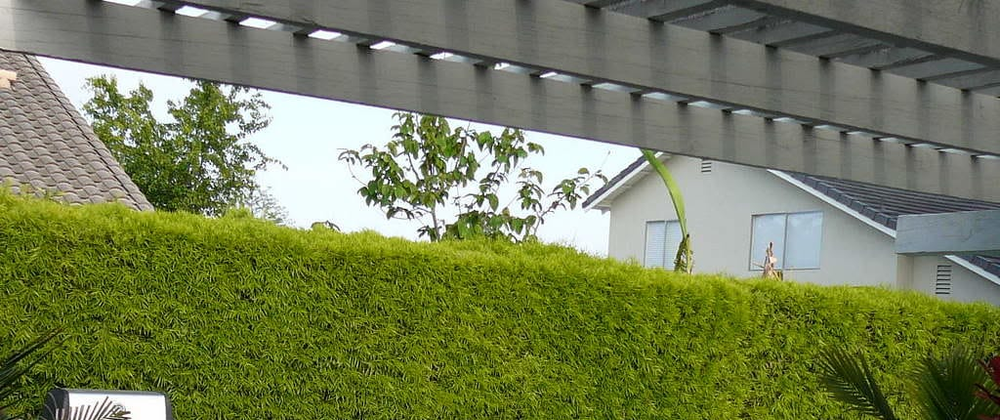

Podocarpus is an evergreen landscape plant valued for its fine-textured foliage, upright growth, and ability to function as a screen, hedge, or specimen tree. Its soft, narrow leaves create a different visual effect from broad-leaved evergreen hedges, while its tolerance of heat and dry conditions makes it useful in suitable warm-climate landscapes.
For homeowners and landscapers considering Podocarpus Gracilior, understanding its mature size, sunlight requirements, soil drainage, watering needs, and pruning response is important before planting. These factors determine how well the plant performs and whether it can develop into the desired privacy screen or landscape feature.
What Is Podocarpus Gracilior?
Despite the common name fern pine, it is not a true pine. Its fine foliage and somewhat drooping branches give it a softer appearance than many traditional screening plants. It can be grown as a tree or maintained as a hedge or screen through appropriate pruning.
Podocarpus Gracilior is an evergreen tree commonly known as weeping podocarpus.
The plant can eventually reach considerable dimensions when allowed to grow naturally. For this reason, planting location and available space should be considered before installation. When maintained at a smaller size, regular pruning can help control its height and width.
## Why Use Podocarpus for Privacy Screening?
Evergreen hedges can provide year-round visual screening and help define boundaries between different areas of a landscape. Podocarpus Gracilior is useful for this purpose because its foliage remains present throughout the year and the plant responds well to shaping.
Its fine-textured leaves produce a softer appearance than dense, broad-leaved screening plants. This can be useful in landscapes where a privacy barrier is needed without creating an excessively heavy visual mass.
Where Should Podocarpus Gracilior Be Planted?
Before planting, evaluate the location for sunlight exposure, drainage, available root and canopy space, and nearby structures. A narrow planting strip may be suitable for a maintained hedge, but the mature dimensions of the plant still need to be considered.
Podocarpus Gracilior performs best in full sun to partial shade and can tolerate a range of well-drained soils. Poor drainage is an important concern because persistently wet soil can place the roots under stress and increase the risk of root problems. For larger landscape installations, checking underground utilities and other site constraints before digging is also an important planning step.
How Much Water Does It Need?
Once established, it is considered drought-tolerant and generally requires less supplemental irrigation than during the establishment period. However, drought tolerance does not mean that newly planted specimens can be neglected. Regular watering during establishment supports root development, while excessively frequent watering in poorly drained soil can create other problems. Water requirements change as the plant becomes established. Newly planted Podocarpus Gracilior needs consistent moisture while its root system develops. Applying a suitable layer of mulch around the planting area can help conserve soil moisture and moderate temperature. Mulch should not be piled directly against the trunk.
Conclusion
The right hedge ultimately depends on the landscape's available space, desired level of privacy, appearance, climate, and maintenance schedule. Comparing foliage characteristics and long-term care requirements is particularly important when deciding alternatives such as a ficus hedge. Hedge selection should always consider the desired mature height, available planting space, soil conditions, sunlight, and expected maintenance requirements. The comparison should not focus solely on how quickly a plant grows. Faster-growing plants may require more frequent trimming, while a slower-growing choice may take longer to create the desired screen. Site conditions, mature dimensions, root behavior, and maintenance expectations should all be considered when selecting a hedge.






Top comments (0)