

A nutritionist website needs to do more than list services and offer a contact form. It should help potential clients quickly understand what you offer, who you help, where you practice, and how to take the next step.
That makes structure a genuinely important part of nutritionist SEO. When pages are organized around real client needs, search engines understand the practice better, and visitors find what they need without digging through the whole site.
This is exactly the kind of foundation good Nutritionist SEO Services are built on — because even the best keyword strategy falls flat if the website itself doesn't have the right pages to send people to.
What Pages Should a Nutritionist Website Have?
There's no single structure that fits every nutritionist — it depends on services, specialties, location, and whether you offer online consultations.
That said, most nutritionist websites benefit from a similar set of core pages:
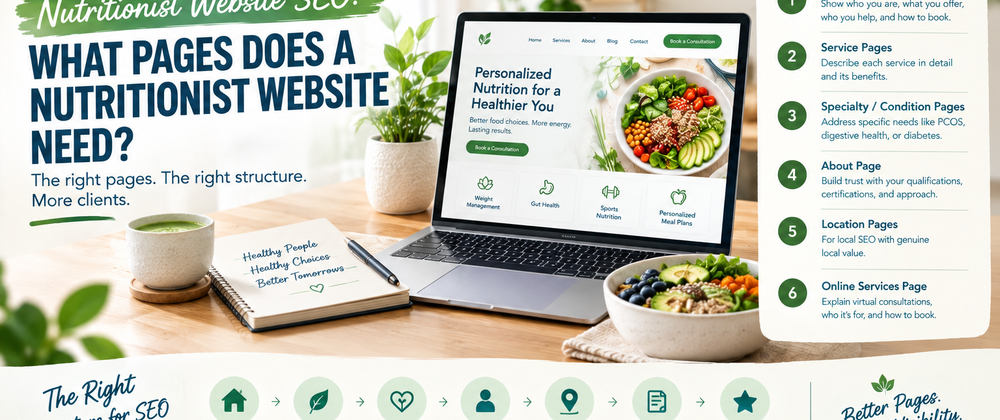
Homepage — quickly shows who you are, what you offer, who you help, and how to book, with clear paths into service and specialty pages rather than explaining everything at once.
Service pages — each meaningful service (consultations, weight management, sports nutrition, meal planning, online coaching) deserves its own page when there's enough demand and detail to support one.
Specialty or condition pages — people often search around a specific concern rather than "nutritionist." Pages covering PCOS, digestive health, or diabetes should give useful information and clearly show how you help.
About page — more than a bio. It should establish qualifications, certifications, and approach, since health-related searches call for showing who's behind the information.
Location pages — useful if you serve specific areas, but only when each page offers genuine local value rather than the same content with a city name swapped in.
Online services page — if you offer virtual consultations, this deserves its own page explaining who it's for, how it works, and how to book, separate from local search intent.
How Should the Site Be Structured for SEO?
A useful structure moves from broad to specific: homepage → nutrition services → individual services → specialties → condition pages → locations → educational content → practitioner expertise. This creates clear relationships between topics and gives visitors several paths to the service that fits them.
Why Separate Service Pages Matter
Putting every service on one page makes it harder for users and search engines to understand what you offer. A dedicated page can answer who the service is for, what it includes, how it works, and how to book — connecting a specific search to the right service.
What About Blog Content?
A nutrition blog works best when it supports your services rather than existing as a pile of unrelated articles. A post on "what should I eat if I have PCOS?" should naturally lead into your PCOS nutrition page: question → helpful content → relevant service → consultation. That makes the blog part of the conversion journey, not just a traffic source.
How Trust Signals Fit Into Website SEO
Because nutrition is health-related, trust needs to be visible throughout the site — not just on the About page. Qualifications, evidence-based content, transparent service details, genuine reviews, and clear contact information all help visitors feel confident, wherever they land on your site.
Handling Local SEO
A local practice should make it easy for both users and search engines to understand where it operates. That means consistent business information, an optimized Google Business Profile, relevant location details, and reviews — working together with the rest of the site rather than sitting separately from it.
What Makes a Website SEO-Friendly?
Beyond keywords, a genuinely SEO-friendly site has clear architecture, content that answers real needs, strong internal linking between related pages, technical accessibility (crawlable, indexable, mobile-friendly), visible trust signals, and easy paths to contact or book.
Common Mistakes
A few structural issues tend to hold practices back: cramming every service onto one page, near-duplicate location pages, generic articles disconnected from services, hidden credentials, reused specialty content, optimizing only for "nutritionist," and hard-to-find booking. The fix usually isn't more pages — it's making sure every page has a clear purpose.
How This Supports Client Acquisition
A well-structured site helps turn visibility into action: someone searches for a specific concern, lands on a relevant specialty page, reviews your expertise, and books a consultation. That journey is much harder when everything is buried on one generic page. At Rank You Well, this search-to-action journey is exactly what our nutritionist website SEO work is built around — connecting architecture, service relevance, trust, local visibility, and conversion paths so the site supports both visibility and real growth.
Frequently Asked Questions
How many pages should a nutritionist website have?
There's no ideal number — enough to clearly represent your genuine services, specialties, locations, and expertise.
Should every nutrition service have its own page?
Usually, yes, when the service reflects a distinct client need and has enough content to justify its own page.
Does a nutritionist need location pages?
Only when location genuinely matters to your business and each page offers real local value — duplicate city pages built just for keywords tend to backfire.
Should a nutritionist have a blog?
Yes, when it answers real questions potential clients ask and supports your service pages, rather than covering unrelated topics.
Can a nutritionist rank with only a homepage?
It's possible for some searches, but relying on one page makes it much harder to serve different services, specialties, and locations well.
Conclusion
A strong nutritionist website is built around the questions and decisions potential clients actually make — the homepage introduces the practice, service pages explain what's offered, specialty pages address specific needs, and practitioner information builds trust along the way.
The goal was never to build the biggest website. It's to create a clear structure where every page has a purpose — and that's precisely what Rank You Well's Nutritionist SEO Services are designed to deliver: a site that turns real searches into real consultations.







Top comments (0)