
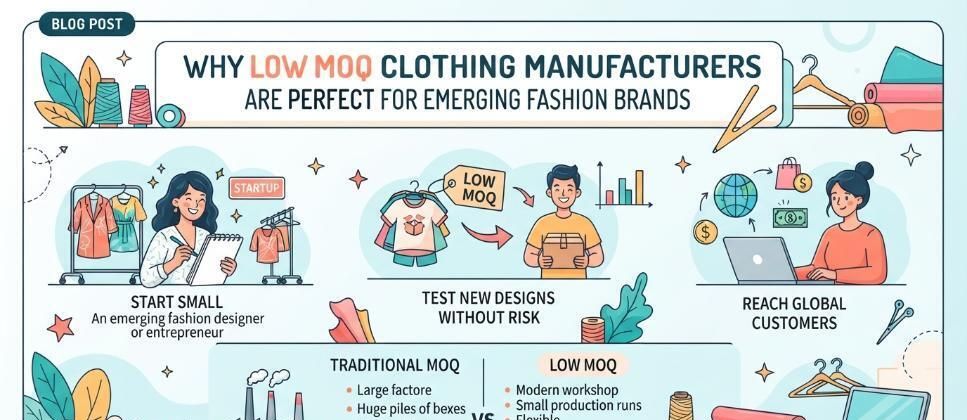

Starting a fashion brand is exciting, but the first production order can quickly turn that excitement into financial pressure. Large factories often expect new labels to purchase hundreds or thousands of units before they have tested a single product. Working with a low MOQ clothing manufacturer gives emerging brands a more practical way to enter the market without tying up most of their budget in unsold stock.
Lower order quantities allow founders to develop a focused collection, gather customer feedback, and make better production decisions. A low MOQ clothing manufacturer also gives a new brand room to experiment with fabrics, colors, sizing, and branding before committing to a much larger run.
That flexibility matters. Emerging fashion businesses rarely know which item will become their bestseller, so ordering smaller quantities can protect cash while providing valuable information about what customers actually want.
What does low MOQ mean in clothing production?
MOQ stands for minimum order quantity. It is the smallest number of pieces a factory will produce for a particular style, fabric, or color. A low MOQ clothing manufacturer may accept a small batch of shirts, jackets, trousers, or accessories instead of requiring several hundred units per design.
Minimums vary between suppliers. One factory may allow 30 pieces of a style, while another may require 100 pieces divided across several sizes. Fabric availability, printing methods, embroidery, custom labels, and garment construction can all affect the final requirement.
For a new fashion label, the number itself is only part of the conversation. A good low MOQ clothing manufacturer will explain which elements can be customized within a small order and which choices require a larger commitment.
Large production orders can strain a young brand
Traditional mass production works well for established companies with reliable sales data. It is far less forgiving for a founder launching a first collection. Paying for hundreds of pieces before knowing how customers will respond creates a serious inventory risk.
A low MOQ clothing manufacturer reduces that pressure by allowing the founder to start with a manageable quantity. Instead of spending nearly the entire launch budget on stock, the business can reserve money for photography, packaging, marketing, website development, and customer acquisition.
Those expenses are easy to underestimate. A product cannot sell simply because it has been manufactured. People need to discover it, understand its value, and trust the brand enough to place an order.
Small batches protect working capital
Cash flow can decide whether an emerging fashion brand survives its first year. Money sitting in boxes of unsold clothing cannot pay for advertising, content creation, shipping supplies, or the next collection. A low MOQ clothing manufacturer helps keep more cash available for daily operations.
Imagine that a brand wants to launch four T-shirt designs. A large factory may require 500 pieces of each design, creating an order of 2,000 garments. If the brand can begin with 50 pieces of each design, it only needs to finance 200 garments.
The smaller order may have a higher cost per item, but the total financial commitment is much lower. A low MOQ clothing manufacturer can therefore reduce the amount of money at risk during the earliest and least predictable stage of the business.
New designs can be tested before scaling
Fashion founders often make assumptions about what customers will buy. A color that looks great in a design file may receive little attention online. An unexpected size may sell out first. Customers may also prefer a different fabric weight or fit.
A low MOQ clothing manufacturer lets the brand test those assumptions with paying customers. The first batch becomes a source of sales data rather than a warehouse full of guesses.
Once orders begin arriving, the founder can compare styles, colors, sizes, return rates, and customer comments. The next production run can then reflect actual demand. Working with a low MOQ clothing manufacturer turns product development into an ongoing process instead of a single expensive decision.
Limited drops can create useful urgency
Small production runs can also support a limited-drop sales model. Customers know that only a certain number of pieces are available, which can encourage faster purchasing decisions without relying on constant discounts.
A low MOQ clothing manufacturer makes this approach easier because the brand does not need to order excessive stock simply to meet a factory minimum. Each release can stay focused, controlled, and connected to a clear story.
Quality control becomes easier to manage
Finding a production issue in 50 garments is frustrating. Finding the same issue in 2,000 garments can be devastating. Smaller batches give a brand more control over quality checks and make corrections less costly.
A responsible low MOQ clothing manufacturer will usually begin with samples or prototypes. These samples help the brand review stitching, measurements, fabric behavior, printing, labels, and overall appearance before approving bulk production.
The first order also reveals how well the supplier follows instructions at production scale. If adjustments are needed, the brand can document them before placing a larger reorder. A low MOQ clothing manufacturer gives both parties time to improve the process together.
Emerging labels gain more creative freedom
Creative founders do not always want to launch ten variations of the same basic garment. They may want to try unusual color combinations, detailed embroidery, private labels, custom packaging, or a small capsule built around a specific idea.
A low MOQ clothing manufacturer can make those experiments more realistic. The brand can release several carefully selected designs without purchasing a huge quantity of every item.
This freedom is especially useful for labels serving a defined audience. A niche streetwear company, modest fashion label, independent sports brand, or sustainable clothing startup may not need mass-market quantities. It needs products that match the taste and expectations of its own customers.
Customization helps a small brand look established
Customers notice details. Neck labels, care labels, hang tags, zipper pulls, embroidery, packaging, and fabric selection all contribute to the way a product feels. A low MOQ clothing manufacturer may offer these options without forcing the client into a large production contract.
The available choices will depend on the supplier and order size. Some custom fabrics or hardware may still carry higher minimums. However, an experienced low MOQ clothing manufacturer can often suggest practical alternatives that preserve the design concept while keeping the order affordable.
For example, a stock fabric may be paired with custom embroidery and branded labels. That combination can create a distinctive product without requiring the brand to commission an entire roll of specially woven material.
Accessories can expand a collection without adding apparel sizes
Clothing is only one part of a fashion collection. Bags and accessories can raise average order value while giving customers more ways to connect with the brand. They also avoid the sizing complications associated with shirts, trousers, and outerwear.
An emerging label may add wholesale canvas cross body bags to a casual collection or use custom tote bags wholesale for merchandise, events, launch gifts, and retail sales.
A business-focused fashion brand may also introduce custom laptop bags wholesale alongside workwear or travel clothing. A low MOQ clothing manufacturer with accessory capabilities can help the brand build a more complete product range through one production relationship.
Inventory risk stays under control
Unsold stock creates more than a storage problem. It often pushes brands toward heavy discounting, which can weaken margins and train customers to wait for sales. A low MOQ clothing manufacturer helps reduce the chance of ordering far more than the market can absorb.
Smaller batches allow a brand to sell through products at full price, review demand, and reorder the strongest performers. Slow-selling designs can be adjusted or discontinued without leaving hundreds of unwanted pieces behind.
This approach does require planning. The brand must watch stock levels and account for production lead times. Still, a low MOQ clothing manufacturer gives founders a healthier balance between having enough inventory and avoiding unnecessary excess.
Reorders can follow actual customer demand
A first production run should answer questions. Which sizes sell fastest? Which product attracts repeat customers? Which color receives clicks but few purchases? Which design generates returns?
A low MOQ clothing manufacturer allows the next order to reflect those answers. The brand can increase quantities for popular items, reduce weak variations, and make measured changes to fit or materials.
This pattern creates a disciplined production cycle: launch, measure, improve, and reorder. Over time, the business develops dependable sales data. A low MOQ clothing manufacturer can then support larger orders when the numbers justify them.
Supplier relationships can grow with the business
Emerging brands often focus on the price of the first order, but communication and reliability matter just as much. A responsive low MOQ clothing manufacturer can become a valuable production partner as the company expands.
The early batches give both sides a chance to learn. The supplier becomes familiar with the brand's measurements, construction preferences, quality standards, packaging, and deadlines. The founder learns how clearly specifications must be presented and how long each stage takes.
That shared history can make future production easier. When order volumes increase, the low MOQ clothing manufacturer already understands the product and the expectations behind it.
How to evaluate production costs
Small orders usually cost more per piece because setup expenses are divided across fewer garments. Pattern development, sampling, screen preparation, embroidery setup, label production, and quality checks still require time regardless of the final quantity.
A low MOQ clothing manufacturer should provide a clear quotation showing what is included. Founders should compare fabric quality, construction, customization, sampling, packaging, shipping, duties, and payment terms rather than choosing a supplier based only on the lowest unit price.
A cheap garment that arrives late or fails quality checks can cost far more than a properly made product with a slightly higher price. The best low MOQ clothing manufacturer is the one that offers a workable balance of quality, service, cost, and dependability.
Sampling should be treated as an investment
Skipping samples may save money at the beginning, but it increases the chance of an expensive mistake. A sample gives the brand an opportunity to test measurements, wear the garment, wash the fabric, inspect the construction, and photograph the product.
A professional low MOQ clothing manufacturer should welcome clear feedback during this stage. Revisions may take time, but fixing a sleeve length or print position before production is much easier than correcting an entire completed order.
How to choose the right manufacturing partner
Begin by reviewing the supplier's previous work and asking whether it has experience with your product category. A factory that produces basic T-shirts may not be the right choice for tailored coats, technical sportswear, or structured bags.
Ask the low MOQ clothing manufacturer about minimums by style, color, and size. Request information about sampling charges, production timelines, customization limits, quality checks, payment schedules, and shipping arrangements.
Clear answers are a good sign. Vague pricing, unrealistic deadlines, poor communication, and pressure to pay quickly deserve caution. A dependable low MOQ clothing manufacturer should be willing to discuss the production process before asking for a major commitment.
Low minimums support steady, realistic growth
Starting small does not mean thinking small. It means matching production to the current stage of the business. A low MOQ clothing manufacturer lets a brand grow from evidence instead of optimism alone.
As demand becomes more predictable, order quantities can increase. Larger runs may lower unit costs and improve margins, but they should follow proven sales rather than come before them.
This steady approach can also improve customer trust. Products remain available in controlled quantities, quality changes are handled quickly, and new releases reflect what buyers have requested. The low MOQ clothing manufacturer becomes part of a production model built around learning and responsible expansion.
Frequently Asked Questions
What is considered a low MOQ in clothing manufacturing?
A low MOQ can range from a few dozen to a few hundred pieces, depending on the garment, fabric, colors, printing method, and customization. Each low MOQ clothing manufacturer sets its own requirements, so brands should ask whether the minimum applies per style, per color, or across the entire order.
Are low-MOQ orders more expensive per item?
They usually carry a higher unit cost because setup and development expenses are spread across fewer products. However, a low MOQ clothing manufacturer can lower the total amount of money required for the order and reduce the financial risk created by excess inventory.
Can a small fashion brand request custom labels and packaging?
Many suppliers offer woven labels, printed labels, hang tags, embroidery, screen printing, and branded packaging for smaller orders. The options depend on the materials and quantity. A low MOQ clothing manufacturer can explain which custom details fit the available budget.
Can production quantities increase later?
Yes. Many brands begin with a small test batch and place larger reorders after identifying successful products. A low MOQ clothing manufacturer can support this progression, although lead times, material availability, and pricing may change as the quantities increase.
What should a brand provide before requesting a quote?
The brand should prepare product images or sketches, measurements, fabric preferences, color requirements, estimated quantities, size breakdowns, branding details, and a target delivery date. Giving a low MOQ clothing manufacturer clear information leads to a more accurate quotation and fewer misunderstandings.
Build your first collection with less inventory risk
A strong fashion brand does not need to begin with thousands of garments. It needs a clear product idea, consistent quality, thoughtful branding, and enough stock to test customer demand. A low MOQ clothing manufacturer gives emerging labels the flexibility to launch without making an oversized financial commitment.
Rays Creations works with fashion businesses that want custom apparel and accessories produced around their brand requirements. Discuss your collection, quantities, materials, and customization needs with the team to find a production plan that supports your launch and leaves room for future growth.







Top comments (0)