
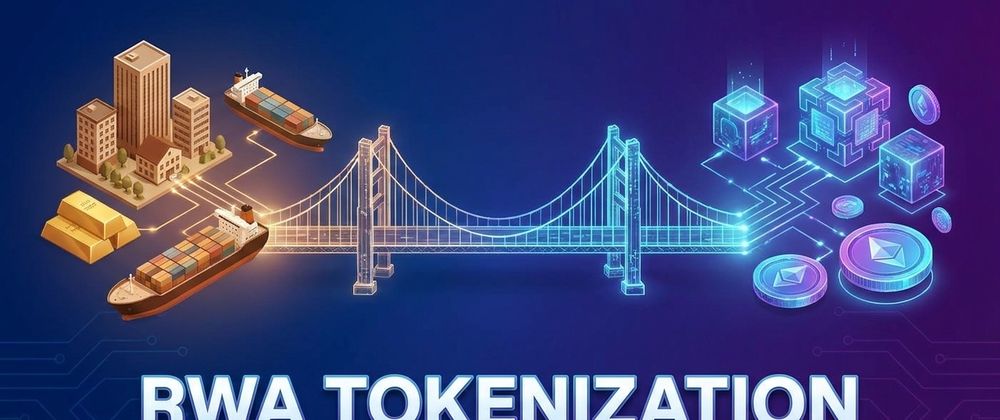


Real-world asset tokenization is emerging as one of the most significant applications of blockchain technology beyond cryptocurrencies. The concept involves representing ownership rights or economic interests in physical or traditional financial assets as digital tokens recorded on a blockchain. These assets can include real estate, government bonds, private credit, commodities, artwork, infrastructure, and other forms of value that have historically been managed through conventional financial systems.
The growing interest in tokenization reflects a broader shift toward digitizing financial markets. Traditional assets often involve complex ownership structures, manual recordkeeping, intermediaries, geographical restrictions, and lengthy settlement processes. Tokenization seeks to address some of these limitations by creating digital representations that can be transferred and managed through blockchain-based infrastructure.
However, tokenization is more complicated than simply creating a digital token. The technology must be connected to legally enforceable ownership rights, reliable asset custody, regulatory compliance, investor verification, and secure smart contracts. For this reason, successful tokenization requires collaboration between blockchain developers, financial institutions, legal professionals, asset managers, and technology providers.
This article examines how real-world asset tokenization works, the technology behind it, its major benefits, practical use cases, challenges, and the role of professional blockchain development providers in building secure tokenization ecosystems.
What Is Real-World Asset Tokenization?
Real-world asset tokenization is the process of creating blockchain-based digital representations of ownership, rights, or financial interests associated with an underlying real-world asset. Instead of relying exclusively on traditional databases or paper-based documentation, ownership information or economic rights can be represented through programmable digital tokens.
For example, consider a commercial property valued at $10 million. Under a traditional structure, an investor might need substantial capital to acquire a direct interest in the property. A tokenization model could potentially divide the economic interest into a large number of digital units, subject to the applicable legal and regulatory framework. Each token could represent a defined interest in the underlying asset or in a legal entity that owns it.
The important distinction is that the blockchain token itself does not necessarily constitute legal ownership automatically. The legal structure surrounding the token determines what rights the holder actually possesses. This could include rights to income, repayment, dividends, governance, or a proportional interest in an asset-holding entity.
Therefore, tokenization should be viewed as a combination of legal structuring, asset management, financial engineering, and blockchain technology rather than merely a cryptocurrency application.
How Real-World Asset Tokenization Works
A typical tokenization process begins by identifying the asset and determining how it can be legally represented on-chain. The asset could be a property, bond, private credit instrument, commodity, or another investment product.
The next step involves establishing the legal framework. In many cases, a special-purpose vehicle or another legal entity may hold the underlying asset. Digital tokens can then be linked to defined rights associated with that structure. The exact arrangement depends heavily on jurisdiction, asset type, and applicable financial regulations.
Once the legal framework is established, the asset is evaluated and documented. This may involve property valuations, financial audits, title verification, custody arrangements, or other forms of due diligence. Investors need confidence that the underlying asset exists and that the tokenization structure accurately reflects the rights being offered.
The token is then created through a blockchain network using a smart contract. The smart contract defines rules governing token issuance, transfers, ownership restrictions, distributions, and other functions. Depending on the asset and regulatory requirements, only verified investors may be permitted to acquire or transfer tokens.
The general process can be summarized as:
Identify and evaluate the underlying asset.
Establish the legal ownership and investment structure.
Conduct asset verification and due diligence.
Design the token and define investor rights.
Develop and audit smart contracts.
Mint tokens on a suitable blockchain.
Complete investor onboarding and compliance checks.
Distribute tokens through an appropriate platform.
Manage ownership, reporting, distributions, and transfers.
This process demonstrates why tokenization projects require a multidisciplinary approach. Blockchain technology is only one part of the overall infrastructure.
The Technology Behind RWA Tokenization
Blockchain serves as the foundation for many tokenization systems because it provides a shared digital ledger capable of recording transactions and ownership information. Instead of relying on a single centralized database, blockchain networks can provide a transparent and tamper-resistant record of token movements.
Smart contracts are another critical component. These self-executing programs define how tokens behave according to predetermined rules. For example, a smart contract might restrict transfers to approved wallet addresses or automate certain distribution processes.
Token standards also play an important role. Depending on the blockchain and the asset's characteristics, developers may use specialized token standards designed to support fungibility, compliance controls, transfer restrictions, or identity verification.
Oracles can connect blockchain applications with external information. For instance, an oracle could provide data related to asset prices, interest rates, or other external events. However, oracle systems must be designed carefully because inaccurate external data can create risks within otherwise secure smart contracts.
Identity and compliance infrastructure are equally important. Unlike many cryptocurrencies, tokenized securities and regulated assets often require investor verification. Know-your-customer procedures, anti-money-laundering checks, jurisdictional restrictions, and transfer monitoring may therefore be integrated into the tokenization platform.
Major Benefits of Real-World Asset Tokenization
One of the most frequently discussed benefits of tokenization is increased accessibility. Traditional investment opportunities can sometimes require substantial minimum capital, complex paperwork, or relationships with specialized financial institutions. Tokenization may enable more flexible investment structures, although actual accessibility depends on regulatory requirements and the nature of the asset.
Another potential advantage is improved operational efficiency. Traditional transactions may involve brokers, custodians, administrators, registrars, and other intermediaries. Blockchain-based systems can automate selected processes and reduce the amount of manual reconciliation required.
Tokenization can also improve transparency. A blockchain can provide a verifiable record of token transactions, making it easier for authorized participants to track ownership changes and transaction history.
Settlement efficiency is another important area. Traditional financial transactions can take time to settle because multiple parties must reconcile records. Blockchain-based settlement can potentially reduce settlement periods and streamline transaction workflows, although real-world efficiency depends on the integration of blockchain infrastructure with existing financial systems.
Tokenization may also enable programmable financial products. Smart contracts can incorporate predefined rules governing distributions, transfers, compliance, and other activities. This programmability creates opportunities for financial products that are more automated and flexible than traditional structures.
Real Estate as a Leading Use Case
Real estate is frequently identified as one of the most promising areas for tokenization because property markets are traditionally characterized by high transaction costs and limited liquidity.
Consider a commercial building that generates rental income. A tokenization structure could represent economic interests in the property or in an entity that owns it. Depending on the legal structure, token holders might receive a proportionate share of income or other defined rights.
The potential benefit is that ownership interests could be represented digitally, making certain administrative processes more efficient. Tokenization could also potentially create new secondary-market mechanisms, although liquidity is never guaranteed simply because an asset is tokenized.
The real estate sector demonstrates an important principle: tokenization works best when it addresses a genuine structural challenge. If a tokenized property still has unclear legal rights, poor liquidity, weak compliance, or inadequate investor protections, blockchain technology alone cannot solve those problems.
Tokenized Bonds and Government Securities
Fixed-income instruments are another major area of interest. Financial institutions and governments have explored blockchain-based issuance of bonds and other debt instruments.
Tokenization can potentially simplify issuance, settlement, and recordkeeping. Smart contracts may automate certain lifecycle events, including interest calculations or payments, depending on the structure.
The growing experimentation with tokenized government bonds and institutional financial products suggests that the technology is moving beyond purely speculative applications. The strongest use cases often involve assets where automation, transparency, and settlement efficiency can generate measurable operational benefits.
Private Credit and Alternative Investments
Private credit is another area where tokenization may create significant opportunities. Private debt markets often involve complex documentation, limited transparency, and restricted access.
A tokenized private credit product could represent claims on a pool of loans or other credit instruments. Smart contracts and blockchain infrastructure may help manage ownership records and automate certain processes.
However, credit risk remains fundamental. Tokenization does not eliminate the possibility of borrower default or poor underwriting. The underlying quality of the credit portfolio remains more important than the technology used to represent it.
Commodities and Other Physical Assets
Commodities such as gold and other valuable physical assets can also be represented through tokens. In such models, the token's value may be linked to an underlying quantity of a commodity held by a custodian.
The primary challenge is ensuring that the digital representation corresponds accurately to the physical asset. This requires reliable custody, auditing, proof of reserves, and transparent redemption mechanisms.
The same principle applies to artwork, collectibles, and other physical assets. Blockchain can establish a digital record, but trusted verification remains essential to confirm authenticity and ownership.
The Role of an RWA Tokenization Company
An RWA Tokenization Company can play a central role in helping businesses transform traditional assets into blockchain-enabled investment products. Such a company may support the process from token architecture and blockchain selection to smart contract development, platform creation, compliance-oriented features, and integration with digital wallets.
The right technology partner should understand that tokenization is not simply a software development exercise. It requires careful consideration of asset custody, legal rights, investor onboarding, cybersecurity, and long-term asset management.
For example, a company tokenizing real estate may need a platform that supports investor verification, token issuance, ownership tracking, automated distributions, transfer restrictions, and reporting. The technology should be designed around the asset's legal and financial structure rather than forcing the asset into a generic token model.
Professional providers can also help organizations determine whether blockchain is genuinely appropriate for their use case. Not every asset benefits equally from tokenization. A successful project should demonstrate a clear advantage in areas such as efficiency, accessibility, transparency, automation, or market infrastructure.
RWA Tokenization Services and Their Importance
Professional RWA Tokenization Services typically cover multiple stages of a tokenization project. These may include asset assessment, token design, smart contract development, blockchain integration, token issuance platforms, wallet integration, compliance features, and ongoing technical support.
A strong service provider should also prioritize security. Smart contracts must be independently audited, platforms should follow secure development practices, and sensitive investor information must be protected appropriately.
The choice of blockchain infrastructure is another important consideration. Factors such as transaction costs, scalability, ecosystem maturity, interoperability, privacy, and regulatory requirements can influence the decision.
A professional tokenization platform should also be designed with long-term operations in mind. Issuing tokens is only the beginning. The system must support ownership management, investor communications, reporting, distributions, compliance monitoring, and potentially secondary transfers.
Key Challenges and Risks
Despite its potential, RWA tokenization faces several challenges. Regulation is one of the most significant. Tokenized assets may fall under securities, financial services, property, taxation, or other regulatory frameworks depending on their structure and location.
Liquidity is another major issue. Tokenization can technically make an asset easier to transfer, but this does not guarantee the existence of buyers and sellers. Genuine liquidity requires market demand, appropriate trading infrastructure, regulatory clarity, and investor confidence.
Custody is equally important. If a token represents a physical asset, there must be a reliable mechanism for protecting and verifying that asset. The connection between the digital token and the physical asset must remain trustworthy throughout the asset's lifecycle.
Cybersecurity presents additional risks. Smart contract vulnerabilities, compromised wallets, phishing attacks, and infrastructure failures can result in financial losses. Robust security architecture and independent audits are therefore essential.
The Future of Real-World Asset Tokenization
The future of RWA tokenization will likely depend on greater integration between traditional financial systems and blockchain networks. Instead of completely replacing existing infrastructure, blockchain may increasingly operate alongside banks, custodians, exchanges, asset managers, and regulatory systems.
Interoperability is expected to become increasingly important as different blockchain networks develop their own tokenized asset ecosystems. Investors and institutions will need secure ways to interact with assets across multiple environments.
Regulatory clarity will also play a major role. As governments and financial institutions establish clearer frameworks, more organizations may feel comfortable exploring tokenized financial products.
The most successful projects are likely to be those that focus on practical value rather than hype. Tokenization should make an asset easier to manage, distribute, transfer, or access while preserving strong legal and investor protections.
Conclusion
Real-world asset tokenization represents a significant evolution in how traditional assets may be issued, owned, managed, and transferred. By combining blockchain networks, smart contracts, digital identity, compliance infrastructure, and legal frameworks, tokenization can potentially improve transparency, operational efficiency, accessibility, and settlement processes across sectors such as real estate, bonds, private credit, commodities, and alternative investments. However, successful implementation requires much more than creating digital tokens; it demands strong legal structures, secure technology, reliable asset custody, regulatory compliance, and thoughtful business models. As organizations increasingly explore RWA Tokenization Services, partnering with an experienced RWA Tokenization Company can help them navigate the technical and strategic complexities of building secure, scalable solutions, and Blockchain App Factory provides best services for businesses seeking professional blockchain development and real-world asset tokenization solutions.





Top comments (0)