

Quick Answer
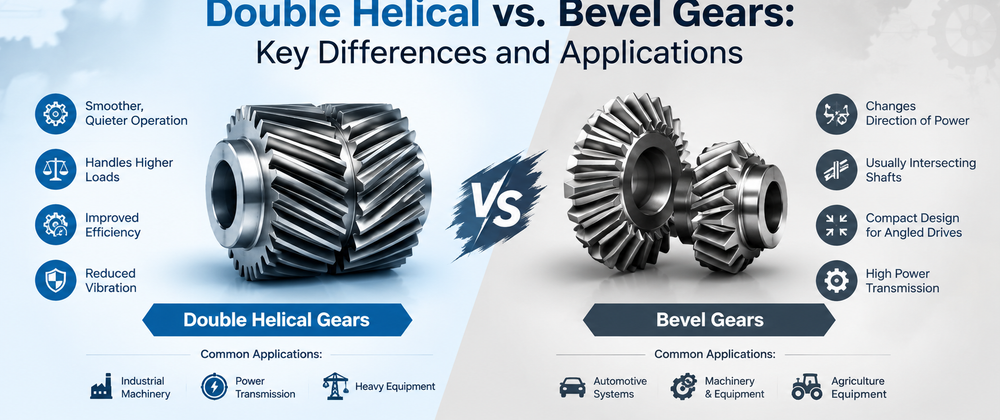
Double helical gears and bevel gears are designed for different power transmission requirements. Double helical gears are best suited for smooth, high-load transmission between parallel shafts, while bevel gears are commonly used when power needs to be transferred between intersecting shafts, often at a 90-degree angle. The right choice depends on shaft arrangement, load, speed, space, efficiency, and application requirements.
Gears play an important role in industrial machinery by controlling speed, torque, and the direction of power transmission. Among the many gear types available, double helical and bevel gears are widely used in demanding mechanical systems. Although both can handle substantial loads, their designs and operating characteristics are quite different.
What Is a Double Helical Gear?
A double helical gear consists of two sets of helical teeth arranged in opposite directions on the same gear. This arrangement creates a V-shaped tooth pattern and helps balance the axial forces produced by conventional helical gears.
Because of their tooth design, double helical gears can transmit high levels of power while maintaining smooth and quiet operation. They are commonly found in heavy-duty industrial equipment where reliability and continuous power transmission are important.
Common Applications of Double Helical Gears
Double helical gears are often used in:
- Steel rolling mills
- Heavy-duty gearboxes
- Cement plants
- Mining equipment
- Marine propulsion systems
- Power generation machinery
- Industrial drives
For example, a rolling mill may use a double helical gear system to transfer high torque from the drive unit to the rolling equipment while maintaining stable operation.
What Is a Bevel Gear?
A bevel gear has teeth cut on a conical-shaped surface. Unlike double helical gears, bevel gears are primarily used to transmit motion and power between shafts that intersect at an angle.
A common arrangement is a 90-degree shaft connection. This makes bevel gears useful when machinery needs to change the direction of power transmission within a compact mechanical system.
Common Applications of Bevel Gears
Bevel gears are widely used in:
- Automotive differentials
- Machine tools
- Industrial gearboxes
- Conveyors
- Material-handling equipment
- Agricultural machinery
- Printing machinery
- Power transmission systems
For instance, an automotive differential uses bevel-type gearing to transfer power while allowing the drive direction to change between the input and output shafts.
Double Helical vs. Bevel Gears: Key Differences
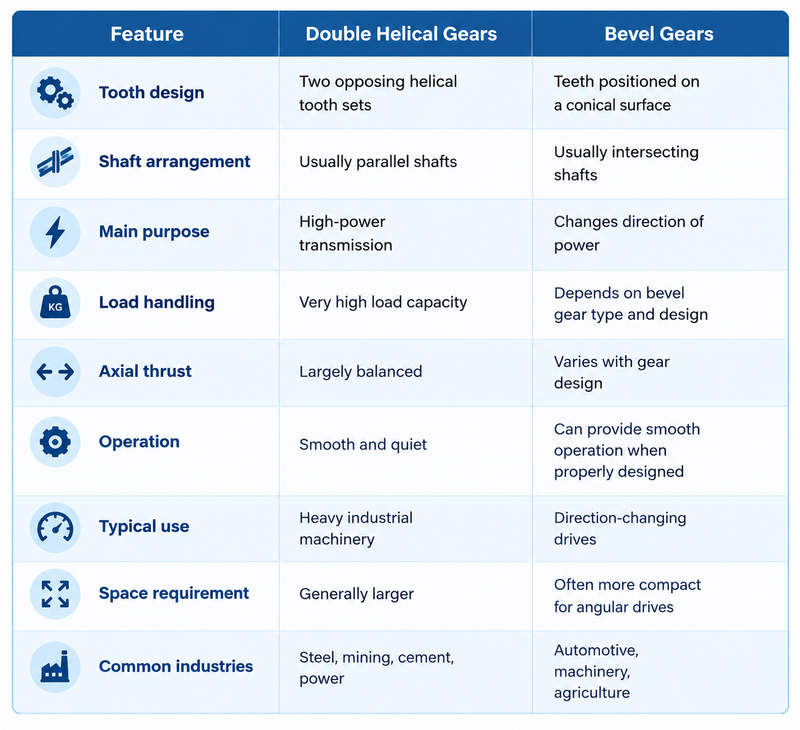
The main differences between these two gear types can be understood by comparing their design, shaft arrangement, load capacity, and typical applications.
Double Helical Gears vs. Bevel Gears: Which Is Better?
There is no universal winner because each gear type solves a different mechanical problem.
Choose double helical gears when:
- High torque transmission is required.
- The shafts are parallel.
- Heavy continuous loads are expected.
- Smooth and stable operation is important.
- The equipment operates in demanding industrial conditions.
Choose bevel gears when:
- Power must be transferred between intersecting shafts.
- The drive needs to change direction.
- A compact angular transmission is required.
- The machinery has limited installation space.
- The application requires a specific shaft angle.
The gear should always be selected according to the machine's operating conditions rather than simply choosing the gear with the highest load capacity.
How Gear Design Affects Industrial Performance
Gear geometry has a direct effect on how efficiently machinery transfers power. Tooth shape, pressure angle, material, lubrication, manufacturing accuracy, and operating speed can all influence gear performance.
Double helical gears are particularly useful for heavy-duty applications because their opposing helix arrangement helps reduce the net axial thrust associated with helical gearing. This can improve stability in large industrial gear systems.
Bevel gears, on the other hand, provide an effective solution for changing the direction of power transmission. Their conical geometry allows designers to integrate angular power transmission into machinery without requiring separate mechanisms for changing shaft direction.
Practical Example: Steel Plant vs. Angular Drive
Consider two different machines.
A steel rolling mill requires substantial torque to move and shape steel products. The drive system may operate continuously under heavy loads, making a double helical gear arrangement a suitable choice for transmitting power between parallel shafts.
Now consider a machine where the motor and driven component are positioned at an angle. A bevel gear arrangement can redirect the power from one shaft to another, making it more appropriate for this type of mechanical layout.
This example shows why application requirements matter more than simply comparing gear types by size or strength.
Factors to Consider Before Selecting a Gear
Before choosing between double helical and bevel gears, engineers should evaluate several factors.
Shaft Arrangement
Start by checking the position of the input and output shafts. Parallel shafts generally favor double helical gearing, while intersecting shafts commonly require bevel gears.
Torque and Load
Determine the torque, operating load, and expected duty cycle. Heavy continuous loads may require a robust double helical arrangement, while bevel gears can be selected according to the required torque and configuration.
Operating Speed
Gear performance can change significantly with speed. Consider tooth geometry, lubrication, heat generation, and manufacturing accuracy when selecting a gear for high-speed applications.
Available Space
The available installation space can influence the final gear choice. Bevel gears can be useful where angular power transmission is needed within a compact layout.
Maintenance Requirements
Proper lubrication, alignment, inspection, and load management are important for extending gear service life. The selected gear should also match the maintenance capabilities of the facility.
Manufacturing Quality
Precision manufacturing is essential for reliable gear performance. Accurate tooth profiles, proper heat treatment, and suitable materials can reduce wear, noise, and premature failure.
Conclusion
Double helical and bevel gears both provide reliable power transmission, but they are designed for different mechanical requirements. Double helical gears are particularly suitable for high-load transmission between parallel shafts, while bevel gears are commonly used to transfer power between intersecting shafts and change direction.
Understanding the differences in shaft arrangement, load capacity, gear geometry, operating conditions, and application requirements can help engineers select the right solution. A careful gear selection process can improve machine performance, reliability, and service life.
Frequently Asked Questions
** Are double helical gears stronger than bevel gears?**
Not necessarily. Strength depends on the gear size, material, tooth design, manufacturing quality, lubrication, and operating conditions. Double helical gears are particularly well suited to high-load industrial applications, while bevel gears are designed for angular power transmission.
What is the main advantage of a double helical gear?
One major advantage is its ability to transmit high power smoothly while balancing the opposing axial forces generated by its two helical tooth sets. This makes double helical gears useful in heavy-duty industrial machinery.
** What is the main purpose of a bevel gear?**
A bevel gear is primarily used to transmit power between shafts that intersect at an angle. It is especially common in applications where the direction of rotation or power transmission needs to change.
Can double helical gears and bevel gears be used in the same machine?
Yes. Complex industrial machinery can use different gear types within the same power transmission system. Each gear can perform a specific function based on shaft arrangement, torque requirements, and machine design.
Which gear is better for a steel rolling mill?
Double helical gears are commonly suitable for heavy-duty rolling mill applications because they can handle high torque and continuous loads while providing smooth power transmission. The final selection should still be based on the specific mill design and operating requirements.
How can gear life be improved?
Regular lubrication, correct alignment, proper load management, periodic inspection, and using accurately manufactured gears can help improve service life. Early detection of abnormal noise, vibration, overheating, or tooth wear can also prevent larger failures.






Top comments (0)