

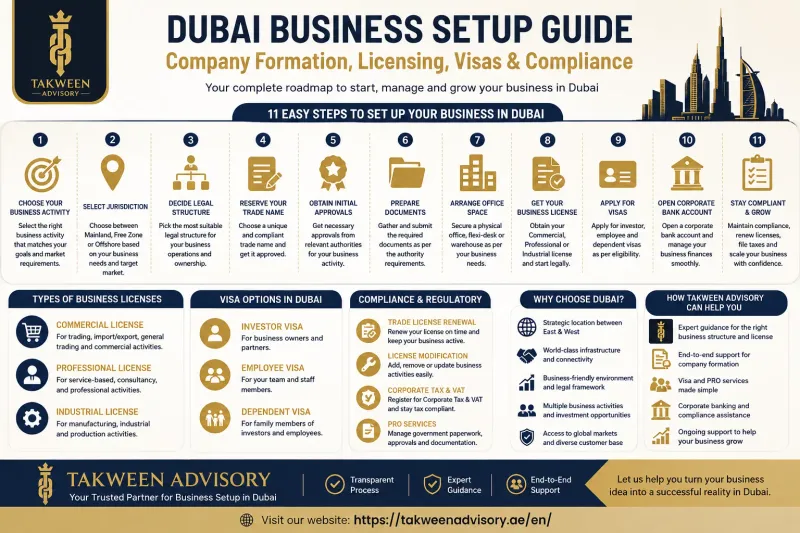
Starting a business in Dubai can be an exciting opportunity for entrepreneurs, investors, and companies looking to enter the UAE market. Dubai has developed a business environment that supports startups, international investors, established companies, and professionals across many industries.
However, setting up a company involves more than simply registering a business name. Entrepreneurs need to choose the right business activity, decide between mainland and free zone setup, obtain the appropriate licence, understand visa requirements, arrange corporate banking, and maintain ongoing compliance.
This Dubai Business Setup Guide explains the major steps in simple language so that new business owners can understand what is involved before starting the process.
Why Start a Business in Dubai?

Dubai is one of the UAE's most recognised commercial centres, with businesses operating across sectors such as technology, consulting, trading, construction, healthcare, logistics, hospitality, professional services, and retail.
Several factors make Dubai attractive to entrepreneurs:
Access to a diverse and international customer base
Modern infrastructure and transportation
Numerous business activities and licensing options
Mainland and free zone company structures
Opportunities for international investors
Developed banking and financial services
Business-friendly infrastructure
Access to regional and international markets
The right setup, however, depends on your business activity, ownership requirements, target customers, office needs, and long-term plans.
What Does Dubai Business Setup Mean?

Dubai business setup refers to the process of establishing and legally registering a business in Dubai.
Depending on the company structure and activity, the process may involve:
Selecting a business activity
Choosing a suitable jurisdiction
Selecting a legal structure
Reserving a trade name
Obtaining initial approvals
Preparing company documents
Arranging an office or business address where required
Obtaining the relevant business licence
Applying for visas, if required
Opening a corporate bank account
Completing applicable tax and compliance registrations
The exact requirements vary from one business to another, so there is no single setup route that works for every entrepreneur.
Step 1: Choose Your Business Activity
The first important decision is selecting your business activity.
A business activity describes what your company is legally permitted to do. For example, a company may operate in consulting, general trading, information technology, marketing, manufacturing, education, logistics, or another approved activity.
Your selected activity can influence:
The type of licence required
Approvals from relevant authorities
Office requirements
Available company structures
Visa eligibility
Regulatory obligations
It is therefore better to identify your actual business activities before applying for a licence rather than selecting an activity simply because it appears convenient.
Step 2: Decide Between Mainland and Free Zone
One of the biggest decisions in Dubai company formation is choosing the appropriate jurisdiction.
Mainland Company Setup
A Dubai mainland company is generally registered through the relevant Dubai licensing authority.
Mainland businesses can be suitable for entrepreneurs who want to operate within the wider UAE market, serve local customers, establish a physical presence, or participate in certain contracts and commercial activities.
The exact ownership and approval requirements depend on the business activity and applicable regulations.
Free Zone Company Formation
Dubai has several free zones designed for different types of businesses and industries.
Free zones can offer specific advantages depending on the jurisdiction, such as specialised infrastructure, business packages, sector-focused ecosystems, and different office solutions.
However, free zone rules are not identical. Each free zone can have its own:
Licensing procedures
Permitted activities
Office requirements
Visa rules
Company structures
Renewal procedures
Administrative requirements
Therefore, choosing a free zone should be based on your actual business requirements rather than simply choosing the cheapest package.
How Should You Choose?
Ask yourself:
Where will my customers be located?
Do I need to operate directly across the UAE?
What business activity will I conduct?
Do I need a physical office?
How many visas may I require?
Will I need warehouse or specialised facilities?
Do I plan to expand later?
Answering these questions can make the decision much easier.
Step 3: Select the Legal Structure
Your company also needs an appropriate legal structure.
Depending on the activity and jurisdiction, available structures may include different forms of companies, establishments, branches, or other permitted entities.
The appropriate structure can affect:
Ownership
Liability
Documentation
Management
Licensing
Banking
Compliance requirements
Entrepreneurs should consider both their current requirements and future plans when making this decision.
Step 4: Reserve Your Business Name
Once the business activity and structure have been considered, the next step can involve selecting and reserving a trade name.
Your proposed name needs to meet the applicable naming rules. Certain words, expressions, or references may require additional approval or may not be permitted.
A good business name should also be:
Relevant to your business
Easy to remember
Suitable for professional use
Consistent with your branding
Acceptable under the applicable naming requirements
Checking name availability early can help prevent unnecessary delays.
Step 5: Obtain Initial Approvals
Some businesses require initial or external approvals before the final licence can be issued.
This is particularly important for activities that are regulated or require approval from another government department or authority.
For example, certain healthcare, education, financial, food, transport, or professional activities may have additional requirements.
The exact approvals depend on the nature of the business.
Step 6: Prepare the Required Documents
Documentation is an important part of company formation.
Common documents may include:
Passport copies of shareholders or managers
Passport photographs where applicable
Proposed trade name
Application forms
Business plan in certain cases
Memorandum or constitutional documents where required
Office or tenancy documents where applicable
Additional approvals for regulated activities
The requirements can differ depending on the company type, jurisdiction, nationality, activity, and licensing authority.
Keeping documents accurate and up to date can make the application process smoother.
Step 7: Obtain Your Dubai Business Licence
A business licence gives the company legal permission to conduct its approved activity.
The type of licence depends on what the company does.
Commercial Licence
A commercial licence is generally associated with businesses involved in trading and commercial activities.
Professional Licence
A professional licence can be relevant to certain service-based and professional activities.
Industrial Licence
Businesses involved in manufacturing or industrial activities may require an industrial licence along with additional approvals and facility requirements.
The licence should accurately reflect the company's activities. Operating outside the scope of an approved activity can create compliance issues.
Understanding Dubai Trade Licence Renewal
Getting the licence is not the end of the process.
Business licences generally need to be maintained and renewed according to the applicable rules and expiry dates.
During renewal, companies may need to review:
Licence validity
Office or tenancy documentation
Company details
Approved activities
Government requirements
Outstanding obligations
Keeping track of renewal dates is important because an expired licence can affect business operations and other connected services.
Trade Licence Modification
Businesses sometimes change after they are established.
For example, a company may want to:
Add a new business activity
Remove an existing activity
Change company information
Update ownership or management details
Modify its business structure
Change other registered information
Such changes may require a formal licence modification or amendment.
It is better to complete the relevant approval process before conducting a new activity rather than assuming the existing licence automatically covers it.
Trade Licence Cancellation
If a business is closing permanently, licence cancellation is another important part of the process.
Simply stopping business operations does not necessarily mean that the company has been formally closed.
Depending on the company and jurisdiction, closure may involve:
Settling outstanding obligations
Cancelling visas where applicable
Closing or terminating certain registrations
Completing authority procedures
Obtaining cancellation documentation
A proper closure can help reduce future compliance problems.
Dubai Business Visa Requirements
Many entrepreneurs establish a company because they also need residency options for themselves or their employees.
Depending on the company structure and eligibility, a business owner may be able to apply for an investor or partner-related residence route.
Companies may also sponsor eligible employees under applicable UAE employment and residency procedures.
Visa processing can involve several stages, including:
Entry permission where applicable
Medical examination
Emirates ID procedures
Residency processing
Employment-related documentation
Visa eligibility, quotas, and requirements can vary, so applicants should check the rules applicable to their specific company and situation.
Employee Work Visas
Once a company has employees, it may need to manage employment and immigration-related requirements.
Employers may need to consider:
Employment contracts
Work permits
Residency procedures
Emirates ID
Medical requirements
Visa renewals
Employee records
Keeping employee documentation organised is an important part of ongoing business administration.
Corporate Bank Account
After establishing a company, many entrepreneurs want to open a corporate bank account.
Banks usually conduct their own due diligence before approving an account.
The bank may review information such as:
Company licence
Corporate documents
Shareholder information
Business activities
Expected transactions
Source of funds
Business model
Customer and supplier information
Having a clear business profile and consistent documentation can make the banking review more straightforward.
However, company formation does not automatically guarantee corporate bank account approval. The final decision rests with the bank.
Corporate Tax and VAT Compliance
Tax compliance is another important consideration for businesses operating in the UAE.
Companies should understand whether they have obligations relating to corporate tax, VAT, or other applicable registrations and filings.
Corporate tax treatment can depend on factors such as the company's activities, income, status, and applicable UAE tax rules.
Free zone businesses should also avoid assuming that being located in a free zone automatically means that every type of income is subject to a zero tax rate. Eligibility depends on the applicable rules and conditions.
VAT registration may also become relevant when a business reaches the applicable registration threshold or otherwise falls within the relevant requirements.
Because tax rules can change, businesses should use current official guidance and professional advice when making tax decisions.
PRO Services and Government Administration
After company formation, businesses often continue dealing with government-related procedures.
These can include:
Licence renewals
Visa applications and renewals
Establishment card procedures
Immigration-related paperwork
Document submissions
Government forms
Licence amendments
Employee-related administrative processes
Professional PRO support can help businesses manage routine government administration more efficiently, especially when owners want to focus on their core operations.
Document Attestation and Legal Translation
International entrepreneurs frequently need to submit documents issued outside the UAE.
Depending on the procedure, documents may need to be attested, legalised, or translated into Arabic by an appropriately authorised provider.
Examples can include:
Educational certificates
Marriage certificates
Birth certificates
Powers of attorney
Corporate documents
Commercial documents
Requirements depend on the document and the authority requesting it. Businesses should confirm the required process before submitting documents.
Common Mistakes to Avoid When Setting Up a Business in Dubai
New entrepreneurs can make avoidable mistakes when they focus only on the initial licence price.
Here are some common issues to watch for.
Choosing a Licence Before Choosing the Activity
Your business activity should come first. The licence should support what you actually intend to do.
Choosing a Jurisdiction Only Because It Is Cheap
The lowest initial package may not always be the most suitable option. Office requirements, visa needs, renewal costs, banking considerations, and future expansion should also be evaluated.
Ignoring Additional Approvals
Certain industries require approvals beyond the standard licensing process.
Forgetting Renewal Dates
An expired licence can create unnecessary administrative complications.
Mixing Personal and Business Finances
Maintaining proper separation between personal and corporate transactions can make accounting and banking administration easier.
Treating Compliance as a One-Time Task
Compliance continues after the company is established. Businesses should regularly review their licences, tax obligations, employee documentation, contracts, and corporate records.
How Much Does Dubai Business Setup Cost?
There is no single fixed price for setting up a company in Dubai.
The total cost can depend on:
Business activity
Mainland or free zone jurisdiction
Licence type
Number of shareholders
Number of visas
Office requirements
External approvals
Government fees
Immigration-related expenses
Additional administrative services
Instead of focusing only on the initial setup price, entrepreneurs should calculate the expected first-year and recurring costs.
This can provide a more realistic picture of the investment required to operate the business.
How Takween Advisory Can Help
Understanding the Dubai business setup process can be difficult when an entrepreneur is dealing with multiple authorities, documents, licences, visas, and compliance requirements at the same time.
Takween Advisory provides business advisory and setup support for entrepreneurs and companies looking to establish or manage businesses in Dubai and the UAE.
Depending on the client's requirements, professional support can include assistance with company formation, licensing, visa procedures, PRO services, corporate tax-related processes, and other business administration requirements.
The most suitable approach should always be based on the company's actual activity, structure, jurisdiction, and long-term objectives.
Practical Checklist Before Starting a Business in Dubai
Before beginning your application, consider the following:
Define your business activity
Identify your target customers
Compare mainland and free zone options
Select an appropriate legal structure
Check trade name availability
Identify required approvals
Prepare your documents
Understand office requirements
Estimate visa requirements
Plan for corporate banking
Review tax and compliance obligations
Create a renewal and compliance calendar
A little planning at the beginning can prevent many administrative problems later.
Frequently Asked Questions
1. What is the first step in Dubai business setup?
The first step is usually to clearly define your intended business activity. Once the activity is understood, you can evaluate the appropriate jurisdiction, legal structure, licence, and approval requirements.
2. Is mainland or free zone better for a Dubai business?
Neither option is automatically better for every business. The right choice depends on your activity, customers, office requirements, ownership needs, visa requirements, and expansion plans.
3. Can foreigners start a business in Dubai?
Foreign entrepreneurs and investors can establish businesses in Dubai subject to the applicable laws, activity requirements, ownership rules, and licensing procedures.
4. Do all Dubai businesses need a trade licence?
Businesses generally need the appropriate authorisation or licence to legally conduct their approved commercial activity. The exact licence depends on the nature and structure of the business.
5. Do I need an office to start a business in Dubai?
Office requirements vary according to the jurisdiction, business activity, licence type, and applicable regulations. Some setups may offer flexible office solutions, while others may require a physical premises.
6. Can a Dubai company sponsor employee visas?
Eligible companies can generally sponsor employees subject to applicable immigration, labour, establishment, quota, and other requirements.
7. Does setting up a company automatically provide a bank account?
No. Corporate bank account approval is a separate process. Banks conduct their own compliance and due-diligence checks before approving an account.
8. How long does Dubai company formation take?
The timeline varies depending on the business activity, jurisdiction, required approvals, documentation, and authority procedures. Straightforward applications may be faster than businesses requiring additional regulatory approvals.
9. What happens if a Dubai trade licence expires?
An expired licence can create administrative and compliance issues and may affect connected services. Businesses should monitor expiry dates and complete renewal procedures on time.
10. Why is professional business setup support useful?
Professional support can help entrepreneurs understand licensing options, documentation, government procedures, visa processes, and ongoing compliance requirements. However, the final business structure should always be selected according to the company's specific needs.
Final Thoughts
Setting up a company in Dubai is not simply about obtaining a licence. A successful business setup requires careful planning around the business activity, jurisdiction, legal structure, office requirements, visas, banking, taxation, and ongoing compliance.
The best approach is to understand these requirements before starting the application process. This can help entrepreneurs avoid unsuitable structures, unexpected administrative issues, and unnecessary delays.
For entrepreneurs looking for practical guidance on Dubai business setup, company formation, licensing, visas, and compliance, Takween Advisory can provide professional assistance based on the requirements of the business.
Thanks for reading this Dubai Business Setup Guide. If you are planning to start or expand a business in Dubai, take the time to understand your licensing, visa, tax, and compliance requirements, as well as related options such as passport by investment, before making a decision. For further guidance on Dubai business setup and related services, you can explore Takween Advisory's business advisory resources.







Top comments (0)