
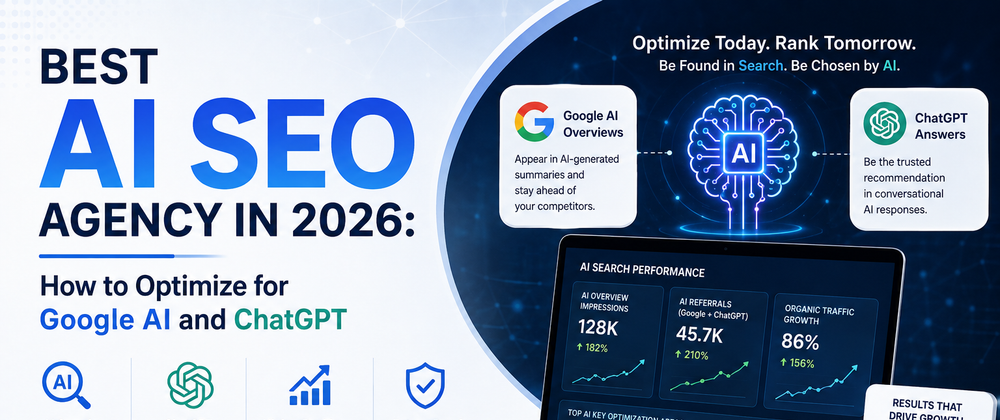

Search has split into two channels that businesses now have to win at the same time. There is still the classic Google results page, and there is a fast growing second surface made up of AI Overviews, ChatGPT, Gemini, Perplexity, and Copilot, all of which answer questions directly instead of sending users to a list of links. Choosing the best SEO agency in 2026 means finding a partner who can win visibility in both places at once, not just one.
This guide breaks down what has actually changed, what Google AI and ChatGPT reward, and how to evaluate an SEO optimization services provider against that reality.
Why Traditional SEO Alone No Longer Covers the Full Picture
For close to two decades, ranking well meant satisfying two questions: is this a good page, and does it meet the searcher's need for this specific query. Those two pillars, page quality and needs met, still matter enormously for classic search rankings. Technical health such as crawlability, mobile usability, page speed, structured data, and HTTPS still decides who shows up on page one.
But AI answer engines do not rank a list of ten blue links. They select, synthesize, and often compress several sources into a single answer, then decide whether to cite anyone at all. That is a fundamentally different game, and it is why Generative Engine Optimization, sometimes called Answer Engine Optimization, has become its own discipline rather than a subset of classic SEO. A business can rank on page one of Google and still be invisible inside an AI Overview or a ChatGPT answer if the content is not structured to be retrieved and trusted by those systems.
What Google AI and ChatGPT Actually Reward
Getting cited inside an AI generated answer depends on three things working together.
Retrievability. Content has to be findable and machine-parseable before it can ever be cited. That means stating clearly what the page is about within the first few sentences, breaking information into self-contained sections with clear headers, and using structured data such as FAQ, HowTo, or Article schema so claims are machine legible. AI retrieval systems typically pull short passages out of a page rather than reading the whole thing, so each section needs to make sense on its own.
Answer-worthiness. AI systems favor content that states the conclusion first and elaborates afterward, the opposite of the storytelling-before-the-point structure that has traditionally kept readers scrolling. Specificity matters too. Concrete numbers, named entities, and defined terms get cited far more often than vague generalizations. Original data or a genuinely unique framework is disproportionately valuable, since AI systems otherwise default to whichever source explained something first or most clearly.
Source credibility. This is the AI-era version of E-E-A-T, expertise, experience, authoritativeness, and trust. AI systems weigh whether there is a named, checkable author or organization behind the content, whether independent and reputable sources corroborate the same claims, and whether the source has a consistent track record rather than being a brand new, reputation-less domain. Content that contradicts well established consensus without strong justification gets quietly passed over, even when it is topically relevant.
Trust functions as a floor across both channels, not a bonus on top of good writing. A page cannot earn a high rating just for being well optimized if the information itself is inaccurate or misleading, and this bar rises even further for Your Money or Your Life topics such as health, finance, and legal content, where low effort or unqualified content should never rank regardless of how polished it looks.
The Dual-Track Approach: Search Visibility and AI Citation
The most reliable way to evaluate an agency, or to audit your own content, is to score every important keyword on two separate tracks rather than one blended score.
Track S looks at classic search: page quality, needs met, and technical readiness including schema, crawlability, and mobile speed. Track A looks at AI answer performance: retrievability, answer-worthiness, and citation likelihood, meaning how confidently a cautious AI system would attribute a claim to your page.
A keyword can score well on one track and poorly on the other, and that divergence is diagnostic rather than a failure. Content that ranks well in Google but is not structured for extraction usually needs direct-answer summaries, FAQ blocks, and cleaner schema. Content that is a strong, citable source but lacks backlinks or domain authority needs traditional technical and authority SEO work layered on top. Content that is weak on both tracks has a fundamental quality or sourcing gap that has to be fixed before any technical optimization will help. The strongest keyword targets are the ones scoring well on both tracks, and those deserve ongoing measurement and defense as competitors catch up.
What to Look for in an SEO Optimization Services Partner
When you are evaluating providers, the label matters less than the process. A capable seo services for business partner should be able to show you, for your actual target keywords, how content performs on both search rankings and AI citation, not just one dashboard of rankings that ignores what happens inside a ChatGPT conversation.
Ask how they structure content for chunkability and directness, whether they implement schema markup as standard practice, how they build source credibility signals like named authorship and independent corroboration, and whether they track citation likelihood the same way they track keyword rank. Ask how they handle geographic targeting if you operate internationally, since AI systems weigh jurisdiction-appropriate corroboration heavily for regulated or location-specific topics. And ask to see their seo blogs or published content directly, since a genuine best seo agency will have live examples of dual-track optimized content rather than just claims about it.
Bringing It Together
Winning in 2026 is not about picking search over AI or AI over search. It is about building content that a Google rater and a large language model would both judge as genuinely useful, accurate, and well sourced, then structuring it so each system can actually retrieve and trust it. That combination, page quality plus retrievability plus credible sourcing, is what separates agencies that talk about AI SEO from agencies that can actually deliver visibility inside AI answers.
If you want a partner that treats both tracks as equally important and can show you where your content currently stands on each, SEO Discovery works with businesses across 50-plus countries to build this kind of dual-track strategy from the ground up, combining technical SEO, content structured for AI retrieval, and authority building that holds up under scrutiny from both raters and retrieval systems. Reach out to discuss where your current content stands and what a realistic roadmap looks like for your industry.
Choosing the best AI SEO agency in 2026 ultimately comes down to one question: can they prove, with evidence rather than promises, that your content is positioned to win on both the search results page and inside the answer a user actually reads. That is the bar SEO Discovery holds itself to on every engagement.







Top comments (0)