


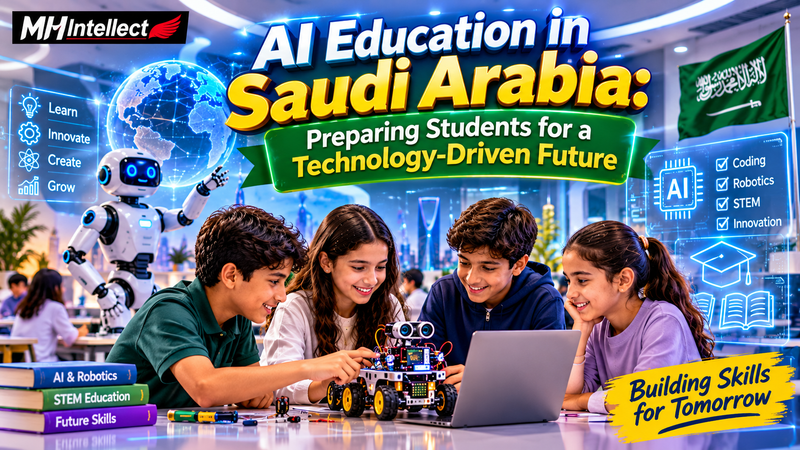
Artificial Intelligence (AI) is transforming industries and creating new opportunities in education, healthcare, engineering, and technology. As digital innovation continues to shape the future, schools have an important responsibility to prepare students with the knowledge and skills needed to adapt. AI education in Saudi Arabia is becoming an important area of focus, encouraging learners to explore emerging technologies through coding, robotics, machine learning, and practical STEM activities.
The Growing Importance of AI Education in Saudi Schools
Technology is changing the skills students need to succeed in the modern world. Introducing AI education for Saudi schools can help learners understand how intelligent systems work and how artificial intelligence is used to solve real-world problems.
By including AI concepts in classroom activities, schools can encourage students to develop digital awareness, computational thinking, creativity, and analytical skills. Early exposure also helps learners become familiar with technologies that are increasingly relevant across different industries.
Why Students Should Learn Artificial Intelligence
Providing opportunities to learn artificial intelligence helps students move beyond simply using digital devices. They can begin understanding how AI systems recognise patterns, process information, and generate results.
Age-appropriate activities can introduce these concepts through visual programming, interactive demonstrations, and educational robotics. Older students can explore Python programming, machine learning, data analysis, and simple AI applications. These experiences encourage independent thinking and help learners connect classroom knowledge with practical challenges.
Making AI Learning Interactive and Practical
Effective AI learning should combine theoretical understanding with hands-on experiences. Instead of only reading about artificial intelligence, students can experiment with tools, build simple projects, and explore how intelligent technologies operate.
For example, learners can develop basic chatbots, investigate image recognition, programme robots, or use sensors to collect and analyse information. Practical activities make complex concepts easier to understand while encouraging collaboration, creativity, and problem-solving.
Teachers also play an essential role in helping students use AI responsibly. Lessons should introduce important topics such as data privacy, information accuracy, algorithmic bias, and ethical technology use.
Connecting AI in STEM Education with Real-World Applications
Integrating AI in STEM education creates opportunities for students to apply science, technology, engineering, and mathematics to practical challenges. AI-based activities can connect these subjects through robotics, coding, automation, and data-driven projects.
Students can explore applications such as smart agriculture, environmental monitoring, healthcare technology, and automated systems. These projects help learners understand how different disciplines work together and encourage them to develop innovative solutions.
Preparing Future-Ready Students with MH Intellect
Schools need structured educational experiences that make emerging technologies accessible and engaging. MH Intellect supports schools in developing practical STEM learning opportunities through activities involving coding, robotics, engineering, and artificial intelligence.
As a STEM Implementation Partner, MH Intellect helps schools introduce hands-on learning experiences that encourage curiosity, creativity, and technical understanding. Students can also explore examples of practical projects and learning experiences through the Student's Gallery.
Conclusion
AI education can help prepare students for a future shaped by technology and innovation. By introducing artificial intelligence through practical activities, structured lessons, and responsible technology practices, schools can strengthen digital literacy, creativity, and problem-solving skills. Investing in AI and STEM learning today can empower students to become confident technology users, innovative thinkers, and future creators.



Top comments (0)