


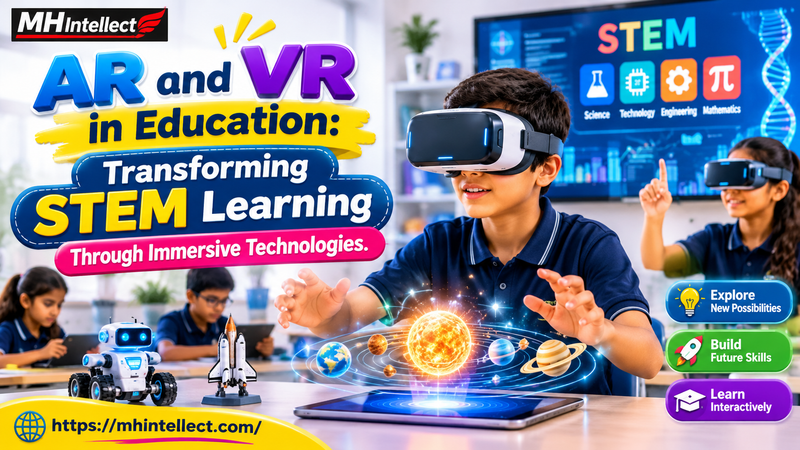
Technology is transforming modern education by creating new opportunities for students to learn through interactive and practical experiences. Traditional teaching methods are increasingly supported by digital tools that make complex concepts easier to understand. Among these innovations, AR and VR in Education are becoming powerful approaches for improving classroom engagement, encouraging creativity, and developing future-ready skills.
Understanding AR and VR in Modern Education
Augmented Reality and Virtual Reality offer different ways to enhance educational experiences. Augmented Reality adds digital elements, such as animations, interactive objects, and 3D models, to the real-world environment. Virtual Reality creates computer-generated environments where students can explore and interact with simulated experiences.
These technologies help learners understand subjects through visualisation and practical exploration. For example, students can examine the human body, explore the solar system, investigate scientific processes, and understand engineering structures using interactive digital environments.
How Immersive Learning Improves Student Engagement
Immersive Learning changes the way students interact with educational content by allowing them to experience lessons rather than simply read or memorise information.
Through virtual experiments, interactive simulations, and three-dimensional visualisation, students can explore complex topics in an engaging learning environment. This approach encourages active participation and helps develop curiosity, creativity, and critical-thinking abilities.
For example, a science lesson about the solar system can become an interactive experience where students explore planets and understand their movements through virtual environments.
Importance of AR and VR in STEM Education
Integrating AR and VR into Science, Technology, Engineering, and Mathematics (STEM) education provides opportunities to connect theoretical knowledge with practical applications.
Some important applications include:
- Science: Explore biological structures, chemical reactions, and scientific experiments.
- Technology: Understand digital environments, programming concepts, and emerging technologies.
- Engineering: Examine mechanical systems, architectural structures, and 3D designs.
- Mathematics: Visualise geometric shapes, mathematical models, and complex calculations.
These activities help students develop practical knowledge while improving their problem-solving and analytical skills.
Benefits of Immersive Technologies in Schools
The adoption of Immersive Technologies offers several advantages for modern classrooms. By combining digital experiences with traditional teaching methods, schools can create more interactive and meaningful learning opportunities.
Key benefits include:
- Better Understanding: Three-dimensional visualisation makes difficult concepts easier to understand.
- Increased Engagement: Interactive lessons encourage students to participate actively.
- Creative Thinking: Digital exploration inspires imagination and innovation.
- Practical Learning: Virtual simulations provide opportunities to explore real-world scenarios.
- Collaboration: Group activities encourage teamwork and communication.
These benefits support the development of essential skills that students need in an increasingly technology-driven world.
Preparing Students for the Future Through Innovative STEM Education
As educational institutions continue adopting advanced technologies, integrating AR and VR into classrooms can help prepare students for future academic and professional opportunities. Practical STEM activities allow learners to experiment, explore new ideas, and develop confidence in solving real-world challenges.
MH Intellect encourages innovative STEM education through engaging learning experiences that introduce students to science, technology, engineering, and mathematics.
As a STEM Implementation Partner, MH Intellect supports schools in integrating structured STEM learning experiences that encourage practical exploration, creativity, and technical skill development.
Students can also explore educational activities, creative projects, and practical learning experiences through the Student's Gallery.
Conclusion
AR and VR are creating new possibilities for modern education by making learning more interactive, visual, and experience-based. Through immersive learning and technology-driven STEM activities, students can develop creativity, critical thinking, collaboration, and problem-solving skills. Integrating these innovative approaches into schools can help build engaging classrooms and prepare future generations for a world driven by technological advancement.


Top comments (0)