
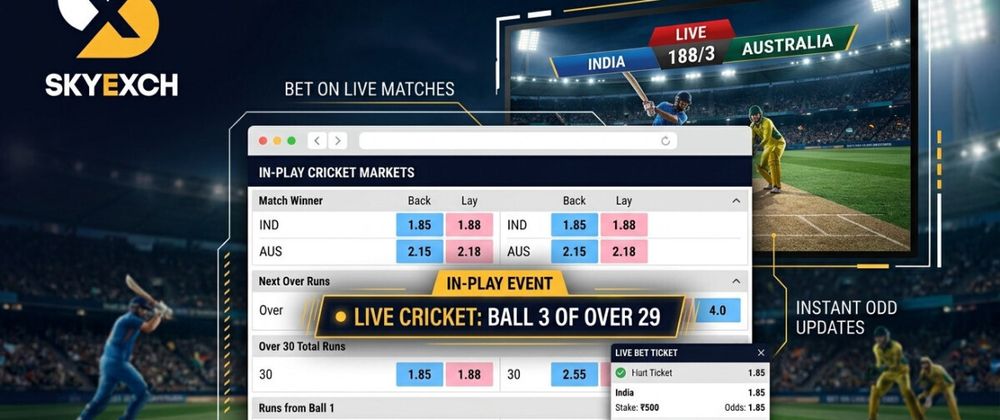

Cricket changes quickly once a match begins. A strong opening partnership, an unexpected wicket, a change in bowling, or a sudden shift in run rate can alter the direction of a game within a few deliveries. This is where in-play cricket on Sky Exchange becomes relevant for users who want to follow match developments while the action is underway.
Unlike pre-match markets, in-play options are connected to events taking place during the game. Understanding how these markets respond to live match situations can help users interpret available information more clearly and make informed decisions. This article explains the basic concept, important factors to monitor, and how users can approach live match information responsibly.
What Is In-Play Cricket?
In-play cricket refers to markets or match-related options that remain available while a cricket game is in progress. Instead of relying only on information available before the first ball, users can follow developments such as runs, wickets, overs completed, partnerships, and changes in momentum.
For example, a team may start strongly during the powerplay but lose two quick wickets soon afterward. Such a development can significantly change how the match is viewed. Similarly, a successful bowling spell or a rapid scoring sequence can alter expectations.
The exact markets and availability can differ according to the competition, match stage, and platform. Therefore, users should always check the information displayed for the particular fixture rather than assuming that every market will be available for every game.
How Does Live Match Activity Affect Markets?
The central feature of in-play markets is their connection with events happening on the field. Cricket provides frequent updates because every over contains several deliveries, and each ball can influence the match situation.
Some of the most important factors include:
- Current score and required run rate
- Number of wickets remaining
- Overs completed and overs remaining
- Current batting partnership
- Recent scoring pattern
- Bowling changes
- Pitch and weather conditions
- Match format and innings situation
In limited-overs cricket, for instance, the number of remaining deliveries becomes increasingly important as an innings progresses. ICC playing conditions define specific innings and over requirements for different formats, which means match context can vary considerably between T20s, ODIs, and Tests.
Following a Match Through the Sky Exchange App
The Sky Exchange app can provide a convenient way for users to follow available match information from a mobile device. Depending on the event and available features, users may be able to view fixtures, scores, match details, and other relevant information from a single interface.
However, users should distinguish between a live score and a market. A score tells you what has happened in the match, while a market reflects the options currently presented by the platform. They are related, but they are not the same thing.
For anyone using an Sky Exchange ID, checking the fixture details, competition, playing format, and current match status before acting is a sensible first step. It also helps avoid confusion when markets change or temporarily disappear during important moments.
Why Timing Matters During Live Cricket
Live cricket moves rapidly. A wicket, boundary, dropped catch, review, or change in bowling strategy can immediately alter the match situation.
This means users should avoid looking at one statistic in isolation. A team's score may appear strong, for example, but the number of wickets lost and overs remaining can provide important additional context. Similarly, a high run rate during the early stages does not automatically determine how an innings will finish.
The official playing conditions also show how factors such as interruptions, reduced overs, and changes to match duration can affect limited-overs games.
What Should Users Check Before Using Live Markets?
A structured approach can make live match information easier to understand. Before considering any available option, users can check:
Match Format
First identify whether the game is a T20, ODI, Test, or another competition format. Each has different scoring patterns, innings structures, and timeframes.Current Match Position
Look at the score, wickets, overs, and required rate rather than focusing on one recent delivery.Recent Momentum
A sequence of boundaries or wickets can change the complexion of an innings. However, short-term momentum should be considered alongside the wider match situation.Playing Conditions
Rain, interruptions, pitch conditions, and revised overs can change the context of a match. ICC regulations contain specific provisions for interrupted limited-overs matches.Market Information
Read the available market and its conditions carefully. Availability can change during live play, particularly around significant match events.
Understanding Sky Exchange Live Cricket Information
For users following live cricket, accurate match information is more useful than relying on assumptions. Score updates, wickets, overs, partnerships, and required run rates provide a clearer picture of what is happening.
An ID may provide access to the platform's available features, but users should still verify the match and market details before taking any action. Information should be treated as a way to understand the game rather than a guarantee of an outcome.
Most importantly, users should set personal limits and avoid making decisions based on pressure created by rapidly changing events. Live markets can move quickly, so taking time to understand the information available can be valuable.
Responsible Approach to Live Cricket
Live sports can be engaging because the situation develops continuously. Nevertheless, users should maintain control over their activity. Set a budget beforehand, avoid chasing losses, and take breaks when needed.
It is also worth remembering that cricket contains considerable uncertainty. Even detailed statistics cannot guarantee what will happen on the next delivery. A match can change through a single wicket, partnership, injury, weather interruption, or tactical decision.
Final Thoughts
Understanding live cricket starts with understanding the match itself. Score, wickets, overs, required rate, partnerships, conditions, and format all contribute to the bigger picture. When users follow these factors carefully, they can better understand why live match information changes throughout an innings.
Whether following a T20 or ODI, a measured approach is important. Live cricket develops quickly, so users should rely on verified match information, understand the conditions presented to them, and maintain responsible limits throughout their activity.






Top comments (0)