
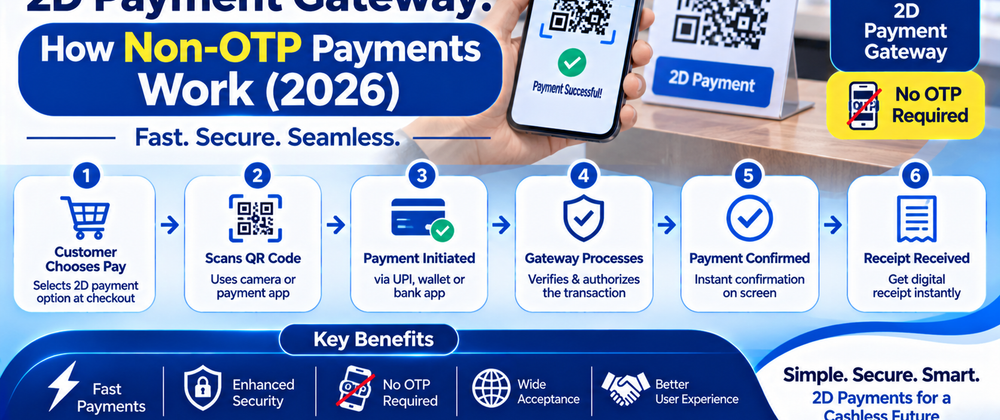

A 2D payment gateway completes an online card payment without asking the customer for an OTP or any other second check. That makes checkout fast, but the rules differ widely by region, and the merchant usually carries the fraud loss when a payment is not authenticated. This guide explains how a 2D payment gateway works, how it compares with 3D Secure, where non-OTP payments are allowed in the EU, UK, India and elsewhere, and how to decide what fits your business.
Quick answer
● What it is: A card payment authorised on the basic card details alone
● Who carries fraud losses: Usually the merchant
● Fast without giving up protection: 3D Secure 2 with frictionless approval
● Non-OTP payments allowed by regulation: Exempt or out-of-scope payments in the EU and UK, such as low-value, merchant-initiated and phone orders
● Strict markets: India and Japan have specific 3D Secure mandates
“Safer” here means lower fraud exposure for a typical merchant based on published scheme and provider guidance. It is not a guarantee for your business.
What a 2D payment gateway is
A 2D payment gateway processes an online card payment using only the card number, expiry date and CVV, without a second identity check such as an OTP or 3D Secure. The term is informal. “2D” is not an EMVCo authentication standard, and a more precise term is non-3DS transaction. Non-3DS payments can still use encryption, tokenisation, PCI DSS controls, CVV checks and fraud scoring. Those controls are separate from cardholder authentication.
A 3D gateway adds the 3D Secure step. The gateway checks whether the card is enrolled in 3D Secure and sends the customer to the issuing bank’s authentication page, where an OTP or biometric prompt appears.
How we compared them
- Authentication method
- Fraud and chargeback liability
- Checkout speed and conversion
- Regional regulatory standing
- Best-fit business type
- Total cost of risk
Rules and scheme policies differ by country and card network, so confirm current requirements with your acquirer.
Comparison table: 2D vs 3D Secure
| Factor | 2D / non-3DS | 3D Secure |
|---|---|---|
| Authentication | Card number, expiry, CVV only | OTP, banking-app approval or biometrics |
| Chargeback liability | Usually stays with the merchant, since there is no liability shift to the issuer | Often shifts to the card issuer once the payment is authenticated |
| Checkout speed | Fastest | Slightly slower, frictionless for low-risk payments in 3DS2 |
| Fraud exposure | Higher | Lower |
| Regulated regions | Limited where strong authentication is required | Aligned with strong authentication rules |
| Best for | Low-risk, low-value or repeat payments | International sales and higher-risk payments |
Where non-OTP payments are allowed: regional rules
| Region | Rule | Non-OTP payments possible when |
|---|---|---|
| EEA | Strong Customer Authentication (SCA) has applied since 31 December 2020 | Payments are exempt or out of scope |
| UK | SCA has applied since 14 March 2022 | Payments are exempt or out of scope |
| India and Japan | Not part of the EEA, but both have mandates on the use of 3DS authentication | Limited, so confirm local rules |
| US and rest of world | No regional SCA mandate, so card scheme, issuer and acquirer rules apply | Depends on your acquirer and risk setup |
For online card payments in Europe, SCA applies only where both the issuer and acquirer are located within the EEA and the UK.
The top 5 types of non-OTP transactions
1. Plain 2D card payment: best for fast, low-risk checkout
The customer enters the card number, expiry and CVV, and the payment is authorised with no second check.
● Limits: No liability shift, so a stolen card charge that clears becomes the merchant’s loss, and it may not be allowed in regulated regions
● Suits: Low-value, low-risk sales in markets with no authentication mandate
2. Frictionless 3D Secure 2: best for balancing speed and protection
3DS2 replaced the older OTP-only flow with risk-based checks. Most low-risk transactions are approved in the background without the customer noticing an extra step. The customer sees no OTP, yet the payment is still authenticated, so liability can still shift.
● Limits: The issuer decides when to ask for a challenge, so some payments still need an OTP
● Suits: Merchants who want fewer abandoned carts without giving up liability protection
3. SCA exemptions: best for low-value and low-risk payments in Europe
In the EU and UK, some in-scope payments can skip the challenge. Amounts under 30 EUR may qualify as low-value payments, but the issuer can still apply SCA after five uses without authentication or once total spend passes 100 EUR. The other common route is the transaction risk analysis exemption. It lets a PSP or acquirer secure payments below 500 euros by risk analysis, with the allowed value depending on the PSP’s overall fraud rate. The issuer decides whether the requested exemption applies.
● Limits: When an exemption is accepted, there may be no liability shift, so you are liable if the payment is fraudulent
● Suits: Merchants selling low-value items in Europe with a PSP that offers exemption handling
4. Out-of-scope payments: best for recurring, phone and cross-border cases
Some payments fall outside SCA altogether. These include mail and telephone orders, later merchant-initiated payments such as subscriptions, and one-leg-out payments where the issuer or acquirer is outside the EEA or UK. The first payment still needs authentication. You must perform SCA when the card is saved or on the first payment of a series, and obtain the customer’s agreement to later charges.
● Limits: Recurring and MOTO payments that bypass 3D Secure leave fraud chargeback liability with the merchant
● Suits: Subscriptions, memberships and businesses that take orders by phone
5. Wallet payments: best for no-OTP authentication
Apple Pay and Google Pay run their own checks. They meet SCA by ensuring two authentication factors through the wallet itself, with an exception for Google Pay payments not stored as an Android device token, which must go through 3DS.
● Limits: Wallet coverage depends on your customers’ devices and your gateway
● Suits: Mobile-first and returning customers
Risks and costs of non-OTP transactions
Without issuer-led authentication, stolen card credentials are harder to tell apart from legitimate use, which raises card-not-present fraud exposure and can lead to more issuer declines. A fraudulent charge on a 2D payment can cost more than the order, because the merchant can lose the goods, the sale and a chargeback fee. Visa reports that authenticated transactions show close to a 45% reduction in fraud compared with non-authenticated ones. Before choosing a 2D provider, read how one is assessed in our Epaymently review.
Best practices if you accept non-OTP payments
● Add fraud tools such as reCAPTCHA, honeypot checks and real-time transaction monitoring
● Set velocity and amount limits for new customers
● Use address and CVV checks, and review high-value orders by hand
● Track chargeback ratios against card network thresholds
● Keep 3D Secure on for international or higher-risk orders
How to choose between 2D and 3D
- Check your markets. Map each region you sell into against its authentication rules.
- Model your fraud losses. Compare chargeback cost against sales lost to abandoned OTP steps.
- Ask your acquirer which transactions qualify for liability shift.
- Segment by risk. Use frictionless flows and exemptions for low-risk orders and challenges for the rest.
- Flag merchant-initiated and recurring payments correctly in your payment requests.
- Test conversion before you change your setup.
Common mistakes
● Treating card number plus CVV as two independent security factors
● Assuming frictionless 3DS2 means no authentication took place
● Assuming an accepted exemption brings liability protection
● Ignoring chargeback liability on recurring and MOTO payments
● Applying one rule to every country
Verdict
A 2D payment gateway suits fast, low-risk checkouts in markets with no authentication mandate, but the merchant usually carries the fraud loss. 3D Secure 2 gives most of the speed with better protection, and Europe, the UK, India and Japan expect strong authentication for many payments. Segment your payments by region and risk, keep fraud controls in place and confirm local rules with your acquirer.
Recent News and Developments in Payment Authentication
● October 2025: Visa began formal enforcement of its Acquirer Monitoring Program (VAMP) for merchants in the Excessive category.
● April 2026: The merchant Excessive threshold under VAMP was reported to tighten from 2.2% to 1.5% in North America, putting more merchants within enforcement scope.
● October 2026: Card issuers in India must have additional authentication in place for non-recurring cross-border card-not-present transactions on Indian-issued cards, when the overseas merchant or acquirer requests it.
Read More:
1. Complete Guide for High-Risk Merchant Account (2026)
2. Top Fintech Companies Around the Globe
3. How Plaid Enables Secure Payments
4. Best Merchant Account Providers in 2026
5. Top 10 Forex Payment Processing Options
6. Is BithoEX.com Safe? Risks and Red Flags
7. Paymentico: What It Is and What to Do
Note: If you require specific details, provider comparisons, or insights that are not currently included in this overview, we are happy to accommodate your request. Please let us know your exact needs, and we will ensure the content is updated accordingly.
About Us:
TheFinRate is a B2B fintech information platform featuring payment provider reviews, comparisons, directories, industry guides, and educational resources. It helps online merchants, eCommerce businesses, SaaS companies, fintech startups, and payment professionals compare providers and make informed payment decisions.
Contact Us:
TheFinRate







Top comments (0)