

Choosing an international holiday package feels exciting until you see the options. One operator offers a "7-night Europe special" for ₹90,000. Another offers something that looks identical for ₹1.4 lakh. Both promise "best hotels" and "complete sightseeing." So how do you decide?
The honest answer is that package prices only make sense once you know what sits inside them. A good choice depends on your budget, destination, trip length, hotel category, flight details, inclusions, travel style, cancellation terms, and the operator's track record. Many first-time travellers start with value-focused regions, and comparing budget Asia tour packages across Thailand, Vietnam, Malaysia, and Singapore is a sensible way to learn what a fair price covers before you attempt a costlier long-haul trip.
Island and beach holidays need the same careful comparison. If you are leaning towards the Indian Ocean, Seychelles tour packages are a good example of why inclusions matter, since inter-island ferries, resort transfers, and beach-hotel categories can change the real cost dramatically. This guide walks you through every decision in order, so you can compare packages with confidence instead of guessing.
Key Takeaways
- Fix your total budget first. Include flights, visa, insurance, shopping, and tips, not just the package price.
- Match the destination to your travel season, visa timeline, and interests.
- Read the inclusions and exclusions line by line. Cheap packages often hide costs here.
- Check hotel location, not just star rating.
- Understand the cancellation and refund terms before paying.
- Verify the operator through reviews, registration, and a written itinerary.
- Avoid rushed itineraries. More cities do not mean a better holiday.
What Is an International Holiday Package?
An international holiday package is a pre-arranged travel product that bundles several trip components, usually flights, accommodation, transfers, sightseeing, and sometimes meals and visa support, into one price sold by a tour operator or travel agency.
Packages usually come in three forms:
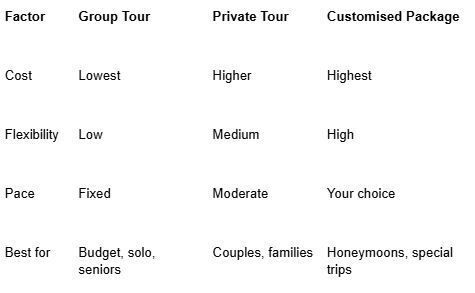
- Fixed group tours: Set dates, shared coaches, and a tour manager. Prices are lower, and flexibility is limited.
- Private or customised packages: Your own vehicle, your own pace, and flexible hotels. Prices are higher.
- Land-only packages: Hotels, transfers, and activities without flights. You book flights yourself.
For example, a "5N/6D Bali package" might include return flights from Delhi, four nights at a Seminyak resort, airport transfers, a Nusa Penida day trip, and breakfast. Another operator may sell the same destination as a land-only plan at a lower price. Knowing the format is the first step in comparing fairly.
Why Choose a Package Over Planning It Yourself?
Packages save time, reduce coordination stress, and often cost less because operators buy hotel rooms and transport in bulk. They suit first-time travellers, families, and anyone visiting a country with complicated logistics.
Benefits of Package Tours
- Bundled pricing: Operators negotiate with hotels, airlines, and local transport companies, so the combined price can be lower than separate bookings.
- Visa and documentation help: Many operators guide you through VFS Global appointments, e-visa portals, and document lists.
- On-ground support: A local representative can solve problems if a flight is delayed or a hotel overbooks.
- Time savings: Researching hotels, transfers, and tours in a new country can take weeks.
- Safety for first-timers: Pre-vetted drivers and guides reduce risk.
When DIY Travel Works Better
Independent travel suits experienced travellers who want flexibility. If you are comfortable using Booking.com, Skyscanner, and local metro apps, and you are visiting a well-connected city like Singapore or Dubai, DIY can work well. Packages tend to win in countries where language, distance, or transport make planning harder, such as Japan's rural regions, Iceland, or multi-country Europe tours.
Step 1: Set a Realistic Budget
Set your budget based on the total trip cost, not just the quoted package price. A safe rule is to add 15–25% to the package cost for visa fees, insurance, local spending, optional activities, and shopping.
What a Complete Budget Includes
- Package price (per person, based on sharing)
- Visa fee and service charges
- Travel insurance
- Forex and card charges
- Optional tours not included in the package
- Tips for guides and drivers
- Local meals not covered
- Shopping and souvenirs.
Also check the tax angle. India applies TCS (Tax Collected at Source) on overseas tour packages, and the rates and thresholds have changed in recent budgets. Ask your operator for the current treatment and a clear invoice.
Typical Budget Ranges (Per Person, Approximate)
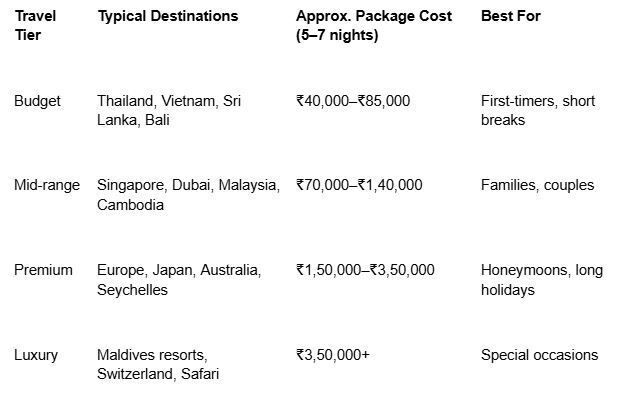
Prices vary by season, airline, and hotel, so treat these as planning guides, not quotes.
Step 2: Choose the Right Destination
Choose a destination by combining four filters: your budget, your travel dates, visa ease, and the kind of holiday you want, such as beaches, culture, adventure, or shopping.
Match the Destination to Your Traveller Type
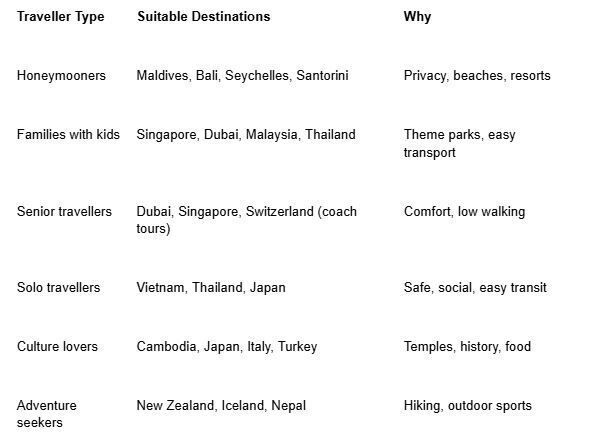
Consider Visa and Season
Visa rules change often, so always confirm them on official government or embassy pages before booking. Some destinations offer visa on arrival or e-visa processes for Indians, while the Schengen area requires an appointment and documentation. Weather matters just as much. Southeast Asia is pleasant from November to March, Europe peaks from May to September, and the Maldives is best between December and April. Travelling in shoulder season, just before or after peak months, often gives better prices and smaller crowds.
Step 3: Decide the Right Trip Duration
For most first international trips, 5–7 nights is ideal for a single country, and 10–14 nights suits a multi-city or long-haul trip. Short trips to far destinations waste time on travel.
Here is a quick guide:
- 3–4 nights: Near destinations such as Dubai, Bangkok, or Singapore
- 5–7 nights: Bali, Vietnam, Malaysia, Thailand with two bases
- 8–10 nights: Japan, Turkey, Australia (one coast)
- 10–15 nights: Europe multi-country, USA, New Zealand.
The Pace Problem
A common mistake is choosing a package that visits five cities in seven days. You spend most of your holiday on buses and in airports. As a rule, give each base at least two full nights, and add a buffer day after long-haul flights to recover from jet lag.
Step 4: Evaluate Hotel Category and Location
Hotel star ratings are only a rough guide. Location, room type, and recent guest reviews matter more than the stars.
Understanding Hotel Categories
3-star: Clean and basic, usually fine for budget travellers
4-star: Better rooms, breakfast variety, pool or spa, the common choice for mid-range packages
5-star: Premium service, central locations, larger rooms
Resorts and boutique stays: Often more memorable than chain hotels, especially in beach destinations.
What to Check Before Accepting a Hotel
- Distance from main attractions or transport: A cheap hotel 30 km away adds cab costs.
- Named hotels: "3-star equivalent" often means the operator can swap hotels later.
- Room type: Confirm bed type, view, and occupancy rules.
- Meal plan: Room-only, breakfast, half-board, or all-inclusive.
- Recent reviews: Check Google Reviews and TripAdvisor scores from the last six months.
Step 5: Check Flights and Transfers Carefully
Confirm whether flights are included, which airline is used, whether they are direct or connecting, and what baggage is allowed. Flight timings can quietly consume a full day of your trip.
Flight Details Worth Verifying
- Airline name and class: Economy on a full-service carrier differs from a low-cost carrier.
- Layover length: Layovers over six hours can be tiring. Under 90 minutes can risk a missed connection.
- Arrival and departure times: A 2 a.m. arrival may waste a hotel night.
- Baggage allowance: Low-cost airlines charge for check-in luggage.
- Departure city: Delhi, Mumbai, Bengaluru, and Kolkata have more flight options than smaller airports.
Transfers
Ask whether transfers are private or shared (SIC, or seat-in-coach). Private transfers cost more but save waiting time, which is helpful for families with children or senior travellers.
Step 6: Read Inclusions and Exclusions Line by Line
Inclusions are what the price covers, and exclusions are what you will pay extra for. Comparing these two lists is the most reliable way to judge whether a package is truly cheaper.
Inclusions Checklist
- Return international flights
- Hotel nights with named properties
- Daily breakfast (and other meals if promised)
- Airport and intercity transfers
- Sightseeing with entry tickets
- Visa assistance or visa fee
- Travel insurance
- Local SIM or Wi-Fi.
Common Exclusions That Surprise Travellers
- Tourism tax or city tax collected at hotels (common in Europe and Dubai)
- Entry fees for optional attractions
- Lunch and dinner
- Tips for guides and drivers
- Domestic flights within the destination
- Peak-season or festival surcharges
- Early check-in and late check-out fees.
Quick Comparison Example
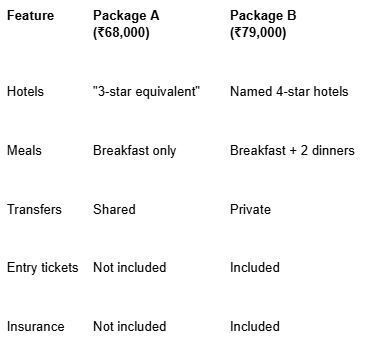
Package B looks costlier, but after adding extras to Package A, the gap often disappears.
Step 7: Match Activities and Travel Style
Choose a package that fits how you like to travel: relaxed, cultural, adventurous, or family-focused. The best itinerary balances planned activities with free time.
Common Travel Styles
- Relaxation: Beach resorts, spas, slow mornings (Maldives, Bali, Seychelles)
- Cultural: Temples, museums, food tours (Cambodia, Japan, Italy)
- Adventure: Trekking, diving, safaris (New Zealand, Tanzania)
- Urban and shopping: Skyscrapers, malls, nightlife (Dubai, Singapore, Hong Kong)
- Family-friendly: Theme parks, wildlife, easy pacing (Singapore, Malaysia).
Group Tour vs Private Tour vs Customised Package
Questions to Ask About Activities
- Is each activity included or optional?
- Are tickets pre-booked, or will you queue?
- Is there a rain-day alternative?
- Are age or fitness limits attached?
Step 8: Understand the Cancellation and Refund Policy
A good package states cancellation charges clearly, by date, in writing. Look for the refund timeline, the non-refundable components, and what happens if the operator changes or cancels the trip.
What to Look for in the Policy
- Tiered charges: For example, a partial refund up to 45 days before departure, then rising charges.
- Non-refundable items: Flights, visa fees, and peak-season hotels are often non-refundable once booked.
- Date change rules: Can you reschedule without paying full penalty?
- Refund timeline: 7–21 working days is typical.
- Force majeure clause: It covers situations such as weather events, strikes, or airspace closures.
Why Travel Insurance Matters
Travel insurance covers medical emergencies, trip interruption, baggage loss, and, in some plans, cancellation for covered reasons. Read what is excluded, since pre-existing conditions and adventure sports often need add-ons. Many countries, including the Schengen area, require proof of insurance for visa applications.
Step 9: Check Reviews and Tour Operator Credibility
Verify the operator through independent reviews, business registration, memberships such as TAAI or IATO, and a clear written itinerary. A trustworthy operator answers questions without pressure.
Credibility Checklist
- Registered company with GST number and physical office address
- Membership of industry bodies (IATA, TAAI, IATO)
- Reviews on Google, TripAdvisor, or Trustpilot spread over several years
- Transparent invoice with a breakup of costs
- Written itinerary with hotel names
- Reachable support number for emergencies
- Secure payment methods with receipts.
Red Flags
- Prices far below every competitor
- Pressure such as "offer ends tonight"
- Cash-only payments to personal accounts
- No written terms
- Only five-star reviews posted within the same week.
How to Read Reviews Properly
Look at patterns, not single comments. If several travellers mention hidden charges or poor support during problems, take it seriously. Pay special attention to how the operator responds to negative reviews, because that shows how they behave when something goes wrong.
Common Challenges and How to Avoid Them
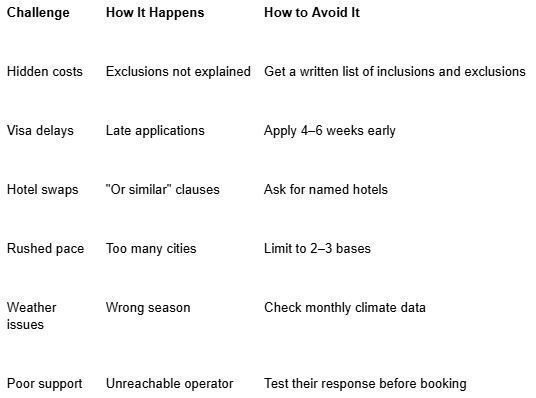
Most package problems come from hidden costs, unrealistic itineraries, visa delays, and unclear policies, and all of them can be prevented with questions asked before payment.
Future Trends in International Holiday Packages
Packages are becoming more flexible, sustainable, and personalised, with more focus on experiences than sightseeing lists.
- Customisation: Travellers increasingly mix fixed and flexible days.
- Digital visas and e-documents: More destinations are moving to online approvals.
- Sustainable travel: Eco-lodges, local guides, and low-impact tours are growing.
- Slow travel and shorter itineraries: Fewer cities, deeper experiences.
- Workation and bleisure trips: Packages that combine remote work with leisure.
- AI-assisted planning: Faster itinerary comparisons, though human verification still matters.
Final Pre-Booking Checklist
- Total budget set, including extras
- Destination matched to season and visa timeline
- Duration realistic for the distance
- Hotels named, with location checked
- Flight timings, baggage, and layovers confirmed
- Inclusions and exclusions reviewed
- Cancellation and refund terms understood
- Insurance purchased
- Operator verified
- All promises received in writing.
Travellers who enjoy temple architecture and street food often find that Southeast Asia rewards a slower approach. If that sounds like you, comparing Cambodia Travel Packages that combine Siem Reap's Angkor temples with a short capital stay can show how much value a well-structured itinerary offers. Even a short weekend break works, and Phnom Penh city breaks from India are a good example of compact, culture-rich trips that fit a limited leave balance without heavy flight timings.
Conclusion
Choosing the right international holiday package is less about finding the lowest price and more about finding the clearest value. Begin with a realistic total budget, pick a destination that suits your season and interests, and give the trip enough days to enjoy it. Then compare hotels, flights, inclusions, and cancellation terms line by line, and verify the operator before you pay.
A good package should feel transparent, flexible, and well explained. If a deal seems too good to be true or the terms are vague, walk away. When the details are clear, an international holiday package can turn a stressful planning job into a smooth and memorable trip.
Frequently Asked Questions
1. How far in advance should I book an international holiday package?
Book 2–3 months ahead for popular destinations and 4–6 months ahead for Europe, Japan, or peak holiday periods. Early booking gives better flight prices, wider hotel choices, and enough time for visa processing.
2. Is a package tour cheaper than booking everything separately?
Often yes, especially for destinations with complex logistics, because operators get bulk rates. However, experienced travellers who book budget flights and local stays directly can sometimes spend less. Compare both before deciding.
3. What should I check before paying a tour operator?
Check company registration, GST details, reviews, written itinerary, named hotels, cancellation terms, and payment receipts. Never pay in cash to a personal account without documentation.
4. Which international destinations are best for first-time travellers from India?
Thailand, Singapore, Dubai, Malaysia, Bali, and Vietnam are popular first choices. They have direct flights from major Indian cities, simple visa processes, and a wide range of budgets.
5. Are meals usually included in international packages?
Most packages include daily breakfast. Lunch and dinner are included only in some plans. Vegetarian and Jain meals may need advance requests, so confirm your dietary needs in writing.
6. What happens if my visa is rejected?
Policies vary. Visa fees are usually non-refundable, and flight or hotel cancellation charges may apply. Ask the operator in advance what is refunded if the visa is rejected, and consider booking only after visa approval where possible.






Top comments (0)