
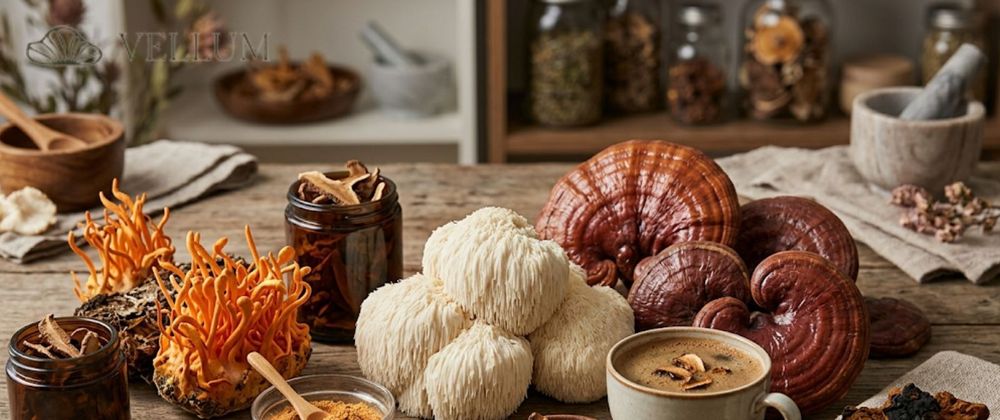

Adaptogenic mushrooms have become a common part of everyday wellness routines, and one name that keeps coming up is Reishi. Long valued in traditional wellness practices across East Asia, this mushroom has earned a reputation as a calming, supportive addition to daily life. If you have come across it on a supplement shelf and wondered what is Reishi, you are not alone, since interest in it has grown quickly in recent years. This guide looks closely at the Reishi mushroom, covering its traditional background, what current research suggests, and practical points to know before adding it to your own routine.
What Is Reishi?
Reishi (Ganoderma lucidum) is a tough, redish-brown fungi species that sprouts on rotting wood in parts of Asia. Unlike culinary mushrooms which are enjoyed as a delicately flavored dish, these are not consumed because of their taste but rather they have traditional uses in wellness practices. Traditionally, this type of Functional mushroom was considered more of a tonic rather than a food. It's available nowadays in a variety of forms like dried pieces, powder, capsules, as well as concentrated extract the latter of which usually packs a powerful concentration of the mushroom's biologically available compounds for convenient daily usage. The original focus of Reishi in traditional medicine was for overall strength and equilibrium with no fixed desired goal in mind. This holistic perspective remains a key reason for its popularity nowadays.
Reishi Benefits and Uses
Interest in Reishi benefits centers on a handful of areas that align well with everyday wellness goals.
Stress and relaxation: Reishi, also known as Ganoderma lucidum, is a fungus found in parts of Asia including China, Japan, and Korea. It has been used in traditional medicine for hundreds of years and has been researched for its potential to help the body handle everyday stress. Although further experiments are needed, some early studies appear to indicate certain substances present in the mushroom may lead to a feeling of quietness, one of the reasons it has gained much popularity in formulations of relaxation.
Sleep: Many people explore it as part of an evening routine, since it has traditionally been associated with restful, easier sleep. Current findings are still preliminary, but this remains one of the most talked-about Reishi uses.
Immune support: Reishi contains polysaccharides and triterpenes that have been studied for their possible role in supporting normal immune function. This is one of the more documented areas of research, though results vary across studies.
Antioxidant activity: Another health benefit that Reishi might have is the free-radical scavenger activity that can protect the body from the daily oxidative stress that arises due to the body's metabolic reactions and external exposure.
Together, these potential benefits explain why the mushroom remains a popular choice among adaptogen users, even though individual results can vary from person to person.
What Does the Evidence Say?
Scientific research on Reishi mushroom has greatly grown but the level of evidence is still quite different from one topic to another. Immune-related research has already produced some solid results with both laboratory models and small human studies showing some immunostimulatory effects. The supporting evidence for stress, relaxation, and sleep is less convincing as it usually relies on small studies or on the long traditional Reishi use that has been going on for hundreds of years but without proper large clinical trials backing it up. It is worth being clear that Reishi has not been shown to treat, cure, or prevent any disease, and it should not replace medical care. The most accurate way to describe the current evidence is supportive and promising in some areas, while still developing in others.
Reishi Extract and Supplements
Reishi is available as a whole powder or as a concentrated extract, and the difference matters. Powder uses the whole fruiting body, ground finely, while a Reishi extract is processed to concentrate specific compounds, often using hot water or alcohol extraction methods. Many people find that a well-made extract offers a more consistent dose than raw powder alone, which is one reason extracts are common in modern formulations.
One of the key aspects to bear in mind when shopping for a Reishi supplement is the following: first, the species name which can be identified as "Ganoderma lucidum", which in fact is the Latin scientific name of Reishi mushroom; second, what particular part of the plant, whether the fruiting body or the mycelium, is used in the supplement; and finally, how it is extracted and whether the supplement is standardized. In terms of quality, a label which clearly states all this is indicative of a genuine and reliable product.
Vellum Health takes this transparency seriously, formulating its Reishi products with clearly labeled extraction methods and sourcing information so customers know exactly what they are getting. For anyone comparing options, Vellum Health's approach to ingredient transparency can make it easier to evaluate what a given product may realistically offer.
Reishi Safety
Reishi is generally well tolerated, but it is not risk-free for everyone. Side effects are quite rare and when they do occur they are minor like a stomach upset or dry mouth, or rarely, dizziness, particularly after taking a high dose. Skin reaction has also been reported rarely.
Reishi may interact with certain medications, including blood thinners and blood pressure medications, because of its potential effects on clotting and circulation. Anyone who is pregnant, nursing, scheduled for surgery, or managing a chronic health condition should speak with a healthcare provider before starting a Reishi supplement. Checking the label and product information provided by a supplement brand, such as Vellum Health, is a reasonable first step, but it does not replace individualized medical advice.
Final Thoughts
As interest in Reishi mushroom continues to grow, choosing a quality-focused source matters just as much as the mushroom itself. Vellum Health offers thoughtfully formulated options for people who want to explore this traditional ingredient with clear labeling and transparent sourcing, making it a reasonable place to start comparing choices with confidence.
FAQ's
So, what is Reishi in simple terms?
Reishi is a mushroom, a traditional medicinal mushroom, with the name Ganoderma lucidum that has been used for centuries in Asia as herbal medicine and is now also available in the form of a Reishi supplementation product.What are the main Reishi benefits people look for?
The majority of its consumers are drawn mainly by the mushroom’s potential to help with issues like stress, improve sleep, provide relaxation, enhance one’s immune system, and antioxidant activities; nevertheless, experiences may vary among individuals.What are common Reishi uses today?
The main forms of taking Reishi are capsules, powder, or extracts, and it is mainly used to strengthen one's well-being and to unwind in the evening or to keep the immune system in good working order.What is the difference between Reishi extract and raw powder?
An extract is a concentrated product of the mushrooms which highlights certain compounds and, usually, has the advantage of more consistent dosage while raw powder contains the whole mushroom and the natural ratio of compounds.Are Reishi mushroom benefits backed by science?
Preliminary studies have shown that the most well-researched and supported effect is the one concerning the immune system, whereas effects which people report as sleep and stress relief, still require some amount of research and evidence from trials.







Top comments (0)