
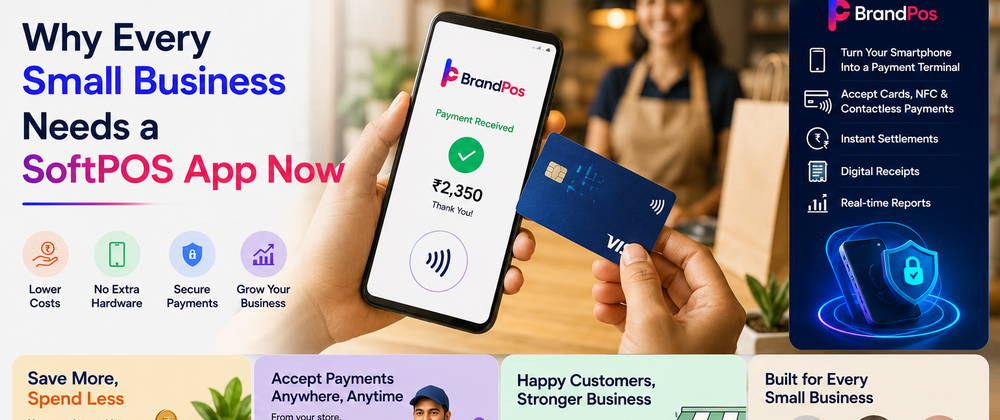

Tap, beep, done.
For millions of shoppers, that simple interaction is becoming the preferred way to pay. Instead of inserting a card, entering a PIN for every transaction, or handling cash, customers can simply bring a contactless card, phone, or wearable close to a payment-enabled device and complete a purchase within seconds.
This shift is changing more than checkout speed. It is changing what merchants expect from payment infrastructure.
Historically, accepting contactless payments required dedicated payment hardware. Today, smartphone-based payment technology is making it possible for eligible merchants to participate using compatible smartphones.
A SoftPOS App can transform a compatible smartphone into a payment acceptance device, allowing businesses to explore contactless acceptance without depending entirely on traditional payment terminals.
For small retailers, mobile professionals, restaurants, delivery teams, event sellers, and other businesses, that represents a significant change in how payment infrastructure can be deployed.
Contactless Payments Are Becoming the New Normal
The popularity of contactless payments has grown alongside smartphones, digital wallets, and increasingly sophisticated payment cards.
Customers have become accustomed to fast digital transactions. In many markets, tapping a card or phone feels more natural than handling cash.
There is also a behavioral element behind this change. Consumers increasingly value convenience. When a payment takes only a few seconds, there is less friction between deciding to buy and completing the transaction.
For merchants, faster checkout can be particularly valuable during busy periods.
A café handling a morning rush, a retailer serving customers during a sale, or a food vendor operating at an event cannot afford unnecessarily complicated payment processes.
Contactless payment addresses this problem by making the final step of a purchase almost effortless.
Why NFC Matters
Near Field Communication, commonly known as NFC, is the technology that allows compatible devices to exchange information over a very short distance.
When a customer taps a contactless card, smartphone, or wearable against a compatible payment device, NFC enables the communication needed to initiate the transaction.
The important point is that the merchant does not need to understand the technical details during every sale.
The customer taps.
The system processes the transaction.
The merchant receives confirmation.
That simplicity is one of the reasons contactless payments have become so attractive.
From Dedicated Terminals to Smartphones
The traditional payment terminal remains an important part of commerce. However, it is no longer the only way businesses can think about accepting contactless payments.
Smartphones have become powerful computing devices with NFC capabilities, secure operating environments, connectivity, cameras, biometric authentication, and business applications.
Payment technology can take advantage of those capabilities.
Instead of deploying a dedicated terminal for every employee, counter, or mobile team, businesses can potentially use compatible smartphones for supported payment acceptance.
This is particularly relevant for merchants who operate outside conventional stores.
Think about a photographer collecting a booking advance, a technician finishing a service at a customer's home, a food seller working at a temporary event, or a delivery professional collecting payment at a doorstep.
Their business does not revolve around a fixed checkout counter.
Their payment solution should not have to either.
How BrandPos Makes Contactless More Accessible
BrandPos is built around the idea that payment acceptance should fit the way a business actually operates.
For an eligible merchant with a compatible smartphone, smartphone-based payment acceptance can reduce dependence on dedicated payment equipment.
That can make contactless acceptance more practical for smaller businesses that may not want to invest in additional hardware.
It can also support businesses that need mobility.
A merchant can potentially take payment directly where the customer is instead of asking the customer to move to a fixed checkout counter.
This changes the payment experience from a location-based model to a more flexible, customer-facing model.
A Small Business Example
Consider a boutique seller participating in a weekend fashion market.
The seller may have dozens of customers arriving within a short period. Some want to pay with cards, while others may use digital payment methods.
A smartphone-based setup can give the seller another way to handle supported contactless transactions without bringing a conventional terminal solely for the event.
The same principle can apply to freelancers, repair professionals, fitness trainers, home businesses, and service providers.
Security Behind Every Tap
Convenience cannot come at the expense of payment security.
Behind every successful contactless transaction is a complex ecosystem of authentication, encryption, tokenization, device controls, payment-network rules, and security standards.
PCI DSS plays an important role in the broader payment security environment.
The Payment Card Industry Data Security Standard provides a framework for protecting payment account data and maintaining secure payment environments.
For merchants, this means the technology behind contactless payments must be designed with security as a fundamental requirement rather than an optional feature.
Smartphone-based payment acceptance also requires attention to device integrity.
Compatible devices need to meet applicable technical and security requirements. Merchants should use supported operating systems, keep applications updated, and follow the provider's security guidance.
The goal is simple: make payment acceptance convenient without treating security as an afterthought.
Why Contactless Works So Well for Modern Commerce
The biggest advantage of contactless payments may not be the technology itself.
It is the reduction in friction.
A customer does not need to count cash. A cashier does not need to provide change. A merchant does not need to manually confirm every detail. A digital transaction creates an electronic record that can support reconciliation and reporting.
These advantages become increasingly important as businesses become more mobile and customers become more comfortable with digital commerce.
Contactless also fits naturally into omnichannel retail.
A business may sell through a website, social media, messaging platforms, physical stores, temporary pop-ups, and home delivery. Payment acceptance needs to work across these different environments.
Smartphone-based acceptance can become one piece of that broader payment ecosystem.
The Road to 2030
By 2030, contactless payments are likely to be even more deeply integrated into everyday commerce.
The checkout itself may become less visible.
Instead of thinking about "going to the payment counter," customers may simply complete transactions wherever the purchase conversation happens.
For restaurants, payment could happen at the table.
For service businesses, it could happen immediately after the job.
At events, customers could pay directly at a stall.
For mobile sellers, payment acceptance could travel with the salesperson.
This does not necessarily mean traditional terminals will disappear. Larger retailers, transport systems, hospitality businesses, and high-volume environments may continue using dedicated equipment where it makes operational sense.
Instead, the future is likely to be more diverse.
Businesses will choose payment infrastructure based on their specific workflows rather than relying on one universal model.
What the Contactless Future Means for Merchants
The expansion of contactless payments creates an opportunity for smaller businesses to compete with larger merchants on payment convenience.
A customer should not have to care whether they are buying from a multinational retailer or a one-person business.
They simply want to pay easily.
That is where smartphone-based acceptance becomes particularly interesting.
A SoftPOS App can help eligible merchants participate in the contactless economy using compatible smartphones, reducing the physical barriers traditionally associated with payment acceptance.
For BrandPos, the opportunity is to make this technology useful beyond the conventional checkout counter.
The future of payments is not only about faster transactions. It is about making payment acceptance available wherever commerce happens.
Contactless Payments Are Moving Beyond the Counter
The contactless revolution began with cards and terminals, but it is evolving into something much broader.
NFC technology, smartphones, digital wallets, stronger security standards, and changing consumer expectations are collectively reshaping how people pay.
By 2030, tapping to pay may feel as ordinary as handing over cash once did.
The merchants best positioned for that future will not necessarily be the businesses with the most payment hardware.
They will be the businesses that make paying simple, secure, and convenient wherever their customers are.
Frequently Asked Questions
- What makes contactless payments faster than traditional payment methods?
Contactless transactions can reduce several physical steps involved in payment. Customers can tap a compatible card or device rather than inserting a card or handling cash, making checkout quicker in many situations.
- Does NFC work with every smartphone?
No. NFC availability depends on the smartphone's hardware, operating system, configuration, and applicable payment-service requirements. Merchants should verify device compatibility before deployment.
- Why is PCI DSS important for contactless payments?
PCI DSS establishes security requirements designed to protect payment account data. It forms part of the broader security framework used across the payment-card ecosystem.
- Can contactless payment technology help mobile businesses?
Yes. Smartphone-based acceptance can be particularly useful for businesses that collect payments away from a permanent checkout, such as service professionals, event sellers, delivery teams, and field representatives.
- Will contactless payments completely replace cash by 2030?
Not necessarily. Payment habits differ across countries, customer groups, and business sectors. Contactless usage is expected to continue expanding, but cash and other payment methods are likely to remain relevant in many markets.






Top comments (0)