

Most new practitioners hit a yoga practice plateau somewhere between month four and month ten of consistent practice, right after the rapid gains of the first few weeks begin to level off. The early months are generous: flexibility increases quickly, balance improves week over week, and postures that once felt impossible start to open up. Then, for many beginners, that sense of forward motion appears to stop. The same tightness returns in the hips. The same wobble shows up in a standing balance. This is not a sign of failure. It is a predictable stage that nearly every practitioner encounters, and understanding why it happens is the first step toward moving through it rather than around it.
What a Practice Plateau Actually Is
A yoga practice plateau is the period in which physical or mental progress slows or stalls despite continued, regular practice. It differs from burnout, which shows up as dread or avoidance of the mat altogether. A plateau is quieter than that. The student keeps showing up, keeps rolling out the mat, but the felt sense of growth is missing. For beginners, this pattern typically surfaces within the first year, once the body has adapted to the basic demands of standing poses, forward folds, and simple breath awareness.
Why This Stage Matters for Beginner Yoga Progress
Recognizing this stage matters because plateaus are exactly when many new students walk away from the practice. Without knowing that a slowdown is a normal part of beginner yoga progress, it is easy to conclude that yoga “isn't working” for a particular body, or that a personal limitation is to blame. In reality, a plateau usually signals that a student has exhausted the gains available through instinct and repetition alone, and now needs more precise feedback to keep developing.
Why Self-Directed Practice Slows Down
Three overlapping factors explain most first-year plateaus.
The first is that the body adapts faster than awareness does. Muscles and joints respond to repeated movement within weeks, but the ability to sense subtle misalignment takes far longer to develop. A beginner might be doing a slightly rotated warrior pose for months without realizing it, because the body has already adjusted to the pattern before the mind has learned to notice it.
The second is that self-taught correction has a natural ceiling. Watching videos or following along in a general class can build competence quickly at first, but it rarely catches the small compensations a body makes to avoid discomfort. Without someone observing from the outside, those compensations get practiced just as diligently as the correct form, and they eventually become the new default.
The third is that progress metrics shift without the student noticing. In the first weeks, progress is visible and physical: touching the toes, holding a plank longer, balancing for an extra breath. After a few months, the more meaningful markers become subtler things such as steadier breathing under effort, better weight distribution, or a calmer nervous system during a difficult pose.
A student still measuring progress by the first set of metrics will feel stuck even while genuine, sustainable yoga practice is taking shape underneath.
Teachers who have spent years guiding beginners through this exact transition often describe it as one of the most common turning points in a student's development. Sukhvinder Singh Chaitanya, founder and director of Yoga Chaitanya International Institute, has noted in training sessions that most plateaus are not physical limits at all, but a mismatch between how a student is practicing and how much individual feedback that practice is receiving. The body is usually ready to keep progressing; what is missing is the outside eye that can see what the student cannot.
What Actually Helps a Student Move Through It
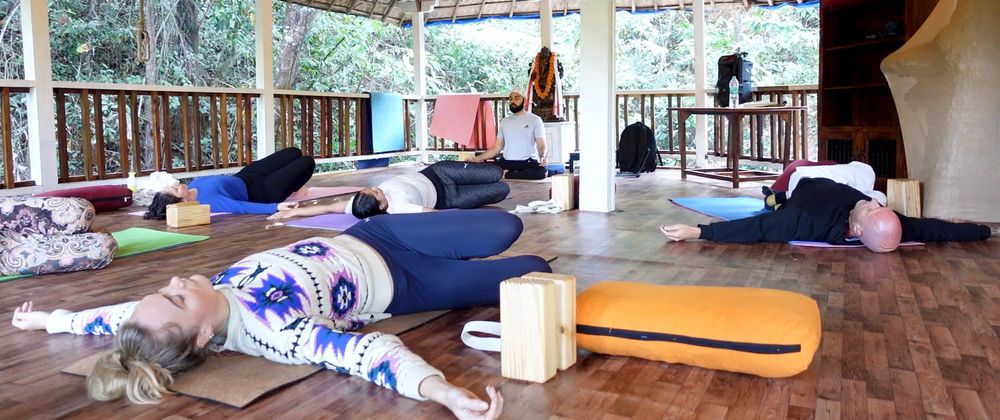
The most reliable way through a plateau is not more effort on the same unsupervised approach, but a shift toward structured, observed practice. This is where self-directed learning often reaches its natural limit. A student can only refine what they can perceive, and after a certain point, that requires a trained eye correcting alignment in real time, sequencing practice deliberately, and tracking progress across weeks rather than single sessions.
This is precisely the gap that a structured yoga teacher training in India is designed to close, since it immerses students in daily supervised practice, detailed anatomical instruction, and consistent feedback loops that self-practice cannot replicate on its own.
This does not mean every plateaued beginner needs to become a teacher. It means that the kind of structured, progressive skill-building found in teacher training environments, built around daily correction and cumulative feedback, is often what unlocks the next stage of physical and mental development that solo practice cannot access alone.
Common Mistakes When Facing a Plateau
Three habits tend to make plateaus last longer than necessary. The first is chasing variety for its own sake, hopping between styles and teachers in search of novelty rather than addressing the underlying gap in feedback. The second is comparing progress to images and videos online, which measures the wrong variables entirely and often erodes motivation. The third is neglecting breath work, since many plateaus are as much about breath control and mental steadiness as they are about flexibility or strength.
Professional Context
Experienced teachers generally recognize plateaus early because they see the same pattern across many students: quick initial gains, a leveling off, and then a jump forward once feedback becomes more precise and consistent. This is one of the reasons structured training environments place such heavy emphasis on daily practice logs, peer observation, and one-on-one correction rather than leaving students to self-monitor indefinitely.
Conclusion
A yoga practice plateau in the first year is not evidence that progress has ended. It is evidence that the tools which produced early gains have reached their limit, and that yoga skill development from this point forward depends more on quality of feedback than sheer repetition. Recognizing this shift, rather than fighting it, is what allows a practice to remain sustainable well beyond the first year and to keep deepening long after the initial excitement has settled into something steadier.






Top comments (0)