
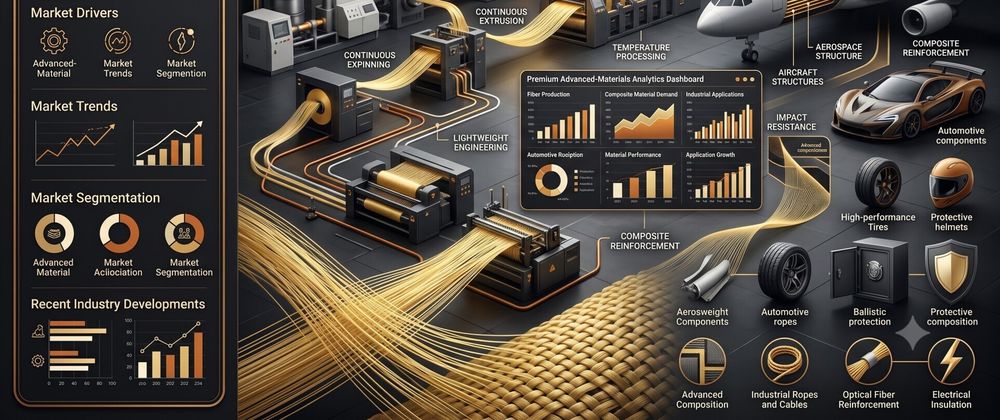

IMARC Group, a leading global market research and management consulting firm, has published its latest market intelligence report on the aramid fiber market. The global aramid fiber market size reached USD 4.1 Billion in 2025. Looking forward, IMARC Group expects the market to reach USD 5.2 Billion by 2034, exhibiting a CAGR of 2.63% during 2026-2034, driven by the implementation of stringent regulatory standards and safety regulations, widespread adoption of the product in the production of sporting goods, and the development of new fabrication techniques that are propelling the market growth across aerospace, defense, automotive, and industrial applications worldwide.
The market is witnessing significant growth momentum driven by the exceptional properties of aramid fiber, including high tensile strength, lightweight characteristics, and thermal stability. Composed of long-chain polyamide molecules, aramid fibers are indispensable in products requiring advanced durability and resistance to wear and tear. The renewable energy sector, particularly wind energy, is experiencing substantial growth, contributing to increased demand for aramid fibers, as their strength and fatigue resistance make them ideal for manufacturing wind turbine blades. Simultaneously, stringent government regulations emphasizing workplace safety, environmental protection, and energy efficiency are further accelerating demand across aerospace, automotive, and protective clothing industries globally.
How Innovation is Reshaping the Future of the Aramid Fiber Market
- Advanced Fabrication Techniques and Customization for Niche Applications: The development of new fabrication techniques is enabling the production of higher-quality aramid fibers with enhanced performance characteristics, allowing manufacturers to tailor fibers for specific industrial needs and standards. These innovations are broadening the scope of aramid fiber applications across construction, oil and gas, and electronics sectors, where unique material properties can be leveraged for concrete reinforcement, chemical-resistant exploration equipment, and high-performance electronic components, expanding addressable market opportunities for producers globally.
- Sustainable Production and Circular Economy Initiatives: Leading companies are increasingly emphasizing environmentally friendly production methods, exploring ways to recycle and repurpose aramid fiber waste, and reducing their carbon footprint to align with growing demand for sustainable materials across industries. Teijin’s accomplishment of yarn-to-yarn recycling for its Twaron fibre in 2021 represents a landmark breakthrough in providing entirely circular high-performance fibre, setting a new industry standard for sustainability that is influencing procurement decisions among environmentally conscious manufacturers in Europe and North America.
- Next-Generation Product Platforms for Protection and Performance: DuPont de Nemours’ release of Kevlar EXO aramid fibre in April 2023 — described as the most significant advancement in aramid fibre technology in over 50 years — demonstrates the accelerating pace of innovation in this space. This new technological platform was created to serve a wide range of applications where protection and performance are needed under difficult and demanding circumstances, opening new market opportunities in defense, industrial safety, and next-generation composite materials manufacturing.
Grab a sample PDF of this report: https://www.imarcgroup.com/aramid-fiber-market/requestsample
Aramid Fiber Market Trends and Drivers:
The global aramid fiber market is experiencing robust expansion, fueled by surging demand from aerospace and defense sectors seeking lightweight, high-strength materials capable of withstanding extreme conditions. The development of new aircraft models and military technology upgrades has driven manufacturers to adopt advanced materials like aramid fibers, which offer superior safety, reliability, and performance characteristics. Governments worldwide are investing heavily in modernizing defense systems, and the commercial aviation sector’s expansion and focus on energy-efficient solutions are further amplifying demand for aramid fibers as critical components in aircraft fuselages, ballistic protection panels, body armor, and advanced composite structures requiring materials that maintain integrity under the most demanding operational conditions.
The automotive industry’s rising adoption of aramid fibers represents a significant structural growth driver for the market. As automotive manufacturers intensify their focus on fuel efficiency, emission reduction, and improved vehicle performance, aramid fibers are being integrated into brake pads, tires, airbags, seat belts, and reinforced structural components. These fibers’ lightweight properties contribute directly to vehicle weight reduction and improved fuel economy, while their thermal stability and resistance to wear ensure longevity and safety in high-stress applications. Kolon Industries’ 2023 announcement to expand its Gumi factory to increase para-aramid production reflects the escalating demand from automotive manufacturers, as the global automotive industry accelerates its transition toward more sustainable and high-performance material solutions.
The development of new industrial applications for aramid fibers continues to diversify revenue streams and broaden the addressable market. In construction, aramid fibers are used to reinforce concrete, enhancing strength and durability in critical infrastructure. In the oil and gas sector, their resistance to chemicals and environmental degradation makes them suitable for exploration and extraction processes in harsh environments. The electronics industry is also increasingly incorporating aramid fibers in optical fiber cables and telecommunication equipment, where their lightweight and high-strength properties improve cable performance and installation efficiency. This constant evolution of industrial applications, combined with increasing investment in research and development by companies such as DuPont, Teijin, Toray, and Hyosung, continues to expand the total addressable market for aramid fiber producers worldwide.
Ask an analyst for customized report: https://www.imarcgroup.com/request?type=report&id=2020&flag=E
Aramid Fiber Industry Segmentation:
The report has segmented the market into the following categories:
Breakup By Product Type:
- Meta-Aramid Fiber
- Para-Aramid Fiber
- Others
Para-aramid fiber dominates the product type segment, driven by its exceptional mechanical properties, including high tensile strength and heat resistance, which render it ideal for applications requiring robust materials in aerospace, defense, automotive, and construction industries. The rising emphasis on lightweight and durable materials to enhance fuel efficiency and safety standards further boosts the adoption of para-aramid fibers in manufacturing. As these fibers demonstrate exceptional resistance to chemicals and abrasion, they find widespread utility in protective apparel, industrial equipment, and ballistic applications, collectively fueling the expansion of the para-aramid fiber segment across the global market.
Breakup By Application:
- Protective Fabrics
- Frictional Materials
- Optical Fibers
- Tire Reinforcement
- Rubber Reinforcement
- Composites
- Others
Protective fabrics hold the largest application share, driven by escalating demand stemming from stringent safety regulations across industrial, military, and firefighting sectors. Aramid fibers’ exceptional flame resistance and high strength-to-weight ratio have positioned them as the ideal material for crafting protective fabrics that offer reliable shielding against thermal hazards and abrasion. Increasing awareness regarding personal safety and the growing need for advanced protective gear in hazardous environments amplify demand, while continuous advances in manufacturing technologies have enabled the production of lightweight yet robust fabrics that enhance comfort without compromising protection.
Breakup By End-Use Industry:
- Aerospace and Defense
- Automotive
- Electronics and Telecommunication
- Sports Goods
- Others
The automotive industry accounts for the largest end-use industry share, driven by manufacturers’ increasing emphasis on lightweighting to improve fuel efficiency and reduce emissions. Aramid fibers’ remarkable tensile strength and rigidity allow them to replace traditional materials such as steel or aluminum in various components, reducing overall vehicle weight while maintaining structural integrity. The automotive sector’s growing focus on safety and crashworthiness has further led to incorporation of the product in critical components such as airbags, seat belts, and reinforced structural parts, where their ability to maintain integrity under extreme conditions and resistance to heat and impact makes them an indispensable safety material.
Breakup By Region:
- North America (United States, Canada)
- Asia Pacific (China, Japan, India, South Korea, Australia, Indonesia, Others)
- Europe (Germany, France, United Kingdom, Italy, Spain, Russia, Others)
- Latin America (Brazil, Mexico, Others)
- Middle East and Africa
Europe exhibits a clear dominance, accounting for the largest aramid fiber market share. The region’s stringent regulations and standards regarding safety, especially in aerospace, automotive, and defense sectors, drive extensive application of aramid fibers due to their exceptional fire-resistant and high-strength properties. The growing demand for lightweight materials to enhance fuel efficiency aligns with aramid fibers’ ability to provide structural integrity without adding excessive weight. Technological advancements and research investments in material science contribute to the development of innovative aramid fiber applications, while the region’s emphasis on sustainable and eco-friendly materials further amplifies adoption given aramid fibers’ recyclability and durability credentials.
Competitive Landscape:
The report provides a comprehensive analysis of the competitive landscape in the aramid fiber market with detailed profiles of all major companies, including:
- DuPont de Nemours, Inc.
- Huvis Corp.
- Hyosung Corporation
- Kolon Industries, Inc.
- Sinochem Holdings Corporation Ltd.
- Suzhou Zhaoda Specially Fiber Technical Co., Ltd.
- Taekwang Industrial Co., Ltd. (Taekwang Group)
- Tayho Advanced Materials Group Co., Ltd.
- Teijin Limited
- Toray Industries, Inc.
What Does The Full Report Cover?
If you are tracking the aramid fiber market for investment decisions, market entry planning, competitive benchmarking, or strategic advisory, IMARC Group’s report gives you everything in one place:
- Complete market sizing with revenue forecasts covering the full projection period from 2026 to 2034
- Quantified growth driver analysis with impact scoring across product type, application, end-use industry, and regional markets
- Sub-segment breakdowns for meta-aramid fiber, para-aramid fiber, protective fabrics, frictional materials, optical fibers, tire reinforcement, rubber reinforcement, and composites with individual share data
- Country-level data for the United States, Canada, Germany, France, the United Kingdom, Italy, Spain, Russia, China, Japan, India, South Korea, Australia, Indonesia, Brazil, and Mexico
- Competitive profiles of 10 leading companies including DuPont, Teijin, Toray, Kolon Industries, and Hyosung with strategic landscape assessment
- Porter’s Five Forces, value chain analysis, and pricing intelligence
- Latest product innovation trends covering next-generation aramid fiber platforms, recycling and circular economy developments, customization for niche industrial applications, and sustainable manufacturing practices shaping market competition across key regional markets
Recent News and Developments in Aramid Fiber Market
- January 2026: Teijin Limited announced expanded production capabilities for its Twaron and Technora aramid fiber portfolio to address rising global demand from aerospace, defense, and electric vehicle applications. The expansion strengthened the company’s position in high-performance lightweight materials and advanced protection solutions.
- March 2026: Kolon Industries, Inc. accelerated investments in its HERACRON para-aramid business to support increasing demand from automotive lightweighting, ballistic protection, and optical fiber reinforcement applications. The initiative reflected the growing adoption of advanced aramid materials across mobility and telecommunications sectors.
- February 2026: DuPont de Nemours, Inc. expanded commercialization activities for its Kevlar aramid solutions targeting next-generation defense systems, industrial safety equipment, and electric vehicle thermal management applications. The development highlighted rising demand for lightweight and high-strength protective materials worldwide.
Note: If you require specific details, data, or insights that are not currently included in the scope of this report, we are happy to accommodate your request. As part of our customization service, we will gather and provide the additional information you need, tailored to your specific requirements. Please let us know your exact needs, and we will ensure the report is updated accordingly to meet your expectations.
Key Questions This Report Answers
- What is the current global aramid fiber market size and what is its projected value by 2034?
- Which product type segment holds the largest share in the global aramid fiber market?
- What are the key drivers of global aramid fiber market growth?
- Which region dominates the global aramid fiber market and why?
- How are sustainability initiatives, circular economy practices, and regulatory safety standards reshaping product development and competitive strategies in the aramid fiber industry?
- Who are the top companies in the global aramid fiber market and what are their competitive strategies?
- What are the investment and market entry opportunities across aerospace, defense, automotive, and industrial applications for aramid fiber producers?
About Us:
IMARC Group is a global management consulting firm that helps the world’s most ambitious changemakers to create a lasting impact. The company provides a comprehensive suite of market entry and expansion services. IMARC offerings include thorough market assessment, feasibility studies, company incorporation assistance, factory setup support, regulatory approvals and licensing navigation, branding, marketing and sales strategies, competitive landscape and benchmarking analyses, pricing and cost research, and procurement research.
Media and Sales Contact
IMARC Group
Email: sales@imarcgroup.com
United States: +1-201-971-6302
India: +91-120-433-0800
United Kingdom: +44-753-714-6104






Top comments (0)