

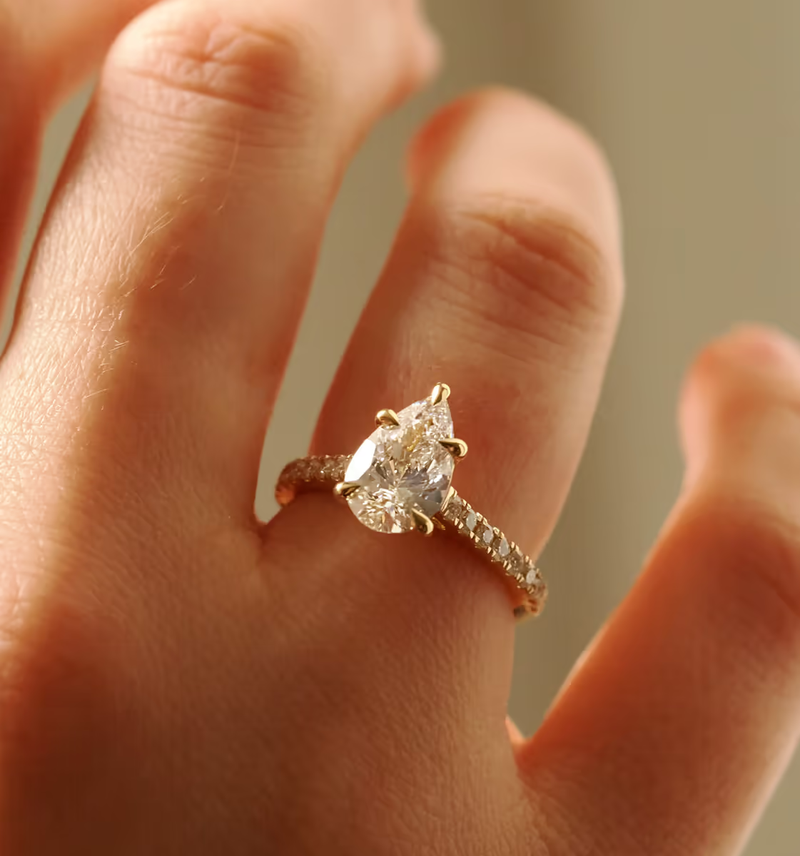
Some engagement ring styles feel tied to a particular decade. Pear-shaped diamonds have a different character. Their combination of a rounded end and tapered point creates a silhouette that feels elegant without looking conventional.
For shoppers considering *pear diamond engagement rings*, the shape offers more than visual interest. Its elongated outline can appear larger than its carat weight suggests, while the faceting pattern delivers plenty of sparkle. Still, choosing a beautiful pear requires closer attention to proportion, symmetry, setting, and stone quality.
Why the Pear Shape Stands Apart
A pear-cut diamond combines characteristics of round brilliant and marquise cuts. One end has a soft curve, while the other narrows into a defined point. That contrast gives the stone its recognizable teardrop profile.
The elongated shape can also create a flattering appearance on the finger. Because more of the stone's surface is visible from above, a well-cut pear may have strong visual presence without requiring an unusually high carat weight.
Pear diamonds also offer styling flexibility. They work with understated solitaire designs, vintage-inspired halos, modern bezels, and detailed side-stone settings. The shape is distinctive enough to carry a simple ring without additional decoration.
Proportion Matters More Than a Single Number
Carat weight tells you how much a diamond weighs, but it does not describe its shape. Two pear diamonds with identical carat weights can look noticeably different once set in rings.
Length-to-width ratio is particularly useful when comparing stones. A lower ratio creates a wider, fuller pear, while a higher ratio produces a slimmer, more elongated outline. Many shoppers prefer proportions somewhere around 1.50 to 1.75, though personal preference matters more than following one ideal measurement.
Symmetry deserves equal attention. The two curved shoulders should appear balanced, and the point should align naturally with the center of the rounded end. An uneven outline can remain noticeable even when the diamond has impressive color and clarity grades.
Pay Attention to the Bow-Tie Effect
Many elongated brilliant-cut diamonds display a darker area across their center. In pear cuts, this feature is commonly called the bow-tie effect because the shadow can resemble a bow tie.
A slight bow tie is normal and may be difficult to notice during regular wear. A strong dark band, however, can interrupt the stone's brightness. Laboratory grading reports do not fully communicate this visual characteristic, so photos and videos are useful when shopping online.
View the diamond from several angles and under different lighting conditions. Movement reveals how consistently light travels across the stone better than a single highly illuminated photograph.
Settings Need to Protect the Point
The pointed tip is one of the pear diamond's defining features, but it is also more vulnerable to impact. A secure setting should protect that area during everyday wear.
A V-shaped prong is a common solution because it wraps around the tip while preserving the diamond's outline. Bezel settings offer even more coverage by surrounding much or all of the stone with metal. Traditional prong settings can also work well if the point receives adequate protection.
People with active lifestyles may want a lower-profile design that sits closer to the finger. High settings can create dramatic presentation, but they are more likely to catch on clothing or other objects.
Choosing Color and Clarity
Pear-shaped diamonds can show color differently from round diamonds, especially near the pointed end. Buyers who want a very white appearance should inspect the stone rather than relying only on the letter grade.
Metal choice also affects perception. White gold and platinum can emphasize a crisp, colorless appearance. Yellow or rose gold may complement diamonds with slightly warmer tones, making a lower color grade a reasonable option for some designs.
Clarity should also be judged visually. Small inclusions that cannot be seen without magnification may have little effect on the ring's appearance. Rather than automatically paying for the highest grade, look for an eye-clean stone with no distracting inclusions in prominent areas.
Natural and Laboratory-Grown Options
Diamond origin is another decision shoppers now regularly encounter. Natural diamonds form underground over geological timescales, while *lab diamonds* are produced in controlled environments using technology that recreates diamond-forming conditions.
Both are real diamonds with the same fundamental crystal material. The differences involve origin, availability, pricing, and personal preference. Buyers comparing options should review grading reports and specifications rather than assuming two stones of equal carat weight offer identical visual quality.
Independent grading documentation can help verify characteristics such as measurements, color, clarity, and carat weight. It also makes comparison shopping more straightforward.
Direction Changes the Ring's Personality
There is no required direction for a pear-shaped center stone. Traditionally, many people wear the point facing toward the fingertip, which emphasizes the diamond's elongated appearance.
Turning the point toward the hand creates a subtly different look. East-west settings rotate the diamond horizontally and can make the design feel more contemporary.
Try viewing the ring from your normal perspective rather than judging it only in display photos. Orientation affects how the ring looks during daily wear, so personal preference should lead the decision.
Balance Beauty With Everyday Wear
The strongest pear diamond engagement rings combine attractive proportions with a setting suited to the wearer's routine. A delicate design may be ideal for someone who removes jewelry during physical activities. Another person may prefer thicker prongs or a protective bezel for greater security.
Band width also changes the visual balance. A narrow band can make the center diamond appear more prominent, while a wider band gives the ring greater presence. Wedding-band pairing should be considered early if a flush fit matters.
A Ring Worth Judging With Your Eyes
Specifications provide a useful starting point, but pear diamonds are especially visual stones. Symmetry, bow tie, outline, and proportion can influence beauty as much as numbers on a grading report.
Compare several stones before deciding, including natural and lab diamonds if both fit your preferences. Focus on the shape that looks balanced to you, then choose a secure setting that supports everyday wear. That approach produces a ring selected for its actual appearance, not simply its specifications.







Top comments (0)